
AUSTRALIA · RESTAURANT PLANNING
Australian restaurant break-even: a beginner's guide to meals, staffing and the sales you need
Break-even asks a simple question: how much must the restaurant sell to cover the costs included in the plan? The answer is useful only when the meals, staff, opening hours and customer demand can actually support it. This guide builds that answer step by step in Australian dollars and explains where a first-time owner's model can go wrong.
Choose a section in this guide
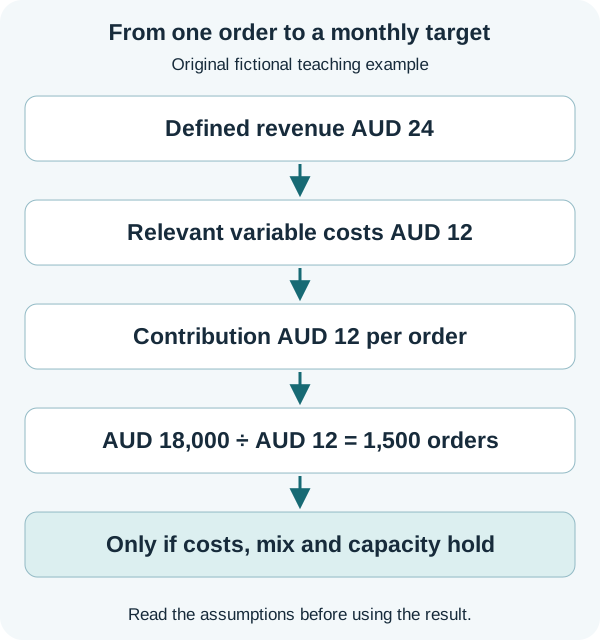
Work out what one sale contributes before covering the month
Contribution means the sales amount left after the relevant costs that increase with the sale. It is money toward the bills that do not change with every additional order and, after those bills are covered, toward operating profit. Use restaurant-owned revenue under a written tax basis, not an unexplained customer payment or bank deposit. Keep the costs included in this stage visible.
For an invented restaurant order, tax-exclusive revenue is AUD 24. Ingredients cost AUD 8, packaging AUD 1 and the relevant variable service and payment costs AUD 3. Contribution is AUD 12. If the order is dine-in, it may have a different service cost and no takeaway container. If it is delivery, actual platform services, promotion funding and packing can change the result. The AUD 3 amount is a teaching assumption, not a DoorDash or Uber Eats rate.
Use one order first because it is easy to check. AUD 24 minus AUD 8 minus AUD 1 minus AUD 3 equals AUD 12. If the spreadsheet produces a different result, inspect its field definitions and any costs entered twice. A large monthly model built on an incorrect single-order input simply repeats the mistake thousands of times. A clearly labelled manual sum is a useful control even when software does the main calculation.
Confirm ingredient yield and serving portion. A purchased pack is not always the amount that can be served. Add the sauce, garnish and cooking ingredients actually used. Do not add a whole prepared-batch cost to each order if the batch produces several portions. Divide the batch cost by usable portions, then include the amount each order uses. Update the card when supplier price, pack size or recipe changes.
Costs depend on the question you are asking
For deciding whether to accept more orders in spare capacity, a staff roster already committed for the shift may be a period cost. If those orders need extra staffing, that additional labour belongs in the decision. For long-term restaurant planning, all necessary staffing must be covered. Write the time horizon and decision at the top. Do not claim that staff cost is “fixed” forever simply because one extra meal does not immediately alter today's roster.
List the bills for a matching period
Choose a month, four-week period or another defined scope. List rent, the planned team cost, equipment lease, software, insurance allocation and other operating costs included in that model. Some bills arrive annually but need a period allocation for planning. Show the full cash payment separately in the cash calendar. A monthly allocation does not mean an annual bill is actually paid in twelve instalments.
Suppose included monthly costs are AUD 18,000 and stable average contribution is AUD 12 per order. Simplified break-even is 1,500 orders: AUD 18,000 divided by AUD 12. At 2,000 comparable orders, contribution is AUD 24,000 and the simplified operating result is AUD 6,000. This is before any financing, tax, owner payment or other item excluded from the stated model. Do not label the result take-home profit without checking those items.
If the restaurant opens twenty-five days, the break-even average is sixty orders per open day. That is a target under assumptions, not proof of demand. It also hides the service pattern. A restaurant can average sixty while receiving forty during one short lunch window that the equipment cannot handle. Keep daily demand and rush capacity beside the monthly arithmetic.
Check cost completeness. A model that omits repairs, waste, paid closing work or software can look healthy because it does not describe the actual operation. Do not add an arbitrary “miscellaneous” allowance merely to feel safe; list known categories and label uncertain estimates. Review the estimate against actual bills once the restaurant trades. The purpose is a transparent model that improves, not a precise-looking forecast frozen before opening.
For the general calculation relationship, see Business Victoria's break-even, margin and markup guide. The restaurant examples here are original and include assumptions rather than its example business.
Staffing: do not build the plan from one guessed hourly wage
Australian pay coverage depends on the business, work and applicable employment arrangements. Restaurant, Hospitality and Fast Food awards are not interchangeable. An award is an official set of minimum employment terms for covered work; an enterprise agreement is a different workplace arrangement that may apply. Check coverage, classification and current pay requirements rather than assuming every café or restaurant worker uses one rate.
Start with Fair Work's award-coverage guidance and the relevant current official pay information. This guide deliberately does not publish a universal hourly rate.
Write the role, tasks, employment arrangement, planned hours and service times. Include preparation, opening, cleaning and closing work that the business requires. Record applicable additional pay or employer costs according to the actual arrangement and professional payroll advice. An owner should not calculate savings by treating required work as unpaid or ignoring the relevant conditions. A costing workbook does not remove employment obligations.
For an arithmetic example only, imagine a lawful fully checked loaded staffing-cost assumption of AUD 900 for a particular service period. “Loaded” means the model includes the employer costs chosen for that scope, not only an hourly cash wage. If sales revenue for the same period is AUD 3,000, the ratio is 30%. If the same staffing is used for AUD 2,400 revenue, the ratio becomes 37.5%. These figures are invented and do not describe an award rate.
A rising labour-cost percentage can result from weaker sales without any increase in staff hours. Inspect hours and service work before blaming efficiency. Conversely, higher sales can improve the ratio while staff are overworked and service deteriorates. A ratio does not establish whether a roster is safe, lawful or sufficient. Review preparation, queues, accuracy, breaks and actual hours along with revenue.
Separate the stable roster from additional staffing caused by a campaign or new opening window. If extra revenue contributes AUD 600 before labour but needs AUD 450 additional checked staff cost, the model gains AUD 150, not AUD 600. If only AUD 300 contribution arrives, the same extra staffing produces a AUD 150 shortfall. This illustrates why demand and the roster commitment must be tested together.
A mixed menu needs a weighted average, not a favourite item
Most restaurants do not sell one identical meal all month. Some baskets contribute more, some less, and their proportions change. Sales mix means those proportions. A weighted average reflects the actual number of each kind sold. A simple average of menu items gives a rarely sold special the same influence as the everyday bestseller, which can distort break-even planning.
Consider two fictional basket groups. The first contributes AUD 8 and the second AUD 14. In a group of 100 orders, seventy are the first type and thirty the second. Total contribution is AUD 560 plus AUD 420, or AUD 980. The average is AUD 9.80. With AUD 19,600 included period costs, break-even under this stable mix is 2,000 orders.
Now change the mix to eighty-five first-type baskets and fifteen second-type baskets out of 100. Contribution is AUD 680 plus AUD 210, or AUD 890, averaging AUD 8.90. The same AUD 19,600 costs now need about 2,203 whole orders, rounding up. Neither recipe nor price changed. The sales mix alone changed the target. Keep this possibility visible when promoting a low-contribution bestseller.
| Mix per 100 orders | Total contribution | Average | Orders to cover AUD 19,600 |
|---|---|---|---|
| 70 at AUD 8; 30 at AUD 14 | AUD 980 | AUD 9.80 | 2,000 |
| 85 at AUD 8; 15 at AUD 14 | AUD 890 | AUD 8.90 | 2,203, rounded up |
Group by route too if dine-in, takeaway and delivery have different costs. An increase in total orders can arrive through a lower-contribution channel. Keep the channel's value and customer purpose in the discussion, but do not call the order-count increase profit. Add the group contributions and check them against the whole restaurant total to ensure costs were not lost between categories.
Staff and equipment costs can jump at a threshold
A step cost is a bill that rises when the operation crosses a practical limit. For example, a new opening window or capacity band may require another complete shift, not a tiny fraction of a worker for each order. An extra station may require an equipment commitment. Write the capacity band and associated cost rather than using one straight line for all possible demand.
Imagine the fictional AUD 18,000 cost model works up to 1,800 orders at the intended service standard. Beyond that, a checked extra staffing and equipment plan adds AUD 4,800 per month, bringing costs to AUD 22,800. At AUD 12 contribution, the larger band's break-even is 1,900 orders. At 1,850 orders, contribution is AUD 22,200, a AUD 600 shortfall in that band even though the original model would have shown a gain.
Capacity is not simply a count per month. Timing matters. Map the rush and the shared station. An oven, grill, coffee machine, till or packing bench can limit the operation before the dining room is full. Measure representative orders and note overlapping preparation rather than timing one dish and multiplying it by the entire day. Keep safe-food and employment requirements as constraints, not inconvenient cells to delete.
Choose a test that is smaller than the full expansion. Trial a suitable limited menu or service window with the necessary lawful resources, then compare actual demand, contribution and service. Confirm licensing or permissions for the actual activity separately. A lower break-even target does not give permission to open or change the use of a property. Financial feasibility and regulatory permission answer different questions.
Delivery reports and payment timing do not replace the cost model
An Australian restaurant using DoorDash or Uber Eats should review its authorised local agreement and reports. Gross sales, order count and payment totals answer useful questions, but none automatically includes ingredients, labour and rent. A payout is a cash transfer under the relevant cycle; contribution is a planning calculation under the stated cost basis. Keep both views rather than forcing the payout to equal profit.
DoorDash's financial help page uses an Australian URL but explicitly states that one report-builder payout-summary CSV download is US-only. Do not assume that exact download exists in your Australian account. Use the reports actually available and ask official support when a control or format differs. This guide does not claim a current authenticated merchant walkthrough.
That availability restriction appears in DoorDash's financial-information instructions. Report features, payout schedules and contract terms should be checked locally.
Track order dates, adjustments, payout reference and bank receipt separately. A late-month order can be paid after the next month begins. Ingredients or wages may need paying sooner. Use a cash calendar with expected timing and a delayed case. Do not spend contribution as though it is already a bank balance. A business can cover its operating costs across a month and still face a short week.
Our main calculator is rupee-labelled and the main analyser supports specified Zomato/Swiggy structures. It is not an Australian DoorDash or Uber Eats importer. Follow the AUD examples manually using your own worksheet. Coming-soon extractor buttons invite interest, not installation of an existing working overseas tool. Our support can explain the website's scope without accessing or replacing your official platform account.
Keep tax assumptions and opening investment visible
This guide does not assign GST treatment to a particular menu item or determine whether your business must register. Use a revenue and cost basis agreed with your adviser and verify the relevant official rules. Do not call tax collected for government restaurant profit. Do not count recoverable tax as an operating cost without checking eligibility, and do not remove its immediate cash effect while waiting for recovery.
Opening equipment, deposits and fit-out payments belong in an opening-cash and investment view as well as the appropriate accounts. A monthly break-even model alone does not establish how much money is needed to open. It also may not establish the full economic return after depreciation, funding cost, tax and owner compensation. State what the model excludes and avoid renaming its remainder final net profit.
For a fictional opening plan, list the actual planned dates and amounts for the lease deposit, equipment, stock and first roster. Build a low-sales case and expected-deposit timing. Do not label a deposit an operating expense automatically; the correct accounting treatment depends on the payment. The cash still needs to be available when due. Separate cash need from expense classification.
Ask a professional about material borrowing, payroll or tax decisions. A simple planning guide can show which question to ask, but it should not pretend to settle a fact-dependent legal issue. Keep the answer, date and relevant circumstances beside the workbook so it is not later applied to a different arrangement by mistake.
A practical opening and weekly-review sequence
Before committing to the operation, cost the intended menu, define the customer and estimate demand by service window. Verify property, food-business and employment requirements separately. Then write the stable-cost and capacity-band models. Include a realistic mix rather than building the business on the most attractive item's contribution. Challenge the model with lower demand and higher costs.
During early trading, capture actual orders, portions, waste, staff hours, delays and supplier prices. Review the first complete period without treating a launch peak as permanent demand. Update estimates with real invoices. Compare the forecast and actual result category by category. A total difference is easier to explain when you know whether it comes from price, volume, mix, usage or staffing.
At each weekly meeting, choose one action with an owner and review date. A repeatable portion check, corrected fee mapping, improved packing flow or clearer opening window can be a useful first improvement. Do not change every item at once. Record the expected direction and measure whether it happened, acknowledging weather, events and ordinary variation.
Open the Australian break-even preparation checklist
Answers to common first-model questions
Should I round the break-even count down?
No, not when counting whole orders to cover a positive amount. If the division gives 2,202.25 orders, you need 2,203 comparable whole orders under the assumptions. The real mix and capacity can still change the target. Show the rounded count and the assumptions together rather than implying the exact count predicts the business.
What if average contribution is zero or negative?
A normal positive break-even order target is not available in the simple model. Zero contribution does not cover fixed bills, and negative contribution increases the shortfall as identical sales rise. Investigate the price and relevant costs before promoting more of the same order. Do not divide by zero or present a negative order count as a sensible sales target.
Can I use a percentage of sales for every cost?
Some costs can be estimated that way, but rent and a committed roster do not necessarily fall when sales fall. A percentage assumption can hide the cash commitment. Keep known period bills as amounts and explain the costs that genuinely vary with sales. Check assumptions against real invoices rather than applying one ratio to every category.
When should I build a more detailed model?
When the decision depends on several capacity bands, uncertain sales mix, significant investment or complex contracts, get appropriate help and retain the simple checked model as a reference. Detail should answer a question. More worksheets do not make a false input reliable, and a complex model should still be explainable to the person who must run the service.
Reviewed 12 October 2026. Sources establish general calculation definitions, employment-coverage checks and the stated report restriction. The staffing amounts, meals, capacity bands and results are original fictional teaching scenarios, not wages, market benchmarks or platform fee quotations.
Stress-test the target with three understandable cases
Keep the main case as the plan you currently think is reasonable. Create a weaker-demand case by changing the order count, not by quietly changing every cost. Create a cost-pressure case by changing a specific ingredient or packing amount. Create a capacity case by adding the required staffing or equipment commitment. Each case should have a short explanation of what changed and why the change is plausible.
In the fictional AUD 18,000 model, 1,600 orders at AUD 12 contribution produce AUD 19,200 contribution and AUD 1,200 operating remainder. If ingredient cost rises by AUD 1 per order while other assumptions stay unchanged, contribution falls to AUD 11 and the same 1,600 orders produce AUD 17,600. The operating result is then negative AUD 400. A modest per-order change reversed the result because the original buffer was small.
If demand falls to 1,400 orders at the original AUD 12 contribution, total contribution is AUD 16,800 and the shortfall is AUD 1,200. Keep that separate from the cost-pressure case. You can also show a combined difficult case, but first display the single changes so the owner understands the cause. A test with all inputs moving together can be too complicated to teach anything.
Ask which uncertainty matters most. If the result changes mainly with mix, investigate item and channel demand. If it changes mainly with an unconfirmed labour commitment, confirm the roster cost. If it changes mainly with a fee assumption, check the agreement and a real invoice. Spend time resolving the uncertainty that could alter the decision rather than refining an insignificant decimal.
Set a practical warning level, not an impossible promise
A warning level can tell you when to review, such as several comparable periods with contribution below the needed level or repeated service failure at the current volume. It should be based on the actual model and obligations. Do not describe it as a legal safe level or guarantee that staying above it prevents failure. Restaurants face risks that the simplified financial model does not cover.
Agree who checks the warning and what action follows. That may be reviewing an offer, obtaining a missing invoice, changing a suitable menu item or seeking professional help. Avoid automatic cuts to staffing or quality based only on a ratio. The response must consider safe service, employment conditions and the customer promise. A warning is a prompt for investigation, not a licence to ignore other requirements.
Keep the forecast and actual review in two columns
For the next complete period, show planned orders, actual orders, planned contribution per order and actual contribution under the same definition. Then compare the planned and actual period costs. Write the explanation for the largest differences: lower count, different mix, new supplier price, a corrected fee or an extra shift. A total profit difference is much easier to understand when its ingredients are visible.
Keep a dated copy before updating next month's plan. Otherwise the old forecast disappears and you cannot see what you learned. Do not change the forecast after the fact and call it accurate. Honest forecasting means recording uncertainty, testing it and improving the next decision. It is a practical skill a new owner can learn without turning the restaurant into a collection of charts.
Practice workbook: decide whether to add a service window
Imagine a fictional Australian restaurant that currently trades in the evening and is considering a weekend lunch. The owner sees spare dining space and assumes lunch will be cheap to add. Before committing, write what lunch actually needs: preparation, cleaning, staffing, ingredients, booking or ordering arrangements, utilities and customer demand. Empty seats are one resource, not proof that the whole operation has spare capacity.
Choose a four-week test scope. The restaurant must meet its actual permissions, safe-food and employment requirements regardless of the financial test. This example does not approve an opening window, specify wage entitlements or represent a real business. It gives the owner a sequence of questions and clearly invented arithmetic to replace with checked local costs.
Step one: define the extra costs instead of dividing every existing bill
Some bills continue whether lunch opens or not. The existing lease may not change in the short-term test. Other costs are caused by lunch, including the necessary staffing, preparation and any extra equipment arrangement. Keep a short-term additional-cost view and a separate long-term whole-operation view. The first asks whether the test helps under existing commitments. The second asks whether a continuing lunch service contributes enough to sustain its share of the business.
For the exercise, assume the four-week lunch commitment adds AUD 2,400 of checked staffing and operating costs and AUD 400 of a separate setup or campaign cost included in this decision. The additional cost total is AUD 2,800. Do not treat these amounts as wage rates or normal restaurant spending. Actual costs need the applicable employment arrangements, supplier records and commercial terms.
Write which costs are payable even if demand disappoints. A roster or equipment commitment may not disappear when only a few customers arrive. A per-meal ingredient cost usually changes with meals prepared or sold, but waste can add costs beyond sold meals. The list should reflect the real commitment rather than a percentage of hoped-for revenue.
Step two: calculate a simple lunch-basket contribution
Use defined tax-exclusive restaurant revenue of AUD 30 per basket in this fictional model. Ingredients are AUD 10 and other relevant variable payment, service and consumable costs AUD 2. Contribution is AUD 18 before the additional period commitment. If a basket also includes a takeaway pack, cost that configuration separately rather than assuming the dining and takeaway orders are identical.
The simplified additional-cost break-even is AUD 2,800 divided by AUD 18, or about 156 whole baskets, rounding up. This says how many comparable baskets cover the stated extra commitment. It does not establish demand, staffing sufficiency, tax classification or the full restaurant's profit. Keep those questions visible instead of renaming the calculation “lunch is profitable.”
At 200 comparable baskets, total contribution is AUD 3,600. Subtracting the AUD 2,800 commitment leaves AUD 800 in this additional-cost view. At 140 baskets, contribution is AUD 2,520 and the test has a AUD 280 shortfall. The count needed is practical only if the service windows can safely handle it and the contribution assumptions hold.
Step three: check a weaker mix before accepting the target
Suppose two basket types contribute AUD 18 and AUD 12. If seventy percent of customers choose the first and thirty percent the second, the weighted contribution is AUD 16.20: 0.7 multiplied by 18 plus 0.3 multiplied by 12. The AUD 2,800 commitment then needs about 173 whole baskets. Using AUD 18 for every basket would understate the target.
If demand shifts to an even split, contribution averages AUD 15 and the target becomes about 187 baskets. Neither basket's price nor cost changed. Only the mix did. This is why a lunch promotion focused on the lower-contribution basket can change the overall result even when customer count improves.
Prepare a small mix table with expected and actual counts for the test. Add each group's total contribution and compare with the whole-service total. Keep any bundle-funded discount in one place. If the listed revenue is already after that reduction, do not subtract it again. Clear definitions matter more than whether the workbook uses a sophisticated chart.
Step four: map the lunch rush and cleaning work
A target of 156 baskets across several services may seem modest until the orders arrive together. List the service windows and note the practical capacity of preparation, equipment, handover and cleaning. The evening operation might need the same equipment or preparation team later. Check whether lunch reduces evening readiness or adds fatigue, delays and errors.
Write a simple queue observation sheet for the test: acceptance time, ready time, order accuracy and any remake or packing issue. Use appropriate aggregate or private records, not public customer details. If safe service cannot be maintained, pause and investigate. A financial target must never justify skipped checks, ignored breaks or an unsafe rush.
Include the actual cost if a new capacity band is required. Suppose an additional checked staffing arrangement raises the four-week commitment by AUD 600. The cost becomes AUD 3,400, and at AUD 18 contribution the target rises to about 189 whole baskets. The original 156 target no longer describes that arrangement. Do not hide the new bill under the old plan.
Step five: test the cash calendar, not only the operating remainder
Some setup spending and supplier purchases happen before customers pay. List the due dates and the realistic cash sources. Card or platform receipt timing can differ from the trading date. If a payment is delayed, the lunch service may need cash for staff and suppliers before its revenue arrives. Keep the operating model and cash calendar side by side.
Do not count a refundable deposit as an ordinary expense automatically, but do include the actual cash needed when due. Do not call borrowed money sales. Record funding separately and seek appropriate advice when borrowing or other material commitments affect the business. This exercise cannot establish the full economic return or affordability of a real expansion.
Compare the low-demand case with the bill calendar. A test that can be stopped after a few services may have different exposure from a commitment lasting months. Check actual cancellation and contract terms instead of assuming every cost is reversible. Choose the test scope only after understanding the obligations it creates.
Step six: write the decision before the first service
State the menu, dates, approved budget, safe capacity limit, cost definitions and expected basket mix. Choose a review date and explain what would lead you to continue, change or stop. The rule should not rely solely on impressions or gross sales. It should include the additional contribution result and the effect on customers, staff and evening service.
A decision can be cautious without being vague: run the limited compliant test, gather actual mix and costs, and continue only if the service and financial conditions support it. Do not extend a weak test repeatedly because closing it feels disappointing. Learning that an opening window does not fit the operation is a useful result before making a larger commitment.
After the test, compare forecast and actual count, contribution and additional costs. Keep the original forecast unchanged in a dated copy. Explain the difference honestly. Weather, an event or a different staffing arrangement may affect the result. Avoid claiming that every improvement was caused by the lunch offer.
Check the practice arithmetic
Additional cost AUD 2,400 + AUD 400 = AUD 2,800. Basket contribution AUD 30 − AUD 10 − AUD 2 = AUD 18. Whole-basket target is 156, rounded up. At 200 baskets the remainder is AUD 800; at 140 it is negative AUD 280. A seventy/thirty mix averages AUD 16.20 and needs 173 baskets. An even mix averages AUD 15 and needs 187. With AUD 3,400 cost and AUD 18 contribution, the target is 189. These are arithmetic answers under fictional assumptions.
When lunch works but the whole restaurant still struggles
The additional-cost test can be positive while the overall restaurant remains unprofitable. Lunch might add AUD 800 but the evening and shared period model might still have a larger shortfall. Keep the whole-business contribution and cost total alongside the test. Do not let a successful small decision hide the larger bills that still need covering.
For a long-term view, explain how lunch uses shared management, equipment, space and preparation. Allocate costs with a reasonable documented method if you need a service-level profit view, then check that the allocations add back to the actual total. Different allocation rules can change the apparent result, so do not present one as an undeniable measure of what the service “owes.”
If you stop the service, identify which costs truly disappear. The lease may remain. Some software or equipment commitments may remain. Ingredient purchases and a particular roster may change under the actual arrangements. Estimate real savings, not every allocated cost on the worksheet. Proper employment and contract processes are still required; a costing decision does not cancel obligations.
The practical purpose of the workbook is to let the owner discuss a decision in ordinary words: what work will we add, what will it cost, how much can each suitable sale contribute, how many sales are plausible, and when will cash arrive? If those questions cannot be answered, obtain the missing evidence before expanding the commitment.
Repairs and downtime belong in a workable restaurant plan
Equipment does not always work for the whole period. A breakdown can reduce available sales capacity while also adding a repair bill. Keep a practical maintenance and interruption view beside the stable break-even model. Do not claim that the target remains achievable when the station required for those orders is unavailable.
For a fictional interruption, suppose the restaurant loses two services that would each have contributed AUD 300 under the forecast. The expected contribution reduction is AUD 600 before considering any orders that move to another service. If a separate repair costs AUD 500 in the chosen decision view, the combined pressure is AUD 1,100. The actual accounting treatment and cost scope should be checked, but the operational lesson is clear: a small original profit buffer can disappear.
Ask what can safely continue when a station is unavailable. A reduced menu may preserve some service, but it should be honestly described and comply with food-safety requirements. Do not improvise unsafe holding or cooking methods merely to reach the forecast. Record cancellations and customer communication appropriately.
Build the reserve and response plan from actual obligations and equipment needs rather than adopting an unexplained universal percentage. The model should help the owner recognise that a restaurant with barely enough contribution under perfect conditions may have little room for a disruption. A maintenance plan, reasonable cash preparation and realistic demand case are practical companions to the simple break-even equation.
Choose a supported tool, then keep the evidence private
The main margin calculator uses rupees and Zomato/Swiggy labels. It is manual: it does not fetch a merchant agreement or verify tax treatment. The settlement analyser supports the specified Zomato/Swiggy report structures, not every platform's CSV. Try a fictional public sample first. DoorDash and Uber Eats extractors marked coming soon are not available importers.
Follow this guide's local-currency arithmetic in a private worksheet. Read the complete input and privacy manual if using a supported Indian workflow. Label revenue basis, per-order inputs and period costs, and count each fee or funded discount once. Never put passwords, bank details, customer records or unredacted reports in a public community post. Our support page can explain tool scope and receive future-feature requests; it cannot grant a food licence, file a tax return or audit an overseas account.