
NEW ZEALAND · CAFÉ OPERATIONS
A New Zealand café's weekly review: sales, food, staff, delivery and cash in plain language
A useful weekly review helps the café owner answer four questions: what sold, what it cost to serve, what money should arrive and what to improve next. It does not need twenty dashboards. Start with one consistent week, a few reliable records and one action the team can understand.
Choose a section in this guide
Choose one week and keep its boundaries clear
Write the opening and closing dates and the café's local reporting time. Use the same week for sales, relevant ingredient usage and staff work. If a supplier invoice arrives later, record which delivery or period it relates to. If a delivery payout arrives the following week, keep the order period and cash receipt separate. Do not move sales into the bank week simply to make two totals match.
Choose the review question. A general first review can cover sales, costs, service and cash, but the action should still be specific. Examples include checking why sandwich ingredient use rose, whether a pickup offer brought useful extra demand, or why a deposit did not match the expected cycle. One clear question helps decide which records are needed and prevents the meeting becoming a discussion of every possible problem.
Gather a point-of-sale report, authorised delivery reports, ingredient invoices, stock notes, staff-hour records, a bill calendar and relevant bank receipts. “Point of sale” means the system recording the café's customer sales. Use exported tables or private reports where possible, not scattered cropped screenshots that omit dates and definitions. Keep original records safe and work on copies. A report can contain customer information even when it looks mainly financial.
Mark each input confirmed, estimated or missing. The first week may not be complete. That does not make the review useless, but it changes the confidence of the result. Missing advertising cost is not zero advertising cost. An estimated ingredient amount is not a measured stock loss. Put the label beside the number so a new owner does not treat every cell as equally certain.
Separate counter, pickup and delivery sales
Count completed sales under a defined revenue basis. Write how refunds, cancelled orders, discounts and tax are handled. Order count can differ from item count: one order may contain several items. A payment total can differ from restaurant-owned revenue: some amounts may be tax or belong to another party. Choose the measure that answers the operating question and keep it consistent across channels.
Here is an invented tax-exclusive weekly example. The café has 200 counter orders producing NZD 3,000 revenue and NZD 1,100 of relevant variable costs. It has 100 pickup orders producing NZD 1,800 revenue and NZD 780 variable costs. It has 80 delivery orders producing NZD 2,000 revenue and NZD 1,240 variable costs. The costs include the stated ingredient, packing and route costs in this teaching model; they are not platform fee rates.
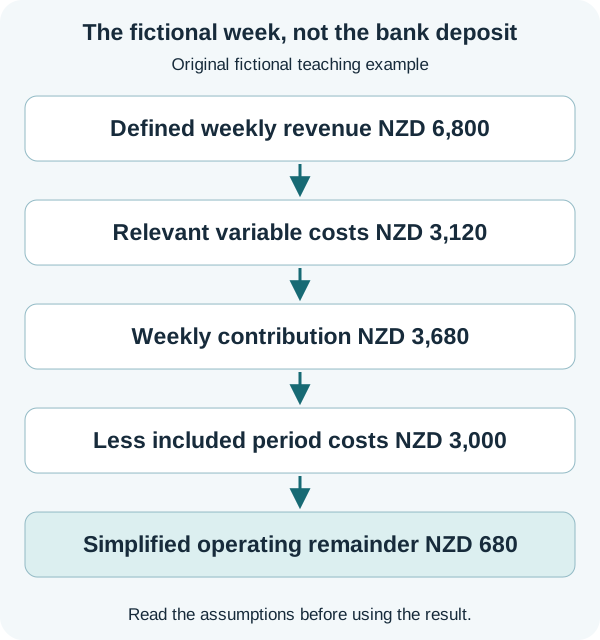
Counter contribution is NZD 1,900, pickup contribution NZD 1,020 and delivery contribution NZD 760. Total revenue is NZD 6,800, variable costs NZD 3,120 and contribution NZD 3,680. If the included weekly period costs are NZD 3,000, the simplified operating remainder is NZD 680. This is not final take-home profit if other costs, financing or tax are excluded.
| Route | Orders | Revenue | Variable costs | Contribution |
|---|---|---|---|---|
| Counter | 200 | 3,000 | 1,100 | 1,900 |
| Pickup | 100 | 1,800 | 780 | 1,020 |
| Delivery | 80 | 2,000 | 1,240 | 760 |
| Total | 380 | 6,800 | 3,120 | 3,680 |
The average contribution is about NZD 9.68 per order, calculated from NZD 3,680 divided by 380. That average reflects this mix, not every item on the menu. If the next week shifts toward the lower-contribution route, the average can fall even when orders increase. Keep the route totals and the whole-café total together. They explain more than a single order-count headline.
Ask whether delivery demand is additional or transferred
A delivery order may serve a customer who would not visit the café, or it may replace a counter purchase the customer already intended. The financial effect differs. Do not label every online order incremental, meaning genuinely additional, merely because it appeared in a platform report. Compare suitable periods and review aggregate customer behaviour where your authorised tools allow it, while acknowledging that the alternative is uncertain.
Direct pickup also has costs: ordering software, payment processing, staff handling, communication and possibly marketing. A direct order is not automatically free. Cost the real route and check applicable platform or ordering terms. Building a useful café website does not justify bypassing a contract or misusing customer contact details.
Food: compare portions and stock, not just purchases
Start with a few regular items and their recipe cards. Record ingredient amounts, pack conversion, usable yield and serving portion. Yield means the amount available to serve after the relevant preparation loss. A kilogram bought is not always a kilogram served. A prepared sauce batch produces several portions; divide its cost by usable output rather than charging the whole batch to each sandwich.
Suppose a fictional preparation batch costs NZD 48 and yields twenty-four usable portions. Each portion costs NZD 2. If one finished item uses one portion plus NZD 1.20 of other ingredients, the ingredient total is NZD 3.20. Packaging and other route costs remain separate if your food-cost definition excludes them. Write that definition rather than calling the whole delivery expense “food.”
Use a consistent stock count to check actual consumption. Opening stock plus purchases minus closing stock, adjusted for relevant transfers, gives a useful consumption view under the chosen valuation method. For an invented week, opening food stock is NZD 700, purchases NZD 1,400 and closing stock NZD 650, with no transfers. Consumption is NZD 1,450, not simply the NZD 1,400 purchase total.
If actual consumption exceeds recipe expectations, investigate price changes, portions, known waste, staff meals, unrecorded sales, transfers and count errors. Do not assume theft or poor effort from one difference. A pack recorded as one item or a sauce counted twice can create an apparent problem. Recount surprising values and check the units first.
Record waste safely and specifically. “Food wasted” is less useful than the item, amount, date and reason. Over-preparation, a delivery problem and a supplier issue call for different actions. Do not reuse unsafe food to protect the weekly percentage. The review should reduce avoidable waste while preserving safe handling and the customer's promised portion.
Staffing: review work and sales together
Collect actual hours, role and service period, including preparation and closing tasks that the café requires. Compare the lawful staffing cost with the sales for that same period. A ratio can help spot a change, but it does not establish that the roster is safe, lawful or excessive. A quiet sales week can raise the ratio with no change in hours. A busy week can lower it while service becomes strained.
For a fictional fully checked staffing-cost total of NZD 1,700 against NZD 6,800 revenue, the ratio is 25%. If revenue falls to NZD 5,500 with the same staffing commitment, the ratio becomes about 30.9%. That change does not automatically mean the team became less efficient. Ask about demand, opening hours, preparation needs and service problems before changing the roster.
New Zealand's official employment information announced an adult minimum wage of NZD 23.95 per hour from 1 April 2026, with separate starting-out and training rules. A minimum rate is not the full employer cost or a statement that every worker belongs in the same category. Recheck current eligibility, employment arrangements and relevant employer obligations before preparing payroll or a staffing budget.
See Employment New Zealand's current minimum-wage guidance. This guide's staffing totals are fictional, not conversions of that rate or a payroll calculation.
List the work that a proposed opening window adds. If an extra afternoon service requires a committed shift, use the actual checked cost of that arrangement. Do not assume the existing team can absorb unlimited work because the average daily sales look modest. Review the busy station and required breaks. Financial planning should help create a sustainable service, not rationalise unpaid or unsafe work.
GST: distinguish a café's food sales from a delivery driver's rules
GST means goods and services tax. Inland Revenue says a business generally needs to register when relevant taxable turnover is at least NZD 60,000 in the past or expected next twelve months, or when it adds GST to prices. Starting a business alone does not automatically require registration. Turnover means the relevant sales activity, not the profit left after food and rent.
Check the current conditions in Inland Revenue's GST registration guidance. This guide does not determine your status or file a return.
Do not transfer advice aimed at delivery drivers to restaurant meal sales. Inland Revenue's listed-services explanation distinguishes delivering food from supplying the food itself. A café using a delivery platform does not become a driver merely because its meals travel to a customer. The correct treatment of the café's sales and purchased services must be checked for its actual circumstances.
The distinction is stated in Inland Revenue's ride-sharing and food-delivery overview. Driver marketplace rules are not a complete restaurant-tax guide.
Write your registration status and operating-model basis privately in the workbook. Confirm whether each amount used is tax-inclusive or tax-exclusive and how recoverable tax is treated in the accounts. Keep the immediate cash effect separately. Do not call tax collected restaurant profit or assume every tax amount paid is recoverable. An adviser can help establish the applicable treatment and record-keeping method.
When a business nears a registration trigger, review relevant sales over the required period and seek help early. One busy week is not the whole twelve-month test, while ignoring several channels can understate turnover. Include the taxable activity that belongs in the calculation under current guidance. Do not use the profit margin or bank balance as a substitute for the required sales measure.
Match deposits without calling the deposit profit
Keep order period, statement period, payout reference and actual bank arrival. A delivery statement can include sales, service deductions, promotions, refunds and older corrections. The net transfer can differ from current-week revenue. A large deposit is welcome cash, but it may cover earlier activity. Ingredients, wages and rent can still be unpaid after it arrives.
Build a bridge from the defined starting amount using the actual report's signs and scope. If fees are already negative, adding the signed value reduces the payout. If your sheet stores them as positive deductions, subtract them once. Do not subtract a negative fee and accidentally increase the payout. Check aggregate totals against detail so a charge included in both levels is not counted twice.
For a fictional cycle, the defined amount is NZD 2,000, service deductions NZD 300, funded offers NZD 100, net refunds NZD 50 and a positive old adjustment NZD 20. Expected payout is NZD 1,570. If the bank receipt is NZD 1,550, investigate the NZD 20 difference by reference and timing before inventing an extra expense. The adjustment may belong elsewhere, or another record may be missing.
Use only the report formats available in your actual authorised account. DoorDash and Uber Eats documentation can contain country-specific limits. Do not assume a US payout-export button exists in New Zealand. Our main analyser supports the stated Zomato/Swiggy formats, not a universal overseas upload. Use a manual NZD bridge and official support for local report questions.
Keep a weekly cash calendar for the next supplier bills, rent, wages and expected deposits. Include a delayed-deposit case if timing could create a shortfall. A contribution number cannot pay a bill until cash is available. Likewise, an equipment purchase or stock build can reduce cash without being identical to that week's operating food expense. The person keeping your accounts can confirm classification.
Check customer service alongside the numbers
Choose a small service set: preparation time, order accuracy, packing problems, refunds and availability during intended opening hours. Read the underlying causes rather than only the count. A refund caused by a missing item needs a handover control. A repeated soggy dish may need a different delivery menu or pack. A queue at a shared coffee machine may need a capacity plan rather than another advertisement.
Gather customer feedback through appropriate channels and protect personal information. You can discuss a general lesson with the restaurant partner community without showing someone's name, address, order contents or payment details. For a private support issue, provide only the relevant evidence through the authorised process. Public comments should not become a repository of unredacted reports.
Inspect the travelling product safely using the intended packing and realistic journey. Keep allergen information accurate when recipes or suppliers change. A finance saving does not justify an unsafe temperature practice or an undisclosed substitution. The customer promise remains part of the operation's integrity even when it is not a simple spreadsheet amount.
If a campaign increases queues and errors, include the extra losses and required staffing in the review. More orders can weaken total contribution if they receive deeper funded discounts or cause remakes. A quiet-period offer may have a different effect from a peak offer. Test the actual service window and record what was changed.
A thirty-minute meeting that finishes with a next step
Use the first five minutes to read the dates, revenue basis and completeness labels. Use the next ten minutes to compare sales, mix and contribution with the previous suitable period. Use another ten minutes to review the largest cost or service difference and the cash calendar. Use the final five minutes to choose one action, its owner and when you will review it. Adjust the timing to suit the café, but keep the sequence understandable.
Start with evidence, not blame. If the ingredient percentage rose, ask whether supplier price, funded discounts or stock count changed before criticising portions. If the labour ratio rose, check demand and actual work. If the deposit differs, check the reference and reporting period. The team will be more willing to share useful information when the meeting looks for causes rather than someone to accuse.
Choose a narrow action. “Improve profits” is not a task. “Check the usable output of this sauce batch on three comparable days” is. “Fix delivery” is not a task. “Compare two appropriate pack configurations for this travelling item under safe conditions” is. “Sort tax” is not a task. “Ask the adviser about these two classification questions with the actual records” is.
At the next meeting, begin with the previous action. Was it completed? What changed? What remains uncertain? Keep the measured result and a modest explanation. One better week does not prove the action caused every improvement. It may still justify continuing a useful controlled routine. The review becomes valuable through repetition and honest learning.
Open your New Zealand café weekly checklist
Your first four weekly reviews
In the first review, aim for a complete sales and date map rather than a full profitability verdict. In the second, add three recipe cards and a consistent small stock count. In the third, add actual staffing and the next bills. In the fourth, compare the route mix and evaluate the first small improvement. You can make useful progress while identifying what the records still cannot show.
Do not compare an incomplete current week with a complete prior week without the warning. Do not fill unknown advertising, refunds or charges with zero. Do not divide one month of rent by one week of orders without explaining the period allocation. Do not present a fictional worksheet as a real restaurant success story. Those simple controls keep the review honest enough for a new owner to trust.
As the system improves, add detail only when it helps an actual decision. A huge workbook can become messy if no one knows which figures are current. Keep the original export, working copy, definitions and next action in a private organised folder. Limit access appropriately. You do not need to publish financial records to get help understanding a calculation.
Research reviewed 12 October 2026. Primary tax sources are Inland Revenue's registration and listed-service explanations; the employment reference is the official minimum-wage guidance. All café figures, review schedules and scenarios here are invented for teaching. Exact merchant-account controls, contract rates and tax treatment remain subject to current local verification.
A worked decision for next week: more delivery orders or a better mix?
Return to the original weekly example's NZD 680 operating remainder. Imagine a proposed delivery offer adds twenty genuinely additional orders. The existing delivery contribution is NZD 9.50 per order, but the offer reduces it by NZD 2 on each promoted order. The new contribution is NZD 7.50, producing NZD 150 across twenty orders before the campaign's separate cost.
If the campaign costs NZD 120 and requires no additional staffing in genuinely spare capacity, the simplified extra operating result is NZD 30. If a necessary checked extra staffing commitment is NZD 100, the effect becomes negative NZD 70. These are invented assumptions. The calculation does not predict extra demand or establish that a particular offer is available. It shows why the campaign, funded reduction and staffing commitment belong in the same decision.
Now imagine ten of the twenty promoted orders would otherwise have been normal delivery orders at NZD 9.50 contribution. The ten genuinely extra orders add NZD 75, while the ten transferred orders lose NZD 20 through the funded reduction. Before the NZD 120 campaign expense, the change is NZD 55. After advertising it is negative NZD 65, even without extra staffing. This is why attributed orders and genuinely extra orders are different ideas.
You might instead improve packing or reduce a verified portion inconsistency without changing the offer. Calculate the possible saving, but do not invent the result before measuring it. If a safe packing change saves NZD 0.20 on eighty comparable delivery orders, the arithmetic saving is NZD 16 under those conditions. It may be modest, but a real repeatable saving can be more useful than a large unsupported growth claim.
Put both options on a simple decision card: expected contribution effect, service effect, cash timing, evidence missing and test size. Choose the action that makes sense for the café's actual capacity and customer promise. The review should not always end with buying more advertising. Sometimes the next best step is checking a misunderstood fee, preventing one repeated packing error or collecting the invoice that resolves an uncertainty.
Can I use the weekly result as a forecast for the whole year?
Not without considering holidays, seasonal demand, changed opening hours, costs and capacity. A representative week can inform a forecast, but a launch week or unusual event can distort it. Keep the week as an observed period and label the annual estimate separately. Write the assumptions that make it reasonable and update them when conditions change.
What if I only have bank deposits and receipts?
Begin with a cash calendar and obtain the authorised sales and cost records. Do not call deposits revenue for a particular trading week without checking what they cover. Keep missing order or invoice information labelled. You can still identify bills and likely cash pressure, but your contribution and channel conclusions will be limited until the relevant detail is available.
How do I know the review is helping?
Look for fewer unexplained amounts, a clearer next action and improvements you can connect to evidence. The goal is not simply a longer report. A new worker should be able to read the week, definitions and action without asking what every abbreviation means. If the review becomes hard to maintain, reduce its scope to the essential reliable records and rebuild gradually.
Practice review: investigate a disappointing Thursday without blaming the team
Imagine a fictional café owner sees Thursday's sales rise but the week's operating result fall. The first reaction is to say that ingredients or delivery fees must have become unreasonable. Instead, create a small review card with the observed facts, possible explanations and records needed. This exercise shows how a beginner can move from an uncomfortable total to a useful investigation.
The starting card says Thursday had more completed orders than the prior comparable Thursday. It does not yet say that more orders were profitable, that the two days had the same hours or that the bank deposit represents Thursday. Save the original reports and label the day, local reporting cut-off and revenue basis. Then compare the route and basket mix.
First question: did the mix change?
For an invented previous Thursday, fifty counter orders contribute NZD 8 each, twenty pickup orders NZD 7 each and ten delivery orders NZD 5 each. Total contribution is NZD 400 plus NZD 140 plus NZD 50, or NZD 590 across eighty orders. The average is NZD 7.375 per order.
For the new Thursday, thirty counter orders contribute NZD 8 each, twenty pickup orders NZD 7 each and forty delivery orders NZD 5 each. Total contribution is NZD 240 plus NZD 140 plus NZD 200, or NZD 580 across ninety orders. More orders produced NZD 10 less contribution because the mix changed. The fictional per-order values already include the costs specified for each route; they are not fee quotations.
This result does not prove that delivery is bad. The forty delivery orders may serve customers who would not have visited. It also does not establish what would have happened without them. Keep the observed contribution change and the additional-demand question separate. A good weekly review can say what the recorded mix did without pretending to know every customer's alternative.
Second question: did the contribution values stay valid?
Check the actual funded offer, supplier prices, packaging and relevant fees. If a delivery promotion reduces the contribution by NZD 1 on all forty orders, the new Thursday contribution falls by another NZD 40 to NZD 540 under that assumption. If the revenue values already include the same reduction, do not subtract it twice. Read the report and label whether the promotion is separate.
If a new pack adds NZD 0.25 on the forty delivered orders and that cost was not already included, the effect is another NZD 10. The adjusted Thursday contribution would be NZD 530 in this constructed exercise. You now have an explanation to test: mix, funded reduction and packing. Those are better questions than “Why did the kitchen become less efficient?”
Find the records that confirm or reject each assumption. The invoice checks the pack price. Campaign terms and the relevant report check the restaurant-funded share. The sales report checks the mix. If a record is missing, keep that part estimated. Do not force every line to agree by calling the unknown remainder waste.
Third question: did the café add work or a period commitment?
Suppose the new service needed a checked extra staffing cost of NZD 80. Under the fictional adjusted contribution of NZD 530, the result after that incremental staffing is NZD 450. Compare with the prior day's relevant costs using the same scope. This is not a wage calculation: the NZD 80 is a fictional total assumed to have been checked lawfully for the actual arrangement.
Ask why the additional work was necessary. A rush may have created a queue at the shared preparation station. A larger delivery menu may require separate packing or longer prep. Cleaning and closing may take longer. Count actual required work rather than assuming the extra hours were unnecessary because one ratio rose. Safe service and proper employment conditions remain boundaries.
If demand falls back next week, some committed costs may remain. Record which costs are reversible and under what actual arrangements. Do not estimate savings by deleting an allocated salary while the café must still pay it. A review should explain both the financial opportunity and the obligation.
Fourth question: are food purchases being mistaken for food use?
Imagine Thursday included a NZD 300 ingredient delivery that will also serve Friday and Saturday. Calling all NZD 300 a Thursday food expense in the operating comparison can exaggerate Thursday's cost. Use the appropriate stock and accounting method. Keep the cash bill in the payment calendar even if the food is used later.
Check beginning and ending stock for a controlled scope when investigating usage. Record known transfers, waste and non-sale use. A missing pack conversion or duplicated prepared batch can make a normal week look wasteful. Recount surprising stock before changing the recipe. If an ingredient must be discarded for safety, record it properly and investigate the cause; do not reuse it to protect the percentage.
Update the standard recipe when a supplier price changes. Otherwise an old theoretical cost makes the kitchen look inefficient even with correct portions. Price variance and usage variance are different questions. A new owner can understand them as “the same amount cost more” and “we used more than the planned amount.”
Fifth question: does the deposit belong to the day?
The bank might receive a transfer on Thursday covering earlier orders and adjustments. Use the payout reference and report period to map it. Do not judge Thursday trading from that deposit alone. The café's operating result, expected payout and actual bank arrival should remain separate rows.
If the transfer is below expectation, inspect signed deductions, prior adjustments and final status. A refund correction can refer to an older sale. A pending credit is not a received credit. Match the actual cycle and keep the unresolved amount visible. Ask official support a narrow question with the reference and calculation through the private authorised channel.
Never publish a bank screenshot or unredacted order record to prove the issue in the community. You can explain a general pattern using rounded fictional numbers instead. If a supplier or support adviser needs evidence, send only what is relevant through the correct channel.
Sixth question: what action is small enough to learn from?
Pick the largest supported cause. If the funded offer reduced contribution without enough extra demand, change or stop a limited test under the actual terms. If packing caused problems, trial an appropriate safe configuration. If the queue is the problem, examine the menu and station flow. If stock records are wrong, repair the counting process before changing prices.
Write what will stay constant. A packing test should not also change every price and opening hour, or the result becomes hard to interpret. Compare suitable services and record unusual events. A local event, weather or staff absence can affect demand. Keep conclusions modest and traceable: what happened in the tested service, not a promise of identical performance every week.
At the next meeting, show the original Thursday card, the evidence obtained and the action result. Do not replace the old figures silently. If the original interpretation was wrong, record what corrected it. Learning from a wrong assumption is valuable; hiding it makes the same mistake likely next month.
Check the review arithmetic
Previous Thursday: 50 × NZD 8 + 20 × NZD 7 + 10 × NZD 5 = NZD 590. New Thursday: 30 × NZD 8 + 20 × NZD 7 + 40 × NZD 5 = NZD 580. A separately counted NZD 1 funded reduction on forty orders removes NZD 40; a further NZD 0.25 pack difference removes NZD 10, giving NZD 530. After the fictional extra staffing total of NZD 80, the relevant remainder is NZD 450. These answers validate the exercise only.
Leave a clear handover note for the next person
A review should survive the owner taking a day off. Give the next responsible worker the dates, definitions, checked inputs, unresolved questions and action. Keep access limited to the people who need the financial information. Do not leave account credentials on a printed sheet or give every staff member unrestricted access to bank and customer records.
Write the terms in ordinary language. Instead of “adverse mix variance,” say that more orders came through the lower-contribution route. Instead of “reconcile receivables,” say which expected transfer has not yet reached the bank. Official names can stay beside the simpler description when needed for support. The goal is not to remove necessary accuracy; it is to make the action understandable.
Keep a short record of changes to recipes, packs, funded offers and opening hours. These can explain the next week's movement. A worker should not have to remember whether a new pack started Tuesday or Friday. Dated notes prevent a good operational observation being lost when it reaches the financial review.
If the review begins to feel too large, retain the reliable essentials: sales by route, actual important costs, upcoming bills and one action. Add detail to answer a real uncertainty. The best weekly routine is one the café can repeat accurately, not one that uses the most impressive headings.
Review returning customers without inventing a loyalty result
A weekly promotion can bring first purchases, but later loyalty is a separate observation. Use only the aggregated or authorised information available to the café. Do not collect customer details from delivery orders for unrelated messages without an appropriate lawful basis. A privacy-safe review can still ask whether returning demand improved in the channels you can legitimately measure.
Suppose a fictional offer has twenty genuinely new purchasers. If five later make one order contributing NZD 6 each, the observed later contribution is NZD 30 before other relevant follow-up costs. Do not count the entire sales value as profit. Do not assume all twenty will return because five did. Keep observed later contribution separate from a forecast for unobserved customers.
Choose the follow-up window before seeing the results. Keep the first-week campaign result visible while waiting. A loss this week is not automatically a successful investment because repeat business is possible. At the next review, state whether return behaviour was observed, estimated or unavailable. That simple label helps a new owner avoid spending an imagined future profit.
Customer comments can also reveal a useful product or service problem. Treat them as evidence to investigate, not a guarantee that a new menu will sell. A clear food description, reliable availability and good handover can help the café fulfil its promise without inventing success statistics.
Choose a supported tool, then keep the evidence private
The main margin calculator uses rupees and Zomato/Swiggy labels. It is manual: it does not fetch a merchant agreement or verify tax treatment. The settlement analyser supports the specified Zomato/Swiggy report structures, not every platform's CSV. Try a fictional public sample first. DoorDash and Uber Eats extractors marked coming soon are not available importers.
Follow this guide's local-currency arithmetic in a private worksheet. Read the complete input and privacy manual if using a supported Indian workflow. Label revenue basis, per-order inputs and period costs, and count each fee or funded discount once. Never put passwords, bank details, customer records or unredacted reports in a public community post. Our support page can explain tool scope and receive future-feature requests; it cannot grant a food licence, file a tax return or audit an overseas account.