
AUSTRALIA · NEW RESTAURANT PARTNERS · AUD EXAMPLES
Uber Eats and DoorDash Australia: a beginner restaurant workflow
Know where to handle today's orders, where to change the menu and where to investigate money. Then build a small routine your kitchen and bookkeeper can both understand.
Choose the task before choosing the screen
Live orders, menu maintenance and financial reporting are different jobs. Give each job an authorised owner. Use official Australian merchant guidance and your own account because a foreign tutorial or localised URL does not guarantee the same feature is available.
All examples here are fictional. DoorDash and Uber Eats extraction are Coming Soon, not working features of our extension. The current extension and main file analyser support Zomato and Swiggy. This guide provides a manual AUD worksheet method; it does not connect to a platform or approve your restaurant.
Choose a section in this guide
Understand the three jobs: orders, menu and business review
A customer ordering app shows what a customer can buy. It is not your complete business accounting record. A live order interface helps the restaurant receive and fulfil orders. A menu interface maintains items, prices and choices. A merchant management portal helps review performance, permissions and financial records. These jobs overlap in the business, but they should not be confused when choosing where to act.
Uber Eats' Australian tools lesson distinguishes Manager for business management, Order Manager for live operations and Menu Maker for menu tasks. Use that distinction as a starting map, not a promise that every account uses identical buttons. DoorDash's merchant navigation guide also separates operational, menu and financial views. Verify the current controls in your authorised account before changing anything.
For a fictional café, the cook needs a clear ticket, the shift lead needs to monitor acceptance and handoff, and the owner needs to understand the report and bank receipt. Giving everybody the owner's login is not a good way to connect those jobs. Share the necessary operational information through approved channels and use appropriate account permissions. The person preparing a dish generally does not need access to bank settings to do that job.
Write a small role sheet with task, responsible person, backup person and authorised system. Avoid vague roles such as someone checks the tablet. A busy service needs an explicit owner. The backup matters when the lead is on a break or dealing with an in-store customer. This practical clarity is useful whether you have one delivery platform or several. It is a restaurant workflow recommendation, not a claim that a platform requires this exact staffing arrangement.
Before opening: run a practical readiness check
Start before the rush. Confirm the restaurant is using the intended authorised location, menu and opening hours. Review sold-out items and the choices that appear on tickets. Make sure the order-receiving device is connected and somebody is watching it. If your setup uses a POS integration, verify that the flow reaches the kitchen correctly. Do not assume a visible online menu proves that tickets, reporting permissions and banking readiness are all correct.
Take one fictional item through the process on paper. A bowl offers two bases, three sauces and an optional side. Ask whether a new cook can tell which choices were ordered. A modifier labelled extra is vague; extra rice and extra sauce have different costs and preparation steps. A clear label should match the actual portion and recipe. Do not add allergy claims or dietary assurances simply to make the menu sound appealing. Accuracy and safe preparation come first.
Review the packing area too. A meal that is correctly cooked can still be sent with the wrong bag. Choose a clear place for assembled orders and a method to match the business order reference at handoff. Keep customer details out of general training notes. Use fictional tickets for practice. The goal is a smooth, understandable flow from selection to preparation to correct handoff, not a collection of unnecessary personal information.
Finish with a brief team explanation. Say who accepts, who prepares, who checks modifiers and who handles a stockout. If something is unavailable, use the authorised controls supported by the account rather than repeatedly accepting orders the kitchen cannot fulfil. Document an escalation path for device or integration failure. This guide does not provide emergency platform support; the team should know how to reach the legitimate merchant channel before a busy shift begins.
During service: handle one order carefully before scaling up
Think of a live order as a sequence of decisions, not only a notification. Can the kitchen fulfil the requested items and choices? Is the order attached to the correct location? Who is responsible for preparing it? Which information belongs on the kitchen ticket? Do not accept unfamiliar instructions without assessing whether they can be fulfilled safely and accurately. Use the current official account workflow for any change or support request.
In a fictional lunch exercise, a café receives two orders close together. One contains a side that has just sold out. The shift lead should identify the problem and use the permitted official process. They should not improvise an undisclosed substitute and hope the customer accepts it. The particular permitted response depends on the platform and circumstances. Record the operational issue in your own review without adding unsupported assumptions about who must pay for a later cancellation.
Keep live service and retrospective accounting separate. The kitchen should not stop a busy shift to classify every fee. Instead, keep necessary order references and let the financial reviewer investigate later with the appropriate report. Conversely, the bookkeeper should not infer that a cancelled status always means no cash effect. Operational history and financial treatment can differ. The two records need to be linked, not treated as interchangeable.
After the shift, ask the team for one practical observation. Was a modifier confusing? Did tickets appear at the wrong station? Was the handoff area crowded? Write a specific problem and next action. Avoid blaming a person from a single customer complaint or a single report row. A clear workflow review improves understanding and helps the owner distinguish a service issue from a transfer or accounting question.
Busy periods: compare demand with what the kitchen can actually handle
Delivery orders share kitchen capacity with dine-in and takeaway. A full order queue is not automatically good news if the restaurant cannot fulfil it reliably. Identify the actual constraint: grill space, staff, packaging, a slow item or a crowded handoff area. Record the constraint in ordinary language. Do not treat total order count as the only performance target, and do not assume a platform's suggested preparation time proves what your kitchen can manage.
For an original fictional exercise, one station can finish twelve bowls in a fifteen-minute period under the stated process. A promotion brings eighteen requests in that period while the station is also serving dine-in customers. The owner must investigate whether the process can support that demand. Simply shortening a displayed preparation estimate does not create extra physical capacity. If a permitted availability or preparation control is used, make the change accurately and in the system that actually owns the setting.
Try a capacity worksheet with time block, expected orders, in-store commitments, staffing and observed bottleneck. It should help plan, not pressure staff to skip safety or quality steps. Compare representative periods rather than a single unusually quiet trial. Note which items use the constrained station and which can be prepared independently. A menu decision can then consider preparation effort alongside contribution, rather than celebrating only high sales.
When reviewing a change, inspect service quality too. Fewer cancellations might reflect lower demand, not a better process. Faster average preparation might hide a small group of delayed orders. Use appropriate current report definitions and be honest about incomplete evidence. A beginner-friendly dashboard should help ask sensible questions, not create false certainty from a single percentage.
Modifiers and bundles: a costing exercise a new cook can understand
A modifier is simply a choice or extra attached to an item. Explain it as choose a base or add a side, rather than expecting every new staff member to understand platform vocabulary. Some choices change ingredient cost, preparation work or packaging. A modifier can be important even when its price is zero. The kitchen ticket should make the selected option clear, and the cost worksheet should reflect the recipe actually used.
For an invented AUD exercise, a base bowl has net revenue of twenty dollars and ingredient cost of six dollars. An optional extra costs the restaurant two dollars in ingredients and is sold for four dollars on the same net-revenue basis. Before additional channel costs, that extra adds two dollars of contribution. It is not four dollars of profit. If the extra requires a separate container or preparation step, include those costs in the decision instead of treating the food price as the whole cost.
Now create a bundle. A bowl and drink have separate net revenues of twenty and four dollars. A bundle sold for twenty-two dollars gives up two dollars of revenue compared with separate sales. Whether it is useful depends on what customers would otherwise buy, the costs and any extra demand. Do not claim the bundle creates more profit merely because average order value rises. Write the baseline, bundle case and assumptions.
Ask a new team member to read a fictional bundled ticket and describe the portions. If they cannot tell what is included, improve the labels before evaluating campaign performance. Clear communication reduces preventable confusion and makes recipe costing more dependable. Use original staged examples rather than screenshots containing real customer information.
Choose reports by question, not by how impressive the dashboard looks
For a sales question, choose the appropriate sales or item information. For an order-handling problem, choose operational evidence. For a transfer question, choose the financial record and bank evidence. Uber's report-category guidance distinguishes payment and operational reports. Availability, roles and screen labels can vary. Describe the report's purpose in your procedure so the team knows what to ask for when the interface changes.
A dashboard's sales figure does not contain your recipe cost, full labour cost and rent by magic. Order count and average order value are useful activity measures, not a complete profit statement. If a dashboard shows more sales, the next question is what changed and what costs accompanied it. If it shows fewer orders, check open hours, availability and comparable periods before drawing a conclusion. The report is evidence for a question, not a verdict about the restaurant.
Before requesting a report, write the selected locations, currency, period and date basis. Specify whether you need a summary or detail. A combined-store export compared with a single-store deposit produces an avoidable mismatch. A transaction-period report compared with cash posted in the same calendar month can also differ legitimately. A cover note makes these choices visible and helps another person reproduce the review.
Keep an unchanged original and work on a copy. Do not send private exports to an unknown converter. Do not execute spreadsheet formulas embedded in unfamiliar text fields. A beginner can begin with manually copied, verified summary values and then expand the process as understanding improves. If the needed report is unavailable, ask the official merchant channel rather than inventing an export feature or using a report meant for delivery riders.
An important Australian warning: do not copy US-only instructions
The Australian-labelled DoorDash financial guide explicitly says the report-builder Payouts summary CSV download is available only to US merchants. Do not follow a foreign tutorial and assume a missing button means your Australian account is broken. The same article mixes regional terminology, so confirm local payout options and banking instructions in your authorised account. A country code in a URL is not enough evidence for every feature on the page.
Likewise, Uber's comprehensive payment report page links US and Canadian glossaries. Those glossaries do not establish Australian tax fields or a universal report schema. Use them for their stated markets, not as proof that an Australian column has the same meaning. Read your current local field definitions and ask support when the treatment is unclear.
A useful Australian procedure therefore starts with available local evidence. View the authorised financial record, identify its scope and reference, and preserve documents that the account actually supplies. This guide does not promise a specific Australian CSV route where it has not been verified. If you need a machine-readable report, ask the platform which official format and permission is available for your location and account type.
Do not import US banking routing, tax facilitator or employment terminology into an Australian checklist. Some broad accounting ideas travel well: consistent scope, signs and separation of cash from profit. Account buttons, legal categories and service eligibility do not automatically travel. This distinction is one reason country-specific examples are useful, rather than making the same article with only the country name changed.
A manual AUD worksheet: activity, contribution and cash
Use three separate parts of a simple worksheet. Activity records orders and net sales on a clearly defined basis. Contribution subtracts costs that change with those orders. Cash records transfers and bills when they occur. For this original fictional exercise, a café sells one hundred identical delivery orders with twenty dollars of net sales per order. It spends eight dollars on food, one on packaging, four on selected channel charges and one on a funded offer per order.
Total net sales are two thousand dollars. Total variable costs are fourteen hundred dollars. Contribution is six hundred dollars, or six dollars per order. If same-period fixed expenses are four hundred dollars, the simplified operating surplus is two hundred dollars before omitted costs and tax. These values are made up and are not Uber or DoorDash fee rates, minimum wages or typical margins. They use a consistent assumed tax basis rather than deriving Australian GST treatment from a report label.
The simple break-even point is four hundred divided by six, which is about sixty-six and two-thirds orders. Under the identical-order and stable-cost assumptions, sixty-seven whole orders are needed to cover those fixed expenses. Real mixed menus need a weighted contribution model. If volume requires another shift, the fixed-cost assumption may change. The worksheet is a way to understand the relationship, not a guarantee about the restaurant's actual break-even.
Now ask the cash question separately. The platform transfer may arrive later than the food supplier payment. Even if the operating example shows a surplus, the bank can be tight before the transfer posts. Record expected receipt dates and bill dates in a cash plan. Do not subtract a bank deposit from a cost model and call the difference profit. Each worksheet part needs its own evidence and purpose.
How to use the free worksheet method without installing anything
Open a blank sheet or use paper. Create headings for item or period, currency, net revenue, food, packaging, selected variable charges, funded offers and contribution. Add notes describing what each amount includes. Start with the fictional one-hundred-order exercise above and calculate it yourself. The point is to understand the inputs before trusting any formula. Use one currency and one period, and do not mix tax-inclusive sales with inconsistent cost amounts.
Next replace one assumption at a time with your verified data. If food cost rises from eight dollars to nine dollars per order while everything else stays unchanged, contribution falls from six dollars to five. For one hundred orders, total contribution falls from six hundred to five hundred. With four hundred fixed expenses, the simplified surplus becomes one hundred. This is sensitivity arithmetic, not a prediction that customer behaviour or fee bases stay unchanged in real life.
Keep a source note beside each real input: recipe costing date, packaging invoice, contract term or scoped report. A guess should be labelled estimate, not quietly presented as fact. If a category is missing, write not provided and investigate. Do not type zero solely because the sheet requires a number. That would hide uncertainty and give an apparently precise answer from incomplete evidence.
Our main margin calculator is rupee-denominated and labelled for Zomato and Swiggy. Our main file analyser supports their documented formats. Do not upload Australian DoorDash or Uber records expecting automatic parsing. The existing US and Canadian guide models have their own stated currency labels, but a label is not a conversion service. For this Australian exercise, use the AUD worksheet method described here until any suitable local tool is separately implemented and verified.
Read a payout record without counting charges twice
A payout is not a menu margin. First identify the location, currency, transfer reference and included period. Then identify financial components, subtotals and bank evidence. A subtotal should check the component calculation, not be added to it. Some charges may already be grouped. A promotion already deducted from net sales should not be subtracted again as a separate expense in the same calculation. Read the current definitions before choosing the formula.
For a fictional transfer exercise, report sales are four thousand dollars, combined charges are eight hundred dollars, separate marketing is one hundred dollars, refund charges are seventy dollars and a correction credit is twenty dollars. Expected transfer is three thousand and fifty dollars if those components are complete and separately defined. The bank match needs the appropriate reference as well as the amount. The exercise does not establish the tax treatment of a real report sales field.
Now imagine the eight hundred dollar combined charge already includes the one hundred marketing amount. Subtracting both would understate expected cash by one hundred. The correct arithmetic depends on the documented grouping. This is why a generic formula pasted from a blog can be dangerous. Write what is included in each total. If the grouping is unclear, ask the official channel and preserve the explanation.
DoorDash's payout and statement guidance distinguishes transaction activity and transfer views. Some descriptions of deductions on the page are not identical, reinforcing the need to read the actual signed fields and groupings. Do not promise that one universal arithmetic template will parse every account. A manual evidence-based review is better than confident but unsupported automation.
Month-end cash: the date on the order is not the bank posting date
Write three dates where available: the transaction date, the payout date and the bank posting date. A week crossing month-end can legitimately put activity in one month and cash in the next. Do not shift an order date merely to make monthly totals equal. An activity review, accounting review and cash forecast can use different date bases if each is clearly documented and appropriate for its purpose.
An original fictional cash bridge starts with three hundred dollars of transfers in transit. During the month, eight thousand dollars of transfers is initiated. At month-end, five hundred remains in transit. With no other relevant cash movements, bank receipts should be seventy-eight hundred dollars. Each opening and closing transit item needs a reference. A guessed timing number should not be inserted to make the total match.
If one receipt appears split, verify which references connect the parts. Do not match two unrelated deposits simply because their sum reaches the expected number. If a transfer is rejected or reversed, use the actual status and official support guidance. A public article cannot verify your account details or promise a bank arrival day. Keep normal timing, a rejected transfer and a genuinely unexplained difference as separate categories.
Carry unresolved items forward each week with an owner and next action. Closing an item requires evidence, not just enough elapsed time. A quiet week with no new differences does not resolve an older question. This simple discipline makes a small business cash review much more useful and prevents an owner from worrying about a broad sales-to-bank gap that is largely explained by legitimate charges and timing.
Staff cost: compare the whole cost, not only the displayed hourly rate
A roster decision should consider the relevant employment rules and full employer cost, not an invented universal restaurant wage. Fair Work's award guidance explains that coverage depends on the business and work. Restaurant, Hospitality and Fast Food awards are not interchangeable. Check any applicable agreement, classification and current rates before using an actual wage assumption. This guide does not classify your workers or calculate lawful pay.
For a purely fictional planning exercise, suppose an extra shift costs one hundred and twenty dollars on a fully stated employer-cost basis. If extra delivery demand contributes six dollars per additional order before that shift, twenty additional orders would cover the assumed shift cost before other effects. This is not a statutory wage example or a guarantee. If some orders would have happened anyway, or the shift supports dine-in service too, the decision needs a more careful allocation.
Compare planned hours with actual hours and explain differences. Do not reduce service quality or safety to reach a target ratio. A lower labour percentage can result from higher sales without fewer paid hours, or from understaffing that creates delays and errors. Record the operational context. A useful roster review asks whether the team was able to fulfil the work properly as well as whether the cost was affordable.
For more practice, read the labour cost and sales-per-hour guide as a general learning method, checking its country scope and assumptions. A cost ratio is not permission to ignore local employment obligations. Use current official resources and appropriate payroll advice for the actual business.
A first-month routine for an Australian café
In the first week, prove the operational flow with a small menu and clear roles. Confirm who monitors orders, who maintains availability and where approved menu changes happen. Keep a short issue log. Avoid changing every setting at once. If several changes occur together, it becomes harder to understand which one affected the observed result. The aim is reliable fulfilment before trying to draw sophisticated growth conclusions.
In the second week, choose one available local financial record and one transfer. Build the scope note and match the relevant bank evidence. Record missing information plainly. Do not promise the US-only DoorDash payout-summary CSV route to the team. If a download is unavailable, confirm the local option with official support. A manual review can still teach the owner what they need from a future reporting process.
In the third week, add recipe and packaging costs for a small set of important items. Use the same revenue basis and date the assumptions. Compare contribution in dollars and percentage. Ask whether modifiers and bundles are clear and properly costed. Review practical service problems beside their financial effect, but do not infer that one staff member or campaign caused every refund.
In the fourth week, review open exceptions, cash timing and the role sheet. Have another authorised manager reproduce one sample. Write a plain-language conclusion and one next action. The routine should remain usable during a busy week. A complex workbook that only the owner can understand is less dependable than a clear process another manager can follow.
Test an improvement without making a false growth claim
Choose a small change with a clear reason. For example, a modifier label may be confusing the kitchen. Write the old label, new label, change date and affected item. Decide which error category you will review. Keep other relevant changes recorded, including hours, promotions and staffing. You are observing a business process, not conducting a perfect scientific experiment, so describe the limits honestly.
For a fictional comparison, there are four relevant errors among two hundred orders before the change and two among one hundred afterward. Both rates are two percent. The absolute count halved, but the rate did not. That does not mean the change was useless; the evidence simply does not show a reduced rate in those small samples. Review more comparable periods and consider whether the ticket is clearer to staff.
Now suppose average net order revenue rises because more customers add a drink. Check the drink's cost and whether the bundle replaced a more profitable combination. Average order value is activity information, not a complete contribution measure. Higher revenue can be encouraging while the financial benefit remains uncertain. Avoid quoting old platform marketing statistics as a promise of what your own restaurant will achieve.
Write a proportionate conclusion: the label is clearer, the early error rate has not yet changed, and another comparable review is planned. This is far more useful than claiming guaranteed growth from an edit. It helps the team learn and makes the guide credible for a beginner who wants practical help rather than promotional language.
Keep customer records and account access safe
Training should use fictional orders and staged examples. A live export may include names, phone numbers, addresses or other sensitive information. Do not upload it to a public discussion merely to ask a formula question. Create a new example with the same numerical structure instead. For an actual account issue, use the legitimate merchant channel and share only evidence necessary for that process.
Review permissions when a worker leaves or changes role. Staff who prepare food need clear order information, not unrestricted bank settings. A bookkeeper needs appropriate financial evidence, not a shared login passed through a chat group. Use the official access controls supported by the account. Do not send passwords, one-time codes, session cookies or authentication tokens to someone offering to fix a report.
A spreadsheet can contain hidden sheets, notes or formulas with private information. A screenshot can show unrelated order details in the background. Before sharing a narrow permitted example, inspect the exported result. Redaction should remove information, not merely cover it with a transparent shape. Keep original evidence secure for the authorised process, separate from the teaching copy.
Our future-tool contact is a requirements conversation. Tell us the country, platform, report purpose and desired workflow without giving account access or raw customer exports. We cannot alter platform payments, approve onboarding or recover your account. Any future integration would need permitted access and its own testing. Coming Soon should never be interpreted as a working parser or guaranteed release date.
Interactive checklist for your first month
These checkboxes are a reading aid, not an account connection or approval. They do not submit or persist business records. Reloading can clear the choices. Keep the actual procedure in authorised business storage, and mark an item only after checking evidence. If a task is unclear, write the next question rather than pretending it is complete.
Can I follow a US DoorDash payout CSV tutorial in Australia?
Not as a guaranteed workflow. DoorDash's Australian financial article explicitly restricts the report-builder Payouts summary CSV to US merchants. Confirm the official report available to your local account rather than assuming a missing button is an error.
Does a high order count mean the kitchen is doing well?
Not by itself. Check whether orders were fulfilled accurately and safely, whether the workload was manageable and whether their contribution covered relevant costs. Volume is one piece of evidence, not the complete result.
Can our extension automatically read Australian Uber or DoorDash exports?
No. The current extension and main settlement analyser support Zomato and Swiggy. DoorDash and Uber Eats extraction are not currently available. This guide's manual AUD examples do not create a platform connection.
A complete handover exercise: from the ticket to the weekly decision
Use a staged example with no real customer data. A fictional bowl order includes a rice base, a named sauce and an extra side. The shift lead identifies the correct location and ticket reference, the cook prepares the stated portions and the packer compares the assembled items with the ticket before handoff. Write which person owns each step. The exercise should expose unclear labels and practical gaps before they become routine service problems.
Next pretend the side is unavailable. Ask the trainee which authorised process they should consult and who must make the decision. The safe answer is not an undisclosed substitute or a fabricated ticket. The actual permitted action depends on the platform and account. The training worksheet should name the official support or operational procedure used by your business. It should not present a generic blog instruction as permission to alter any customer's order.
After service, suppose the financial exercise records a partial refund of three dollars. The reviewer traces its order reference and financial date. They do not infer cash treatment only from a kitchen recollection. If the charge is disputed through the official process, submitted and approved remain different stages. A later correction must be matched to its actual financial record. This connects operational understanding to accounting evidence without pretending the two are the same document.
For the menu decision, use the fictional per-order contribution of six dollars from the earlier worksheet. If a merchant-funded two dollar offer reduces it to four dollars under unchanged assumptions, thirty genuinely additional orders contribute one hundred and twenty dollars before extra staffing and other effects. If ten orders would have happened anyway, the lost contribution on those existing orders is twenty dollars. The simplified change is one hundred dollars, not the full customer sales amount.
Now suppose the rush needs an extra fully assumed eighty dollar staffing cost. The simplified improvement falls to twenty dollars before any other omitted effect. Do not double-count staff already included in a per-order model. State whether the extra cost is actually caused by the promotion or supports several channels. The exercise uses made-up costs and does not determine legal wages. It teaches the owner to ask what changed and what would have happened without the offer.
Finish with a practical conclusion: the live order roles were clear, a stockout procedure needs confirmation, the refund trail is still under review and the hypothetical promotion has a modest benefit under stated assumptions. These are separate findings. Combining them into the app is profitable would hide uncertainty. A useful handover makes the next action obvious to a manager who was not present for the original shift.
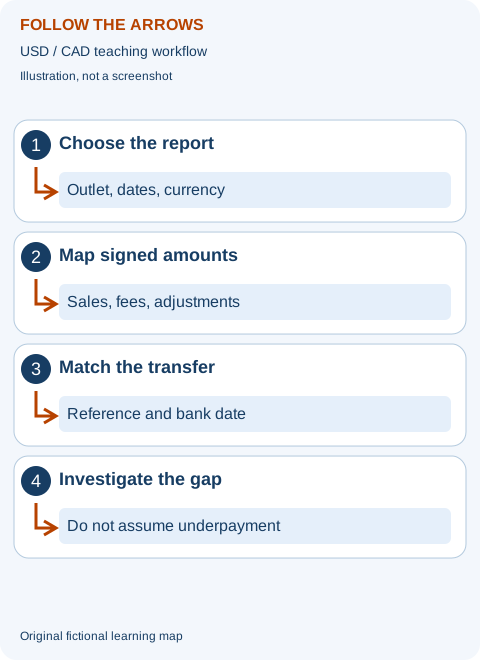
The first arrow asks whether the store, currency and period agree. The second asks what each charge or credit means. The third asks which bank movement belongs to the transfer. The fourth asks what remains unexplained and who will investigate. Use the text steps if a small screen makes diagram labels difficult to read. A diagram should clarify the task, not imply that all platforms have identical fields or that our extension supports an unimplemented Australian report parser.
Official sources and review boundaries
Checked 12 October 2026. No authenticated Australian merchant account was tested. Procedural source summaries are brief; scenarios and exercises are original and fictional. Fees, account permissions, GST classification, pay requirements and bank timing need current business-specific verification. This is independent education, not official support or legal, payroll or audited accounting advice.
- Uber Eats Australia: primary tools
- Uber: report categories
- Uber: report requests and US/Canada glossary scope
- DoorDash: Australian-labelled portal navigation
- DoorDash: explicit US-only payout-summary CSV restriction
- DoorDash: payout and monthly statement distinctions
- Fair Work: award coverage
Read our editorial and corrections policy if a source or interface changes.