
US & CANADA · RESTAURANT OPERATIONS
Restaurant Cash-Flow Forecast: Build a Simple 13-Week Plan
Create a restaurant 13-week cash-flow forecast in USD or CAD with editable weekly inputs, an invented cash-shortfall example and clear distinctions between cash and profit.
Independent educational guide. Examples are invented and independently calculated, not results from a real restaurant. Contract, accounting and jurisdiction-specific questions need the appropriate professional or official provider.
Choose a section in this guide
A profitable restaurant can still run short of cash
Profit measures a defined period's income and expenses. Cash planning asks when money reaches and leaves the bank. A supplier invoice, a payroll run, a delivery-platform transfer and a hardware purchase can occur on different dates from the sales or costs recognised in an operating report. That timing difference is why a restaurant needs a cash forecast as well as a profit review.
A 13-week plan is a rolling view of the next quarter's expected receipts and payments. It is not a promise about future sales, a tax filing or an automatic financing recommendation. Its main purpose is to identify dates that need attention early enough for an owner to investigate them. A forecast built from guesses should visibly distinguish those guesses from confirmed payments.
Choose one currency and one business scope. Use USD for a US restaurant or CAD for a Canadian one, and create separate forecasts when locations have different bank accounts or currencies. Do not add balances in different currencies without a documented conversion method. A cash balance described as available should not silently include restricted deposits, a pending transfer or an undrawn credit facility.
Start with the bank and build week by week
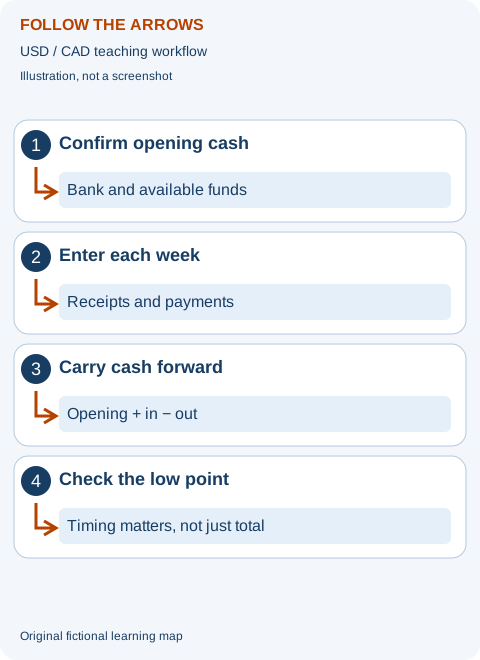
Confirm the opening cash available at the start of week one. For each of the next thirteen weeks, list money expected to arrive and money expected to leave. Receipts might include cash deposited, card settlements, platform payouts or other identified business transfers. Payments might include suppliers, payroll, rent, utilities, taxes, debt payments and equipment. Keep the actual timing rather than spreading a large bill evenly merely to make the line smoother.
The core relationship is opening cash plus receipts minus payments equals closing cash. That closing balance becomes the following week's opening balance. Use the same relationship for all thirteen columns. Document the evidence behind each significant payment, including its due date, and distinguish confirmed obligations from adjustable assumptions. Debt principal can be a cash outflow even when it is not an operating expense in the same accounting presentation.
Avoid counting sales and their later settlement as two receipts. If card sales are expected to arrive through a processor transfer, put the expected transfer in the cash schedule. If the processor deducts fees before payment, do not also deduct those same fees from cash again. The same logic applies to a delivery payout already net of recorded charges. Use the settlement guides to verify the basis before inserting a transfer forecast.
A fictional three-week shortfall inside a 13-week plan
Consider a fictional CAD forecast with opening cash of 8,000. Week one has receipts of 12,000 and payments of 15,000, leaving 5,000. Week two has receipts of 13,000 and payments of 14,000, leaving 4,000. Week three has receipts of 9,000 and payments of 16,000, leaving negative 3,000. A positive opening balance did not prevent a projected shortfall because the large payment arrived before enough receipts.
For weeks four through thirteen, this teaching case assumes receipts and payments of 12,000 each week. The projected closing balance stays negative 3,000; that assumption does not magically fix the original gap. The calculator below contains all thirteen editable weeks. Choose CAD, leave the example entries unchanged and calculate: the first negative week should be week three, the lowest week-end balance negative CAD 3,000 and week-thirteen closing cash negative CAD 3,000.
Now delay 4,000 of week-three receipts into week four while keeping all other assumptions unchanged. Week three falls to negative 7,000, and week four recovers to negative 3,000. The final total is unchanged, but the worst timing problem is much larger. This illustrates why a forecast must show the sequence of receipts rather than only a quarterly net total. It is an invented sensitivity test, not advice to delay a real obligation.
A weekly total can hide a midweek problem
A positive Friday closing balance does not prove payroll was affordable on Tuesday. For weeks with tight cash, expand the schedule into daily dates and check the actual sequence. Keep a separate note for the minimum balance needed for safe operation and for obligations that cannot be freely moved. The calculator reports week-end balances only; it cannot identify a Tuesday shortfall from weekly totals.
Reconcile opening cash with the bank and confirm whether outstanding transactions have already been included. A pending receipt is not available money simply because a platform labels an order completed. Write down who confirmed the expected transfer date and what would happen if it slipped. Similarly, a credit-card purchase and the later card payment must be modelled consistently so they do not become duplicate cash payments.
Do not solve the spreadsheet by omitting taxes, payroll obligations or supplier invoices you do not like. Ask a qualified accountant about the amounts and timing when those are uncertain. If a forecast shows a gap, prepare a clear set of assumptions and questions for the appropriate adviser or provider. This guide does not evaluate loans, recommend borrowing or establish what payments can legally be deferred.
Keep the forecast rolling and learn from differences
At the end of each week, replace that week's forecast with actual receipts and payments, reconcile the closing balance and add a new thirteenth week. Explain the largest forecast-versus-actual differences. A sales miss, an early invoice payment and a delayed payout require different follow-up actions even if all three reduce cash by the same amount.
Keep a base case and a clearly labelled downside case. Change a specific assumption, such as payment timing or sales collections, rather than applying an unexplained percentage to every number. Preserve a dated copy of each version so the owner can see whether forecasts become more accurate over time. Do not confuse the downside case with an expectation or present it as a guaranteed event.
The free planner below runs in this page using typed totals. It does not connect to a bank, save a business forecast to our server or fetch platform settlements. Your entries are not retained by this planner after a page reload. Keep your own secure record if you need to reuse them. For a richer spreadsheet template, BDC's official cash-flow resource is linked in the sources; our examples and browser model are independently created.
Prepare the first forecast from dates, not a sales target
Cash planning starts with the opening money that is actually available and the expected dates of receipts and payments. A revenue target is useful context, but it is not itself a bank receipt. A customer may pay through a processor or platform whose transfer posts later. A supplier bill may become due before the related food is sold. Put each amount on the expected cash date and label the evidence behind it.
For a fictional restaurant called Alder Lunchroom, the owner begins with a bank review and a list of outstanding transactions. They separate available money from restricted amounts, pending receipts and an undrawn facility. They do not add a credit limit to cash as though it had already been drawn. Any financing assumption belongs in a separately labelled scenario and requires the relevant approval and terms.
Create a calendar of known obligations before estimating sales. Payroll, rent, supplier bills and other identified payments have dates that should not be smoothed away. A large payment every fourth week can make that week tight even when a monthly average looks comfortable. If a due date or amount is uncertain, record the uncertainty and who will confirm it.
Keep a dated first version. It is a forecast, not a promise or a retrospective explanation. Later actual evidence should be compared with that version so the owner learns which assumptions were weak. A useful plan is one that highlights a problem early, not one that always shows a reassuring balance because inconvenient payments were omitted.
Map each type of receipt to one cash entry
Separate cash deposited, processor settlements, platform payouts, catering receipts and other business transfers. The forecast should count a receipt once. If card sales are expected to arrive through a processor transfer, do not also count those same sales as immediate cash. If a platform transfer is already net of charges, do not deduct the same charges again from bank cash. Identify how each stream reaches the bank.
In an original fictional exercise, a restaurant expects two thousand dollars of cash deposits and six thousand of card settlements in a week. Its cash-receipt forecast is eight thousand under those assumptions. If the six thousand corresponds to recorded card sales already listed elsewhere, adding both would inflate expected money. The activity record and the receipt schedule are related views, not separate sources of cash.
For a platform payout, use the appropriate financial reference and expected posting evidence. A completed order is not proof of a particular bank date. Do not promise a universal weekday based on a foreign or old tutorial. Write the current source or account-specific confirmation supporting the estimate and what the plan would show if it slips.
Receipts that are genuinely uncertain should have a clear assumption note. An unresolved refund dispute is not confirmed incoming cash merely because a case was submitted. A customer enquiry is not a confirmed event deposit. A forecast can include a labelled scenario, but the base evidence and uncertainty must remain visible.
Put bills on their actual expected payment dates
For every major payment, write amount, date, source and status. Distinguish an invoice due, an approved purchase and a speculative plan. A recurring amount should still have its actual timing. Do not divide rent or a hardware purchase evenly across weeks unless that is how cash will truly leave. The forecast is a cash calendar, not an expense-smoothing exercise.
Suppose an invented month has four thousand dollars of rent due in its first week and the same total receipts as a month with evenly timed expenses. Spreading that rent into one thousand per week hides a first-week requirement of three thousand compared with the real schedule. The quarterly total may remain unchanged while the early cash risk is understated.
Check credit-card treatment. If a purchase is paid later through the business card bill, do not count the purchase as an immediate bank payment and the card payment again unless the model explicitly tracks separate accounts and transfers appropriately. The same care applies to internal bank transfers. Movement between included accounts is not a new group expense or receipt.
Taxes, payroll obligations and contractual payments must not disappear because they make the forecast uncomfortable. Confirm their amounts and timing with the appropriate source. This guide does not decide whether a payment can legally be postponed or recommend borrowing. A forecast showing a gap is evidence for a timely discussion, not permission to ignore an obligation.
A daily example: a positive week can still have a Tuesday shortage
Weekly closing balances can hide the order of events inside the week. For an original fictional case, opening available cash is fifteen hundred dollars. A two thousand dollar payment is due Tuesday and a three thousand dollar receipt is expected Friday. The week-end result is twenty-five hundred, but the Tuesday balance before the receipt is negative five hundred. The weekly total alone does not show that timing problem.
Use a daily schedule when cash is tight or a large payment occurs before receipts. Begin with actual available opening money and list movements in their expected sequence. Check whether bank processing, holidays or the chosen payment method changes availability. Do not simply put every receipt at Monday and every payment at Friday to make the week look safe.
If a receipt is uncertain, test a later date without changing the total. A delay can deepen the lowest balance even when the quarter's ending cash remains identical. The daily view helps the owner identify when confirmation or a legitimate arrangement is needed. It does not guarantee that a transfer will arrive or that a lender will approve funding.
The browser calculator on this page reports week-end balances only. It cannot infer Tuesday's shortage from weekly totals. Keep a separate detailed schedule for such weeks and document the cash date assumptions. This clear limitation helps a beginner use the tool correctly rather than overestimate what a neat result means.
Build a base case and a specific downside case
A base case uses your best supported current assumptions. A downside case changes a clearly identified assumption, such as delayed receipts or lower collections. It should not be a random percentage reduction applied to every line. Some payments are fixed or already committed; others depend on actual purchasing and sales. State which relationships are changed and which are held constant.
In a fictional base week, opening cash is four thousand dollars, receipts ten thousand and payments eleven thousand. Closing cash is three thousand. If two thousand of receipts is delayed into the following week, closing cash becomes one thousand. If payments also increase by five hundred for a documented one-time requirement, closing cash becomes five hundred. These are separate sensitivities with different explanations.
Do not describe the downside as a prediction unless that is justified. It is a test of vulnerability under stated assumptions. Keep the base and downside versions dated. A reviewer should see the exact changed input and its source or reason. That is more helpful than an unexplained worst-case balance that nobody can reproduce.
Use the result to ask timely questions. Which dates need confirmation? Which costs are genuinely discretionary? Which obligations require appropriate professional or provider discussion? This guide does not evaluate financing products or instruct the owner to defer payments. It helps organise evidence for a legitimate decision.
Carry the closing balance forward accurately
Each week's closing amount becomes the next week's opening amount. Do not reset every week to the original bank balance. That would erase the effect of earlier receipts and payments. The chain is the central relationship of the thirteen-week model. Check it with a small three-week example before entering a full quarter.
For an original fictional chain, opening cash is five thousand dollars. Week one has receipts eight thousand and payments seven thousand, closing at six thousand. Week two has receipts six thousand and payments nine thousand, closing at three thousand. Week three has receipts seven thousand and payments eight thousand, closing at two thousand. Starting each week again from five thousand would produce misleading isolated answers.
When a past week is replaced with actual evidence, the later openings should reflect the reconciled actual closing balance. Preserve the forecast version for comparison, then update the rolling view. Do not leave a later opening unchanged merely because it gives a preferred answer. Also do not rewrite the old forecast to make it look as though the actual result was predicted.
At the end of each week, remove the completed forecast column from the active horizon or mark it actual and add a new final week according to your process. The goal is a continuing forward view. A static thirteen-week file becomes less useful as weeks pass unless it is maintained.
Stock purchasing affects cash differently from food consumed
A large purchase can use cash now while some ingredients remain in stock. Food consumption used in an operating review is a different relationship. Do not assume the goods-consumed figure is the cash payment to suppliers. Conversely, an unpaid supplier invoice can be an operating-cost issue before the money leaves the bank. Appropriate accounting policy determines recognition; the forecast follows cash timing.
In an original fictional week, the restaurant buys and pays for three thousand dollars of stock but consumes twenty-four hundred of that purchase within the relevant simplified stock scenario. Cash falls by three thousand, while the consumed amount for that isolated assumption is different. This does not establish your inventory valuation policy. It illustrates why a profit review and a bank schedule need not agree.
Before deciding to buy extra stock because of a discount, consider the cash date, storage capacity, expected use and safety. A lower unit price is not automatically a sensible purchase if it creates waste or a severe cash gap. Use appropriate receiving and food-safety practices, not the forecast alone, to evaluate the plan.
Link the question to the inventory-variance guide for consumption evidence. Keep the methods connected but distinct. A stock-count correction may change the operating review without changing a bank payment already made. Do not force the cash schedule to absorb that accounting correction as a second payment.
Deposits and advance orders need a careful cash story
A catering or event deposit brings cash before all the work occurs. It is not automatically free money available for unrelated withdrawals. Contract terms, refund obligations and accounting treatment matter. Keep the receipt date and the future delivery costs visible in the forecast. Ask the accountant how to classify the amount in accounts; the public calculator cannot decide it.
Suppose a fictional event deposit of two thousand dollars arrives in week two. Related purchases and staffing cash of twenty-five hundred leave in week four, and a remaining payment of fifteen hundred is expected in week five. The sequence matters. A positive week-two bank change does not prove the event has already earned two thousand profit or that all future costs are covered.
Test a delayed final payment if appropriate. The forecast can show whether the event's outflows create a temporary gap even when total receipts exceed selected costs. Do not turn an uncertain customer promise into a confirmed receipt. Write the contract, due date and status supporting the expectation, using authorised private records.
Also avoid counting the deposit again inside the remaining balance due. The total event receipts should follow the actual payment structure. A sales document and two bank receipts are not three separate sources of income. This small check is especially useful for a new owner handling advance bookings for the first time.
Equipment purchases and financing are separate assumptions
Equipment can create a large cash payment while accounting expense is recognised differently over time. The forecast should record the actual expected cash movement and any relevant approved financing receipts or repayments separately. It does not determine depreciation, tax treatment or whether borrowing is appropriate. Those questions need qualified advice and the real terms.
For an original fictional plan, an approved machine requires a four thousand dollar cash payment in week six. Leaving it out because it is not a routine food expense understates that week's cash need. Spreading the cash evenly over thirteen weeks also hides the payment date unless that truly matches the arrangement. Show the one-time amount and its source.
If financing is merely being discussed, do not insert it as available cash in the base case. A separately labelled scenario can demonstrate the effect if it is approved, but uncertainty should remain clear. Include repayments, fees and timing only when supported by the actual arrangement. Avoid presenting a simple model as a loan comparison or approval forecast.
Ask what happens if the equipment purchase is delayed, cancelled or required earlier, using legitimate decision authority. A sensitivity can help prepare a discussion. It does not authorise deferring obligations or signing an agreement. The forecast's role is to show timing, not to make every commercial decision automatically.
Keep obligations visible without inventing tax rules
A cash plan must include properly established obligations, but a general guide should not calculate tax liability from a single sales total. Jurisdiction, registration, supply classification and filing arrangements can matter. Obtain the actual amount or a professionally supported estimate and its payment date. Label an estimate and update it when evidence improves.
If money is reserved for a known obligation, do not silently treat it as fully available for discretionary spending. Explain the opening available-cash definition and any separate reserve. Avoid subtracting the reserve twice: once from opening cash and again as though it were an extra payment before the real obligation is settled. The model should clearly show which cash view it uses.
A negative forecast is not a reason to omit payroll or tax payments. Seek appropriate advice early if obligations appear unaffordable. This guide does not establish legal priority, payment deferral rights or insolvency advice. It provides an organised set of assumptions and dates for a qualified discussion.
For a fictional worksheet, record the obligation description, supported amount, due date, evidence source and confidence. Avoid entering a made-up universal percentage of sales. A beginner can understand that approach without complicated tax vocabulary, while the actual professional calculation remains where it belongs.
Learn from the difference between forecast and actual
At week-end, compare expected receipts and payments with the actual bank evidence. Explain the biggest differences. A delayed transfer, weaker sales collection and an earlier bill payment can reduce cash by the same amount but require different follow-up. Do not combine them into a single sales miss. Record the driver and revise future assumptions appropriately.
In an original fictional week, receipts were forecast at ten thousand dollars but actual receipts were ninety-five hundred. Three hundred is a transfer arriving next week and two hundred reflects lower collection under the selected scope. Payments were forecast at nine thousand but actual payments were ninety-two hundred because a known bill was paid earlier. The week-end difference is seven hundred compared with the forecast.
Carry the delayed three hundred into the later week only when evidence supports its expected date. Do not add the missing two hundred as a future receipt unless it is actually owed and collectable. Adjust the early-paid bill so it is not paid again in the forecast. This is how a variance review improves the plan rather than merely explaining the past.
Keep a small forecast log. Over several weeks, the owner can see recurring weak assumptions and improve them. Accuracy should be judged against saved prior versions, not a rewritten forecast that always matches actuals. The purpose is learning and early warning, not pretending uncertainty has disappeared.
Use the free thirteen-week planner in a sensible order
Reproduce the default fictional case before replacing inputs. Follow opening cash plus receipts minus payments through the first three weeks and confirm the negative week-three balance. Then inspect the later weeks. Their equal receipts and payments preserve the shortfall rather than fixing it. Explain why the final answer alone does not show the worst point in the sequence.
Change one receipt date in the exercise by moving four thousand from week three to week four. The lowest balance becomes more negative even though the ending total is unchanged. This sensitivity helps explain why timing matters. It is not evidence that your own platform payment will slip or that an actual obligation can be moved.
Enter receipts and payments as the positive amounts described by their labels. Keep one currency and one bank scope. Selecting CAD or USD labels the numbers; it does not convert them. The model does not fetch balances, classify bills, save a forecast or connect to merchant accounts. Reloading resets the teaching inputs.
For a real forecast, retain the source calendar and assumption notes elsewhere securely. Use a daily schedule for tight weeks because this calculator only reports week-end balances. Before relying on a result, ask whether every material receipt and payment is included once and whether the opening amount is genuinely available.
Interactive checks for a first-time owner
My quarter ends with positive cash. Can I ignore a negative week in the middle?
No. The sequence can contain an earlier shortage even when the final balance is positive. Review the dates and seek the appropriate legitimate action or advice before that point. The model does not guarantee access to funding.
Can I count card sales and the processor deposit as two receipts?
Not when they represent the same cash stream. The sales activity and later settlement are related evidence. Put the expected bank receipt in the cash schedule once and treat any fees consistently.
A dispute is submitted. Is the expected credit confirmed cash?
No. Submission is not approval, and approval still needs the relevant financial and bank evidence for a cash conclusion. A separate uncertain scenario can be labelled, but it should not be mistaken for a confirmed receipt.
Keep the plan understandable when somebody else takes over
Assign an authorised forecast owner and reviewer. Keep source documents, date assumptions and unresolved questions in a clear private location. The reviewer should reproduce a sample week and trace the opening-to-closing relationship. Do not put passwords in the handover notes or share unnecessary customer and employee information.
Use plain statuses such as confirmed, estimated and waiting for evidence. Every important estimate should have a source or reasoning and a person responsible for confirmation. If an amount changes, keep the dated reason. A new manager should not have to guess whether a figure represents an invoice, a transfer, a wish or an actual bank movement.
BDC's official cash-flow resource provides another planning reference. Our examples and browser model are independently created, not a copy of its template. Neither a template nor this guide replaces business-specific accounting or financing advice.
The final weekly note should name the lowest relevant cash point, the main assumptions affecting it and the next evidence or decision needed. Do not claim the plan guarantees solvency or profit. Its practical value is an early, understandable warning and a clearer conversation with the appropriate people.
Several bank accounts: do not turn internal transfers into extra income
A business may use an operating account, a reserve account and a card account. Decide which accounts belong to the forecast scope. A transfer between two included bank accounts changes their individual balances but not the combined cash total. Counting it as a new group receipt can overstate money. Counting the outgoing side as a group expense can understate it. A location or account-level view may still need both sides labelled correctly.
For a fictional example, the operating account has four thousand dollars and the reserve has two thousand. Moving one thousand from reserve to operating leaves combined cash at six thousand, assuming no other movement. The operating balance rises to five thousand and reserve falls to one thousand. The transfer may improve availability for a particular authorised payment, but it does not create an additional thousand dollars of business money.
If the reserve is restricted or set aside for an obligation, explain how available cash differs from total cash. Do not assume all balances can be spent freely. Ask the appropriate adviser or provider about restrictions where relevant. A public model cannot establish that transfer authority or determine whether using a reserved amount is lawful or appropriate.
Keep a scope note naming the included accounts and how internal movements are treated. The thirteen-week calculator accepts one opening total and weekly receipts and payments; it does not maintain separate account ledgers. If your business needs several account views, use a suitable controlled worksheet or accounting process and reconcile the combined total separately.
Reconcile the opening amount before trusting thirteen later weeks
A forecast with the wrong starting cash will remain wrong even if every future movement is entered correctly. Confirm the actual opening evidence and any outstanding items under the chosen scope. A pending transfer is not the same as posted cash. A payment already initiated may need to be reflected without being counted again when its bank posting appears. Apply the appropriate bank reconciliation method rather than guessing.
Suppose a fictional opening statement shows five thousand dollars, while an already-accounted-for outgoing payment of five hundred is still awaiting posting under the business's reconciliation convention. The appropriate available opening figure may need to reflect that difference. Do not also schedule the same payment as a new future outflow unless the model's scope requires it and avoids duplication. The precise treatment depends on the actual records and method.
Ask the reviewer to trace the opening figure to its source before checking the week-thirteen answer. This is more useful than inspecting a final total while assuming the starting number is correct. Record the date and scope of the reconciliation. If the opening figure changes later because evidence was incomplete, preserve the correction note and update the carry-forward chain.
A clear plan distinguishes what exists, what is expected and what is uncertain. Do not describe hoped-for sales, undrawn financing or a potential dispute credit as existing cash. This plain distinction makes the forecast safer for a first-time owner and keeps its warning function intact. When a material gap remains, bring the documented assumptions to an appropriate qualified adviser rather than hiding them in a reassuring spreadsheet.
Describe a cash warning honestly
Say the forecast shows a possible shortage under the stated dates and assumptions, not that the business will definitely fail. Say a receipt is expected but not confirmed when that is the evidence. Say the model has week-end balances only when an earlier daily gap could exist. These plain statements help the owner understand uncertainty instead of treating a forecast as a guarantee.
Also avoid false reassurance. A positive final balance does not erase an earlier negative point, and an expected financing receipt is not existing money. Review material warning dates promptly with the appropriate qualified people. Do not wait until the thirteenth week simply because the plan covers that horizon. The purpose of the exercise is to make a useful next decision early enough.
An average receipt is not a confirmed payment date
A historical weekly average can help estimate uncertain trading receipts, but it should not replace a known transfer or invoice date. If a documented large receipt falls in one week, spreading it evenly can conceal the earlier shortage. If a large payment is due before that receipt, the timing remains important even when the thirteen-week totals balance.
For a fictional two-week example, opening cash is one thousand dollars, the first week has no receipts and two thousand of payments, while the second has four thousand receipts and no payments. The first week is short by one thousand even though the final balance is three thousand. Averaging the receipt into two thousand each week would hide that warning. A convenient average is not evidence that cash arrives sooner.
Separate the estimate from the schedule. Use historical patterns for genuinely uncertain items with a clear assumption note, and actual expected dates for supported movements. Recheck material dates rather than treating last month's pattern as a guarantee. This plain discipline preserves the forecast's purpose: showing when an owner needs to investigate and act legitimately.
Sources and further checks
BDC's cash-planning reference was rechecked 12 October 2026. The thirteen-week browser model and restaurant scenarios are independently created. No bank account, financing arrangement, tax obligation or actual business forecast was inspected. The calculator reports week-end balances only; daily scheduling and appropriately qualified advice remain necessary when timing or obligations are uncertain.
Read our editorial and corrections policy. This guide is not audited financial advice, a legal determination or a recommendation to enter a contract.