
FOOD-COST GUIDE
Food-cost percentage: calculate the recipe before judging the menu
Food-cost percentage is useful only when its numerator and denominator describe the same thing. A detailed ingredient cost divided by an inconsistent selling-price figure creates a neat percentage that cannot guide pricing.
Calculate edible recipe cost
List every ingredient in the quantity actually used for one sellable portion. Convert purchase prices into the same unit, then adjust for usable yield. If 1 kg is purchased for ₹200 but only 800 g remains after cleaning, the usable cost is ₹0.25 per gram, not ₹0.20. Include oil absorption, garnish, sauces and other small components when they are material.
Define the selling-price basis
State whether your denominator excludes GST, customer delivery charges and platform-funded discounts. For a menu decision, use the revenue the restaurant economically owns under your documented policy. Avoid dividing by the menu MRP in one report and net realised revenue in another.
Worked example
A bowl uses ₹64 of main ingredients, ₹11 of sauce and garnish, and ₹5 of expected preparation loss. Recipe food cost is ₹80. If defined restaurant revenue is ₹320, food-cost percentage is 25%. If a restaurant-funded ₹40 discount reduces revenue to ₹280 while the recipe remains unchanged, the effective food-cost percentage becomes 28.6%.
This illustrates why a discount can damage margin even when food cost per plate is stable. Platform commission, packaging and advertising still need to be added before contribution is known.
| Component | Cost |
|---|---|
| Main ingredients | ₹64 |
| Sauce and garnish | ₹11 |
| Preparation loss allowance | ₹5 |
| Total food cost | ₹80 |
| Revenue before funded discount | ₹320 |
| Food-cost percentage | 25.0% |
Theoretical versus actual food cost
Theoretical food cost comes from recipes multiplied by item quantities sold. Actual consumption comes from opening stock plus purchases minus closing stock, adjusted for transfers and staff meals. The difference can indicate waste, portion variation, theft, recipe errors or stock-count problems.
Compare both across a meaningful period. A one-day comparison can be distorted by purchases and stock timing. Investigate high-value ingredients first, then items with frequent modifier or add-on mistakes.
Use the result without chasing a universal target
There is no single correct food-cost percentage for every cuisine or format. A beverage, biryani and premium protein dish naturally behave differently. Evaluate contribution rupees, preparation time, demand, wastage risk and platform charges together. A higher food-cost item can be attractive if its price and volume produce strong contribution.
Practical control routine
- Maintain recipe versions with dates and portion units.
- Update purchase prices at a documented frequency.
- Record yield assumptions for trimmed ingredients.
- Map exported menu names and variants to recipe codes.
- Compare theoretical consumption with inventory movement.
- Recalculate pricing scenarios before changing a live menu.
KITCHEN CONTROL
Compare theoretical cost with actual consumption
A recipe card answers what an item should cost. Purchases and inventory answer what the kitchen actually consumed. Both are needed: a theoretically profitable menu can still leak margin through portion drift, spoilage, substitutions or unrecorded staff meals.
Run the variance check consistently
- Choose one period and use the same cut-off for sales, purchases and stock counts.
- Convert every ingredient to a common usable unit after trimming and cooking yield.
- Multiply item quantities sold by their current recipe cost.
- Compare the theoretical total with actual food used.
- Investigate the largest rupee variances first; do not chase every rounding difference.
Sources and further checks
- Food Safety and Standards Authority of India — official food-business compliance reference; this guide’s costing formulas do not replace food-safety requirements.
- Contribution-margin guide — shows how verified food cost flows into order economics.
Sources support the stated regulatory or methodological context. They do not determine the treatment of a particular outlet, contract or transaction.
Frequently asked questions
Does packaging belong in food cost?
Keep it separate for clearer diagnosis, but include it in total variable cost and contribution.
Should I include kitchen labour?
Direct per-order labour can be modelled as a variable cost. Regular monthly salaries are usually considered after contribution when evaluating operating profit.
How often should recipes be updated?
Whenever ingredients, portion sizes or preparation methods change. Update unit prices frequently enough to reflect material supplier movements.
PRACTISE WITH EVIDENCE
Build one recipe card, then use it in the free margin calculator
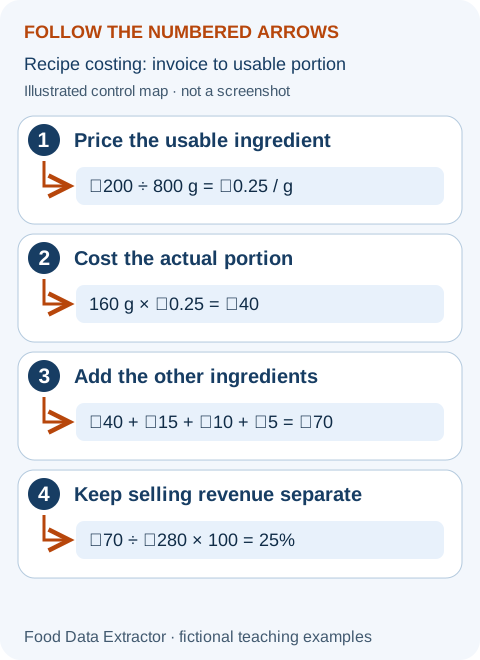
Follow an ingredient from invoice to plate
Suppose a fictional vegetable purchase costs ₹200 for one kilogram. Cleaning leaves 800 grams usable. The usable unit cost is ₹200 ÷ 800 = ₹0.25 per gram. A portion containing 160 usable grams therefore uses ₹40 of that ingredient. Adding ₹15 of rice, ₹10 of sauce and ₹5 of garnish gives a ₹70 recipe. At restaurant revenue of ₹280 per plate, food cost is 25%.
The 200 grams removed during cleaning are already reflected in the usable unit price. Do not add that same trimming loss a second time. A separate allowance is justified only for a different, documented loss not included in the yield, such as an expected unsold cooked portion. Write the distinction on the recipe card because “waste” can otherwise become a convenient but duplicated charge.
Know what the free tool does—and does not do
The margin calculator does not read a recipe, weigh ingredients or discover purchase prices. You calculate the recipe cost first, then type the resulting per-order amount into “Food cost per order.” Add packaging separately. If the order contains two dishes, use the combined ingredient cost of the actual basket rather than the cost of just its highest-priced item.
- Choose one platform and one period. Enter the average restaurant-owned order value and completed order count.
- Enter the weighted food cost of those orders. For a single-dish experiment, the ₹70 recipe can be used directly; for mixed baskets, calculate their average using actual quantities.
- Replace every fee, funded-discount, ad and refund default with the relevant evidence. Follow the annotated input guide rather than treating default numbers as your contract.
- Save the scenario privately. Increase ingredient cost from ₹70 to ₹74 and compare contribution rupees at unchanged demand. The four-rupee increase is more useful for an operating decision than saying the percentage “looks slightly worse.”
Investigate a stock variance without blaming someone first
For another fictional week, opening inventory is ₹20,000, receipts are ₹45,000 and closing inventory is ₹18,000. Recorded ingredient consumption is ₹47,000. Sold-item recipes explain ₹42,000, leaving a ₹5,000 difference. A costed waste log explains ₹3,000 and staff meals explain ₹1,000. The remaining ₹1,000 still needs investigation.
Start with count accuracy, ingredient transfers, purchase cut-off, substitutions and portion weights. A variance is not proof of theft. Because the ₹47,000 consumption already includes the ingredients used for waste and staff meals in this example, do not subtract those logs again when calculating the operating result. They explain consumption rather than create a second expense.
Make the control practical for a small restaurant
Begin with the five ingredients that account for the largest purchase value and the ten items that sell most often. Give each recipe an owner, date, usable portion and yield assumption. Update the affected recipes when a supplier price or portion changes. Use the weekly review calculator to connect inventory and recipe expectations, while keeping safe handling, quality and accurate portions as requirements—not variables to sacrifice for a lower percentage.
Walkthrough and arithmetic checked 3 October 2026. The complete beginner tool manual explains controls, units, privacy and access limits. Examples are invented and are not platform rates or restaurant results.
Educational information only; use your own recipes, invoices and accounting policy.