
PROFITABILITY GUIDE
Restaurant contribution margin: formula, example and simple explanation
Contribution margin is the money left from a sale after paying the costs caused by that sale. It tells a restaurant whether an extra dish, order, discount or delivery channel helps pay the monthly bills. It is not the bank payout and it is not final profit.
The quick answer
If a restaurant earns ₹600 from an order and the ingredients, packaging, restaurant-funded discount, platform charges, advertising allocation and expected refund loss total ₹412, the order contributes ₹188. That ₹188 first helps pay rent, fixed salaries, licences and other fixed expenses. Only the amount left after those expenses becomes operating profit.
Think of every order as placing money into a jar for fixed monthly bills. Revenue fills the jar; variable costs are removed first. Contribution margin is what stays in the jar. A positive contribution helps with fixed costs. A zero contribution adds sales but nothing toward the bills. A negative contribution means the order loses money before fixed costs are even considered.
Why two restaurant definitions appear online
In traditional menu engineering, contribution margin is often shown as selling price minus standard food cost. That version is useful for comparing dishes inside the same dining operation. In managerial accounting, the broader definition is sales minus all variable costs. For delivery and takeaway decisions, the broader definition is usually more informative because packaging, platform charges, funded discounts and other per-order costs can change with each sale.
This guide therefore uses the broader order-level definition. If you use the food-cost-only version for menu engineering, label it clearly so nobody mistakes it for the amount left after every variable order cost.
Choose the revenue basis first
Write down what “revenue” means before calculating. Decide how you will treat GST, packaging income, delivery amounts collected for another party, cancellations and discounts. For an internal operating calculation, many restaurants start with restaurant-owned sales net of taxes collected on behalf of government. Your accounting treatment may differ; the important control is to use one documented definition when comparing items, weeks or channels.
Which costs should be included?
Include a cost when selling one more order causes that cost to increase. Leave a cost for the later profit calculation when it stays broadly unchanged within the current operating range. Some costs are mixed or step up at a threshold, so classify them according to the decision you are testing.
| Usually variable for an order | Usually fixed for the month | Needs judgement |
|---|---|---|
| Recipe ingredients and garnishes | Kitchen rent | Labour: fixed roster or extra shift? |
| Order-specific packaging | Annual licences spread monthly | Utilities: base charge plus usage |
| Restaurant-funded discount | Core software subscriptions | Advertising: campaign or brand spend? |
| Per-order commission or service fee | Fixed equipment lease | Delivery: per order or fixed contract? |
| Payment fee or refund loss tied to sale | Owner salary that does not change per order | Extra staffing after capacity is reached |
Use the restaurant's authorised invoices and settlement records rather than a generic platform percentage. Commercial terms can vary by outlet, service, campaign and time.
Worked order example
A delivered order has ₹600 of restaurant revenue under your chosen definition. Ingredients cost ₹180, packaging ₹25, restaurant-funded discount ₹45, platform commission and related variable services ₹120, advertising allocation ₹30 and expected refund or wastage allowance ₹12. Contribution is ₹188, or 31.3% of revenue.
The bank receipt for this order may differ because settlements include tax movements, withholding, prior adjustments and payout timing. Use settlement reconciliation for cash control and contribution margin for operating decisions.
| Order component | Amount | % of revenue |
|---|---|---|
| Restaurant revenue | ₹600 | 100.0% |
| Ingredients | ₹180 | 30.0% |
| Packaging | ₹25 | 4.2% |
| Funded discount | ₹45 | 7.5% |
| Platform services | ₹120 | 20.0% |
| Advertising | ₹30 | 5.0% |
| Refund allowance | ₹12 | 2.0% |
| Contribution | ₹188 | 31.3% |
Contribution margin is not the same as these numbers
| Number | What it answers | Why it differs |
|---|---|---|
| Food cost percentage | How much of sales is used by ingredients? | It does not include other variable order costs. |
| Gross profit | What remains after the cost-of-sales definition used in the accounts? | The exact included costs depend on the accounting presentation. |
| Bank payout | How much cash was transferred in a settlement? | It can include GST movements, withholding, refunds, prior adjustments and timing differences. |
| Contribution margin | How much does the sale add toward fixed costs and profit? | It subtracts costs that change with the sale, using a documented scope. |
| Net profit | What remains after variable and fixed expenses? | It comes after rent, fixed payroll and other operating expenses. |
Move from one order to the whole menu
Calculate contribution in rupees as well as percentage. A low-priced item can show a high margin percentage but produce too few rupees to cover labour and rent. A higher-priced combination may have a lower percentage yet contribute more cash. Compare both measures by item, daypart, channel and offer.
For example, imagine Item A sells for ₹300 and has ₹90 of food cost. Its food-cost percentage is 30% and its food-cost-only contribution is ₹210. Item B sells for ₹500 and has ₹190 of food cost. Its food-cost percentage is worse at 38%, but it contributes ₹310 before other variable costs—₹100 more per sale. Percentage alone would make Item A look better; contribution rupees show why Item B may do more to pay the bills.
Sales volume matters too. Multiply each item's contribution by the number sold to find total contribution. An item earning ₹80 per sale across 1,000 sales contributes ₹80,000, while an item earning ₹200 across 100 sales contributes ₹20,000. Menu engineering therefore considers both contribution and popularity.
For shared costs, use a rule that reflects cause. Allocate a campaign to orders attributed to that campaign, not evenly across every sale. Allocate packaging from the actual item configuration where possible. When a value is estimated, label it and keep the method stable.
From contribution to break-even and operating profit
Contribution must still cover fixed or semi-fixed expenses: kitchen rent, permanent salaries, licences, software, equipment and owner overhead. After total contribution covers those expenses, the remaining amount becomes operating profit under the simplified model.
If monthly fixed cost is ₹150,000 and average contribution is ₹150 per delivered order, simplified break-even volume is 1,000 orders. If the outlet's contribution margin ratio is 30%, simplified break-even revenue is ₹500,000. These formulas assume the current cost pattern remains valid. Capacity limits, wastage and additional staffing can make fixed costs jump after a threshold.
How to calculate it from restaurant records
- Pick one scope. Choose a menu item, order type, campaign, channel, outlet or month.
- Use net restaurant revenue. Record the revenue definition and apply it consistently.
- Build the recipe cost. Use current purchase prices, standard portions and realistic yield or wastage.
- Add other variable costs. Include packaging, funded discounts, per-order platform charges, payment costs and attributable advertising or refund loss.
- Subtract and divide. Calculate contribution in rupees first, then divide by revenue for the percentage.
- Reconcile the inputs. Compare order reports with invoices and settlements; do not force the bank payout to equal contribution.
- Compare like with like. Keep the same revenue and cost definitions across periods and channels.
Decisions this metric supports
- Set a maximum restaurant-funded discount that keeps contribution positive.
- Identify items that sell well but destroy contribution after commission.
- Compare organic and advertised orders after including acquisition spend.
- Model a price or recipe change before publishing it.
- Separate temporary cash timing from structural unit-economics problems.
DECISION TEST
Stress-test the inputs before trusting one margin
A single result can look precise while depending on uncertain inputs. Recalculate at least a base case, a cost-pressure case and an improvement case. Keep selling price constant first so the effect of each cost change is visible.
| Scenario | Ingredient cost | Discount | Ad allocation | Question answered |
|---|---|---|---|---|
| Base | Current recipe | Observed average | Observed attributed spend | What is happening now? |
| Cost pressure | +5% to +10% | Unchanged | Unchanged | How much inflation can the item absorb? |
| Promotion | Current recipe | Proposed offer | Campaign budget | How many extra orders are required? |
| Improvement | Updated yield | Reduced leakage | Best verified channel | Which operational change matters most? |
Never compare margin percentages built from different revenue definitions. Store the definition, date and evidence beside every result.
Sources and further checks
The research below supports the plain-language accounting and restaurant menu-engineering explanations in this guide.
- OpenStax: contribution margin, unit margin and ratio — supports the general sales-minus-variable-cost definition and the link between contribution, fixed costs and profit.
- BCcampus Open Education: principles of menu engineering — supports the restaurant menu-item definition and the need to compare contribution rupees with food-cost percentage and popularity.
- Toast: restaurant break-even analysis — supports the contribution-ratio break-even formula.
- Food-cost percentage method — builds the ingredient input used here.
- Settlement reconciliation method — explains why contribution and bank payout are separate controls.
External sources establish the accounting and menu-engineering methods. They do not determine the tax treatment, contract terms or correct inputs for a particular Indian outlet.
Frequently asked questions
What is a good contribution margin for a restaurant?
There is no universal percentage that is good for every restaurant. A useful margin must cover that outlet's fixed expenses at a realistic sales volume and leave room for profit. Compare the result with your own history, capacity, channel and required break-even level—not an unexplained internet benchmark.
Can contribution margin be negative?
Yes. If the variable costs caused by an order are greater than its revenue, contribution is negative. More sales of the same order under the same conditions would increase the loss unless another benefit is deliberately being measured.
Is contribution margin the same as food-cost percentage?
No. Food-cost percentage measures ingredient cost as a share of sales. Contribution margin measures the rupees or percentage left after the variable costs included in your definition. Both numbers are useful, but they answer different questions.
Is commission the only platform cost?
No. Depending on the agreement, there may be payment, logistics, promotional, service or other charges, plus taxes on services. Use the authorised invoice rather than assuming one universal percentage.
Should owner salary be included?
For order-level contribution margin, normally not if the amount does not change when one more order is sold. Include it later when calculating operating or economic profit. If extra volume requires an additional paid shift, that step-up cost belongs in the decision model.
Should GST be included in revenue?
Use the revenue basis followed by your accounts and label it. For internal comparisons, many operators use restaurant-owned sales excluding taxes collected on behalf of government. Confirm the correct treatment for your business with its accountant or tax adviser.
What if ingredient costs change weekly?
Use the latest weighted recipe cost or a documented average, then run sensitivity cases. A margin calculated from an obsolete recipe is misleadingly precise.
PRACTISE WITH EVIDENCE
Calculate the ₹188 example yourself, then test a real change
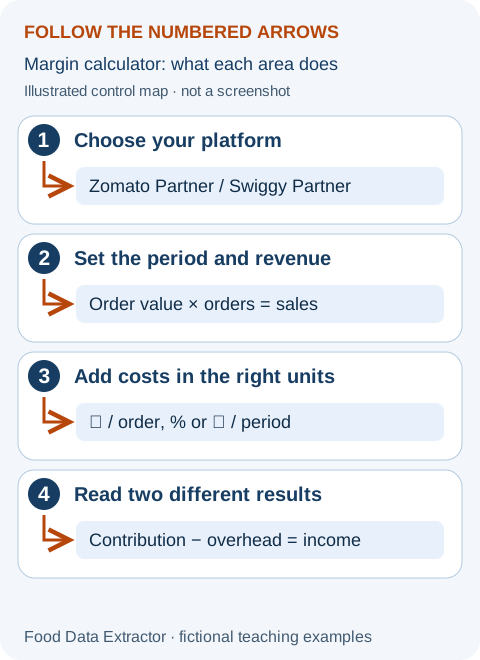
Enter a single order before modelling the whole month
Open the free margin calculator and choose the relevant platform. For this article’s fictional order, enter average order value ₹600, one order, food ₹180, packaging ₹25, funded discount ₹45 and advertising ₹30. Enter the combined ₹120 service amount in fixed platform fee/order, and set commission and its tax percentage to zero so that combined cost is not repeated. Set refund allowance to 2%, equivalent to ₹12, and zero the other fields and overhead for this simplified example.
The tool should show ₹188 contribution. This verifies the arithmetic, not the correctness of someone else’s contract rate. The combined service amount is an all-in teaching assumption; real invoices may require a different breakdown. The input manual explains percentage fields, per-order rupee fields and period overhead.
Change one assumption, not the entire business at once
Raise food cost from ₹180 to ₹198 while keeping revenue and the other costs fixed. Contribution becomes ₹170, or about 28.3% of ₹600. Across 1,000 comparable orders, that ingredient change removes ₹18,000 contribution. At the original ₹188 contribution, 1,000 orders produce ₹1,88,000; after ₹1,50,000 period overhead, the simplified operating result is ₹38,000. With the higher food cost, it is ₹20,000.
The model does not predict how customers will respond to a price change, whether orders will remain at 1,000, or whether higher volume needs another staff shift. Treat those as additional scenarios. Record the source and date of each input and explain which costs are estimated. Check actual demand and quality before publishing a menu or promotion change.
Do not combine two discounts unknowingly
If the revenue entered is already reduced by the restaurant-funded discount, do not also enter that same reduction as a separate discount cost. Either use a before-discount revenue basis with a separately entered funded discount, or a properly documented after-discount basis without subtracting it again. Keep that choice consistent across platform, item and weekly comparisons.
Walkthrough and arithmetic checked 3 October 2026. The complete beginner tool manual explains controls, units, privacy and access limits. Examples are invented and are not platform rates or restaurant results.
Educational information only. Verify commercial and tax inputs against your own records.