
OMNICHANNEL RESTAURANT
Dine-in vs takeaway vs delivery: compare profit, not just sales
Dine-in, takeaway and delivery can all support one restaurant, but their sales are not economically identical. Compare them on the same revenue basis, subtract costs caused by each channel, then check whether one channel consumes capacity or creates demand for another.
Choose a section in this guide
Interactive three-channel comparison
Use one period and one documented definition of restaurant revenue. “Variable costs” should include the costs that increase because those transactions occurred. For delivery, include the authorised platform, promotion, refund and packaging amounts attributed to the selected orders rather than applying a generic percentage.
Build a channel cost map
| Cost or control | Dine-in | Takeaway | Partner delivery |
|---|---|---|---|
| Food and beverage | Recipe, garnish, complimentary items, waste | Recipe, condiments, travel adjustment | Recipe, travel adjustment, cancellation waste |
| Packaging | Usually limited | Container, bag, cutlery policy, seal | Container, bag, seal and platform requirements |
| Service or channel cost | Incremental floor labour, reservation or payment cost | Counter labour, ordering and payment cost | Contractual commission/services, payment or logistics-related charges as applicable |
| Promotion | Restaurant-funded offer, loyalty or booking deal | Owned-channel or counter offer | Restaurant-funded discount and attributable advertising |
| Capacity unit | Seat-hour and kitchen time | Counter and kitchen time | Kitchen, packing station and handover time |
| Cash evidence | POS and payment settlement | POS/order system and payment settlement | Order report, invoice, settlement and bank receipt |
Do not allocate every fixed cost equally per transaction and declare the highest-volume channel unprofitable. Rent may support all channels; a reservation subscription may belong mainly to dine-in; a dedicated packer may be caused by delivery volume. First calculate contribution using directly caused variable costs, then allocate fixed and shared costs for the specific decision.
Example: one established restaurant, three routes
A fictional neighbourhood restaurant reviews one month. Dine-in produces ₹10,80,000 from 1,800 covers, takeaway ₹2,25,000 from 450 orders and partner delivery ₹4,68,000 from 900 completed orders. After channel-specific variable costs, the results are:
| Channel | Revenue | Variable costs | Contribution | Margin |
|---|---|---|---|---|
| Dine-in | ₹10,80,000 | ₹4,59,000 | ₹6,21,000 | 57.5% |
| Takeaway | ₹2,25,000 | ₹94,500 | ₹1,30,500 | 58.0% |
| Partner delivery | ₹4,68,000 | ₹3,37,500 | ₹1,30,500 | 27.9% |
| Total | ₹17,73,000 | ₹8,91,000 | ₹8,82,000 | 49.7% |
Takeaway and delivery create the same total contribution in this example, although delivery has twice as many orders. Takeaway produces ₹290 contribution per order; delivery produces ₹145. That does not automatically make delivery a bad channel: it may reach customers beyond walking distance, create trial or use otherwise idle kitchen capacity. The restaurant must test whether those benefits are real and incremental.
If monthly fixed and shared operating costs are ₹7,50,000, the simplified operating result is ₹1,32,000. Removing delivery without changing anything else would remove ₹1,30,500 of contribution and nearly eliminate that result. The better first question is whether delivery’s per-order contribution can improve without damaging demand or dine-in.
Run a capacity test before a growth campaign
Platform demand arrives at specific times, not as a smooth monthly average. Zomato’s preparation-time research identifies queued orders and item mix among the factors that affect restaurant production time (Zomato). If online orders arrive during a full dining-room service, the relevant cost can include slower tables, rejected orders and weaker repeat experience.
- Map 15-minute demand. Count dine-in tickets, takeaway orders and delivery orders by arrival time.
- Identify the constrained station. It may be the tandoor, fryer, beverage station, packing bench or payment counter—not the whole kitchen.
- Measure service time. Track order acceptance, kitchen start, ready time and handover using authorised operational data.
- Create a safe limit. Restrict availability, extend preparation time accurately or pause a promotion before the queue becomes unrecoverable.
- Review displaced demand. Check dine-in waits, walkouts, complaints and repeat visits alongside added online contribution.
Use each channel for a defined job
Dine-in: experience and high-value occasions
Measure seat-hour productivity, average check, service quality and repeat visits. Reservations and dining discovery may support demand, but funded deals still require incremental-contribution analysis.
Takeaway: convenience with ownership
Useful for nearby repeat customers and scheduled collection. Count packaging, counter congestion, digital payment cost and order-error risk.
Delivery: geographic reach
Useful for off-premise demand and idle production capacity. Reconcile every settlement and measure contribution after platform-related and order costs.
One brand: consistent promise
Keep item naming, portion expectations, availability and service recovery coherent. Channel differences should be intentional and clearly explained.
Dining discovery can connect online and offline
Swiggy describes Dineout as enabling restaurant discovery, menus and images, reservations, promotions and in-restaurant payment (Swiggy corporate business overview). Its FY2024-25 annual report says restaurant partners use the wider ecosystem for visibility, customer engagement and brand building (Swiggy Annual Report FY2024-25). These are platform descriptions, not proof that a specific restaurant’s offer is profitable.
For any dining deal, compare guests and contribution with a credible baseline. Avoid counting regular customers who would have visited anyway as fully incremental. Record average check, funded discount, reservation fee or campaign cost, party size and repeat behaviour.
Keep tax and payout definitions separate
CBIC Circular 167/23/2021 explains that the e-commerce operator is liable for GST on restaurant service supplied through it under section 9(5), effective 1 January 2022, while restaurants may still have other reporting and supply obligations (CBIC circular). Do not infer the restaurant’s complete tax position from one settlement line or this guide. Document whether each comparison uses tax-inclusive customer value, restaurant-owned revenue, platform-reported gross order value or cash payout.
Zomato’s online-ordering terms describe menu listing, order transmission and settlement after agreed deductions and adjustments (Zomato online-ordering terms). The signed outlet agreement and current invoice remain controlling; public terms do not prove an individual restaurant’s rate.
US and Canada: delivery apps versus direct ordering
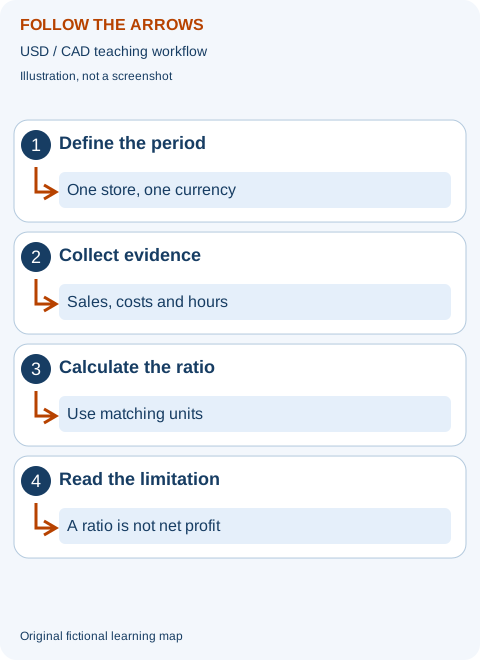
A direct order avoids some marketplace charges, but it does not make customer acquisition or delivery free. Compare the restaurant revenue basis and every incremental channel cost before claiming one channel is always more profitable. For a US or Canadian scenario, use USD or CAD explicitly. This section is a new international example; the earlier INR calculator and Indian platform examples remain separate and unchanged.
Consider an invented USD 30 order with USD 9 food cost and USD 1 packaging. Suppose the marketplace channel has USD 8 of all-in incremental channel cost, including its scoped merchant charges, restaurant-funded promotion and advertising allocation. Marketplace contribution is 30 minus 9 minus 1 minus 8, or USD 12. Suppose the direct channel has USD 5 of payment, delivery and customer-acquisition cost for the same scope. Direct contribution is USD 15. The USD 3 difference is contribution, not net profit or guaranteed savings.
The planner below reproduces that comparison. Enter costs per order, not a percentage in a dollar field. It does not fetch DoorDash or Uber Eats rates. Its all-in marketplace and direct amounts deliberately avoid a universal commission assumption; derive your own figures from current agreements and scoped evidence. Do not count a promotion again if it is already in the all-in cost. Switching USD to CAD changes labels only, not exchange conversion.
Now suppose direct customer acquisition costs an additional USD 4 per order. Direct channel cost becomes USD 9 and contribution becomes USD 11, below the marketplace scenario's USD 12. That does not prove direct ordering is undesirable; it shows the outcome depends on actual acquisition and fulfilment costs. Separate a first-order marketing experiment from repeat-order economics, and document the allocation used. A repeat customer is not automatically free to serve or retain.
Incremental volume also matters. An order that replaces a customer who would have bought through another channel may shift margin rather than add a whole new contribution. At peak capacity, an extra delivery order can delay an existing dining-room order or increase overtime. Measure rejected tickets, delays and remakes alongside sales. A forecast that assumes unlimited kitchen capacity can overstate the value of either channel.
Use actual payout reports for cash reconciliation and a consistently defined revenue basis for this operating comparison. Platform reporting can include tax movements, credits and timing differences that should not be converted blindly into a per-order expense. Check country-specific agreements and ask the appropriate adviser about accounting classification; this example does not apply Indian GST or FSSAI rules to North America.
For a practical test, select one menu basket, one location and a comparable service period. Record order count, net restaurant revenue, variable food and packaging, merchant-funded incentives, payment and fulfilment costs, and the campaign allocation. State whether a cost is a modelled estimate or a verified amount. Evaluate service quality and repeat behaviour as well as money. The result supports an evidence-based next question, not a guaranteed decision to leave or join a platform.
DoorDash and Uber Eats merchants can use the new report-reading guides without our extension. Current extraction support is Zomato and Swiggy only. If you need an international dashboard exporter, contact us to describe the authorised business workflow; no existing integration or delivery promise is implied.
Where to get help
Dine-in performance
Begin with POS and reservation evidence by service period. Use the seat-hour guide before changing tables or offers.
Open the dine-in dashboardDelivery settlement
Trace included order IDs, invoices and bank receipts before disputing a difference.
Use the settlement analyserPlatform account issue
Use the current authenticated partner app and keep outlet, order, invoice or settlement identifiers ready.
Review the partner checklistTax classification
Check current CBIC material, then obtain advice based on the outlet’s premises, registration and supplies.
Open CBIC rate schedulesSources and further checks
- OpenStax: contribution margin and fixed-cost coverage.
- Cornell: restaurant revenue-management baseline and RevPASH.
- Zomato: operational factors in food-preparation time.
- Zomato: online-ordering terms.
- Swiggy: food delivery and Dineout business descriptions.
- Swiggy Annual Report FY2024-25.
- CBIC Circular 167/23/2021-GST.
Company sources are used for descriptions of their own services, not as independent evidence of restaurant profit. The worked figures are invented and must be replaced with the outlet’s own evidence.
Frequently asked questions
Which restaurant channel is most profitable?
There is no universal winner. Contribution per unit, total demand, fixed costs, capacity, repeat behaviour and displacement differ by restaurant and period.
Is bank payout the revenue figure for delivery?
Not necessarily. Payout is a cash settlement after deductions and adjustments. Choose and document the revenue basis, then reconcile payout separately.
Should rent be divided equally across all orders?
Not for an initial incremental decision. Rent is usually a shared fixed cost. Calculate channel contribution first, then allocate shared costs using a rule appropriate to the longer-term decision.
Can a dining offer and a delivery campaign be compared by ROAS?
ROAS alone is insufficient. Use incremental contribution after the restaurant-funded discount, campaign cost and variable fulfilment costs, while checking whether existing demand was merely relabelled.
PRACTISE WITH EVIDENCE
How to complete the channel comparison without mixing units
Use a common period, not a common transaction label
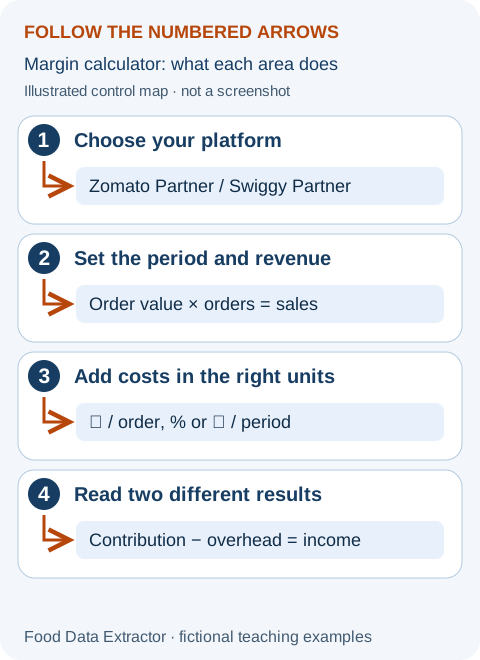
Enter one reviewed week or month in all three columns. Dine-in may use covers, while takeaway and delivery use completed orders. A family order is not equivalent to one diner. Total contribution can be compared across channels after aligning revenue and cost definitions; a per-unit comparison needs the unit name beside every number.
For this article’s fictional month, the delivery result is ₹1,30,500 contribution across 900 orders, or ₹145 per order. Takeaway produces the same total contribution across 450 orders, or ₹290 per order. This is a reason to investigate mix and capacity, not a rule that takeaway is always twice as attractive.
Know where each tool fits
- Use the on-page three-channel form when you already have each channel’s total revenue and variable costs. Click “Compare contribution” and verify the totals against your control sheet.
- Use the margin calculator to build a delivery basket from explicit per-order costs and percentage charges. Convert a period ad bill into the correct per-order allocation before entering it.
- Use the settlement analyser to review supported cash settlements. Do not paste bank payout into revenue simply because it is the easiest number to find.
- Use the seat-hour calculator for dining-room utilisation. It cannot tell you delivery capacity because kitchen and packing work have different constraints.
Separate incremental and long-term decisions
A few extra orders during an idle afternoon may require only variable ingredients, packaging and services. A permanent delivery expansion may require a dedicated packer, equipment, software and additional storage. Put those newly caused costs into the expansion decision. Do not keep calling them “shared rent” merely to make the channel look profitable.
Before reducing a channel, estimate which costs would genuinely disappear and which contribution would be lost. Before growing it, check displaced demand and safe fulfilment. Record your reasoning next to the outputs and use the beginner tool guide when a colleague needs to reproduce the calculation.
The complete beginner tool manual explains controls, units, privacy and access limits. Examples are invented and are not platform rates or restaurant results.
Give each route a job instead of making every route identical
A dining room can offer atmosphere, personal service and occasions that justify a different menu. Takeaway can serve nearby people who want convenience without paying for a delivery journey. Delivery can reach customers who will not visit at that moment. The same restaurant can use all three, but the economics and customer promise differ. Start by describing what the customer gets through each route rather than simply copying every item and price across them.
Some dishes travel poorly but are excellent at the table. Some bundles work well for a household but do not suit a solo lunch. Some items need a station that is already busy during dining service. A sensible channel menu reflects these differences while keeping the restaurant's identity clear. It should not make misleading claims about portions or quality to hide a cheaper delivery recipe.
For each route, list the preparation, service, payment, packing and handover work. A direct takeaway order is not automatically free to acquire or process. It can use ordering software, payment fees, staff time, collection space and marketing. A delivery platform can provide discovery and order handling while charging under its agreement. Compare complete relevant costs rather than treating one route as expensive and another as costless.
One fictional dish, three different contributions
Imagine the same base dish in three channels, using tax-exclusive restaurant revenue throughout this example. Dine-in revenue is ₹400, ingredients are ₹120 and the relevant additional variable service and payment costs are ₹30. Contribution is ₹250 before the shared period costs. Takeaway revenue is ₹380, ingredients are ₹120, packaging ₹20 and other relevant variable costs ₹15. Contribution is ₹225.
Delivery revenue is ₹450 before a separately counted restaurant-funded offer. Ingredients are ₹120, packaging ₹25, agreed all-in variable services in this teaching case are ₹90, the funded offer is ₹30 and advertising allocation is ₹15. Contribution is ₹170. The figures are invented, not published platform prices. They do not prove that dine-in always wins. Demand, service costs, seating capacity and the actual commercial agreement can change the comparison.
If twenty delivery orders are genuinely additional and fit unused capacity, they add ₹3,400 contribution in this model. If those twenty replace dine-in orders that would have contributed ₹250 each, they replace ₹5,000 with ₹3,400, reducing contribution by ₹1,600. The exact behaviour is not known just because orders moved online. Keep a separate assumption for whether the demand is additional, transferred or uncertain.
The comparison also does not allocate rent per order yet. For a short-term spare-capacity decision, that can be appropriate because the rent may not change. For deciding whether to open a delivery-focused site or permanently reduce the dining room, include the long-term cost consequences. The right cost view depends on the decision, so name the decision before choosing the formula.
Protect the dining room while organising collection and courier handover
A restaurant can lose value if delivery packing takes over the counter, couriers wait among diners or collection orders disrupt service. Map the path of a dine-in order, takeaway order and delivery order. Identify where they share equipment, staff or space. A small operational change, such as a clearly organised packing point or consistent handover check, can reduce confusion without changing the menu.
Measure the rush in short time windows. Do not use only total daily orders. The kitchen may have enough daily capacity but not enough capacity when all routes peak together. Track queue length, preparation time and incorrect orders while keeping customer data private. If adding a channel requires an extra shift or equipment, include that cost in the channel test rather than claiming that every additional order is pure gain.
Do not solve handover pressure by compromising food safety or allergen checks. Use a process that suits the premises and applicable rules. Confirm the order reference, items and packaging through the appropriate workflow. The financial objective is to reduce avoidable errors and losses, not to remove necessary checks. A cheaper operation that harms customers is not a successful channel strategy.
Keep the brand recognisable without pretending platforms are the same
Use clear item names, honest descriptions, accurate opening hours and appropriate photos. Explain differences in bundle size or packaging. A customer should understand whether an online family pack is the same dish in a larger quantity or a different product. Do not use unsupported rankings, fake reviews or invented claims about popularity to attract clicks. Build trust by fulfilling the actual promise.
Check each platform's current rules for menus, pricing, communication and account access. Do not tell customers or staff to bypass a contractual process merely because direct ordering appears cheaper in your model. You can improve the restaurant's own website and lawful opt-in communication while following the relevant rules. If you want to change a contract, discuss it through the appropriate commercial channel.
For international readers, DoorDash, Uber Eats and other delivery services require local fee, reporting and menu checks. Our main tools currently support the stated India-focused workflows, not automatic importing from every app. The coming-soon overseas extractor links are a way to express interest and contact us, not an installation of a ready extension. Use the manual channel comparison with your local currency and confirmed costs.
A first weekly review across the three routes
Collect sales and order counts for one consistent period, then separate them by route. Calculate contribution with the matching cost basis. Record transferred demand as an assumption, not a fact. Compare service issues and capacity at the same time. A lower-contribution route may still be useful if it serves additional demand in a quiet period; a higher-contribution route may be limited by seats or preparation capacity.
Choose one improvement per review: a better travelling menu, clearer collection hours, fewer handover errors, or a funded-offer limit that protects contribution. Keep the test small and record the result. Avoid changing every price and item at once, because you will not know which change helped. If a route repeatedly fails the model under realistic assumptions, reassess its role rather than adding more promotion to hide the weakness.
Open the three-channel review checklist
The channel cases are fictional teaching examples. Related methods appear in the contribution guide, cloud-kitchen capacity guide and recipe-cost guide. They are not evidence that one channel is always more profitable.
Practice decision: protect a full dining room while adding pickup
Imagine an invented restaurant with a busy Friday evening dining room and a quieter afternoon. The owner wants pickup and delivery sales but does not want diners to experience long waits. Instead of making every channel available for every dish and every hour, build a service-window decision with the actual shared kitchen resource in mind.
This exercise describes fictional demand and costs, not a successful real merchant. It does not set platform terms, approve a premise or choose the legal tax treatment. Its purpose is to help a beginner compare contribution, capacity and customer expectations without assuming that the largest gross-sales total wins.
Identify the customer's job in each route
A dining customer may want time at a table, fresh presentation and service. A pickup customer may want a convenient meal on the way home. A delivery customer may be ordering for people who cannot visit. Those customers can want related products without requiring identical menus. Describe the portion, included sides, journey and service promise clearly.
Keep names and descriptions recognisable, but do not pretend that a travelling dish is identical if its configuration changes. A group pack can be a different quantity from a single plated dish. Price and cost the promised product. Do not use undisclosed smaller portions or substitutions to make the delivery card look better.
Review actual contract rules before publishing route-specific menus or prices. The costing worksheet cannot override a platform agreement. The restaurant's own ordering channel may also have software, payment and marketing costs. “Direct” describes the route, not an automatic absence of expense.
Build a consistent contribution comparison
For the exercise, a dining basket has defined restaurant revenue ₹600, ingredients ₹180 and relevant variable service and payment costs ₹40, leaving ₹380 contribution. A pickup basket has ₹550 revenue, ₹180 ingredients, ₹25 packaging and ₹25 relevant variable payment and handling costs, leaving ₹320.
A delivery basket has ₹650 revenue, ₹180 ingredients, ₹35 packaging, ₹130 invented all-in variable services and a separately counted ₹40 restaurant-funded offer, leaving ₹265 contribution. All use a consistent tax-exclusive teaching basis. The service amounts are not published platform rates, and staff costs included at this stage must not be included again in period costs for the same scope.
Record actual costs in separate cards for the real operation. If a funded offer is already reflected in revenue, avoid a second deduction. If an all-in service total contains tax, do not count its tax component again. A matched revenue definition is essential before comparing the route percentages.
Use spare capacity differently from a full rush
Suppose twenty pickup baskets arrive in a genuinely quiet service with available lawful staffing and no other added commitment. At ₹320 contribution they add ₹6,400 before any new period cost. If instead they replace twenty dining baskets that would have contributed ₹380, the change is negative ₹1,200. The same pickup card can support very different decisions depending on what it displaces.
You may not know exactly which sales were transferred. Keep the demand assumption labelled and test a range. A channel report proves that an order was recorded through that route, not what the customer would otherwise have done. Compare suitable periods and service patterns without claiming precise causation from limited records.
For the Friday rush, inspect the shared preparation station. Empty pickup space at the counter does not mean the grill or oven has room. A dining table can be available while the kitchen is full. The owner's capacity question should follow the bottleneck, meaning the resource that limits completion, not whichever empty space is most visible.
Measure station load in a realistic test
Use a simple queue record with accepted time, ready time and relevant item group. Observe overlapping tasks and shared equipment. Do not calculate an absolute station capacity by dividing every hour by one item's recipe time. Orders can share preparation, and cleaning or setup may interrupt it. Actual observations provide a better starting point.
List problems by cause: long preparation, missed items, packing backlog or handover confusion. A designated appropriate packing point can help one issue; a narrower travelling menu can help another. Buying more advertising does not repair a packing queue. Choose the action from the observed constraint.
Keep safe-food checks, allergen accuracy and employment obligations intact. A capacity plan should not rely on skipping checks or unpaid closing work. If an extra staffing arrangement is required, include its actual checked cost in the route test. Customer experience is part of the operation, not a separate optional concern.
Compare the added shift with the expected route contribution
Suppose a quiet-window pickup plan requires a checked added service commitment of ₹4,800 for the test period. At ₹320 contribution, fifteen comparable pickup baskets cover it. Twenty baskets leave ₹1,600 in that added-cost view. Ten baskets produce ₹3,200 and a ₹1,600 shortfall.
The target of fifteen baskets is not the whole restaurant's break-even. Shared rent and other bills still exist. Keep the added-cost result beside the entire period model. For a long-term route decision, consider the share of management, space and equipment needed, using an explained approach rather than treating all existing resources as free forever.
If a pickup test changes the dining result, include that effect. A profitable added route can still create a larger loss elsewhere if it disrupts service or transfers higher-contribution demand. The whole-operation total prevents a channel sheet from celebrating a gain that the restaurant did not actually receive.
Check the product after the intended journey
Costing a delivery dish is not enough if it does not arrive in an acceptable condition. Use an appropriate safe test with the intended pack and journey conditions. Record leakage, ease of eating, presentation and whether the described product remains recognisable. Follow the relevant food-safety procedures; this exercise does not establish a safe holding time.
A premium pack can cost more but prevent avoidable remakes. A cheap pack can be suitable for one item and unsuitable for another. Test the configuration rather than labelling every expensive pack wasteful. If a change saves ₹5 across a hundred comparable orders, the direct arithmetic saving is ₹500, but quality and any loss change still need observation.
Keep item descriptions and allergen information accurate after a configuration or recipe change. Do not remove an ingredient from the cost card while the kitchen still uses it, or add a cheaper substitute without updating the relevant records. The customer promise and real recipe should match the model.
Separate channel operating performance from payout timing
Dining and pickup payments may arrive on a different schedule from delivery deposits. Build a cash calendar without redefining trading revenue to fit bank arrival. A channel can add positive contribution while its payment timing creates a shortfall before wages or supplier bills. Keep due dates and expected receipts separate.
Use actual payout references for delivery reconciliation. A later credit can relate to an older order. A service invoice can span cycles. Do not call the net transfer the channel's profit, and do not subtract a complete invoice again if its service charges are already in the contribution card. The cash bridge and cost model are related controls, not one formula.
For overseas channels, use local currency and actual available reports. Our main analyser's Zomato/Swiggy support does not make it a universal DoorDash or Uber Eats importer. Coming-soon extractors are not currently working products. A manually checked route comparison is more honest than an unsupported automation claim.
Run a limited service-window test
Define the menu, dates, intended customer, route, funding and capacity boundary. Choose a contribution measure and a service-quality check. Limit the approved commitment and record who can pause the test. Do not change every menu item and opening hour at once; the result becomes hard to explain.
At the review, compare forecast and actual counts, mix, contribution, losses and added costs. Note events, staffing or weather that affected demand. Keep the original forecast dated and unchanged. A modest conclusion such as “this pickup window worked at observed costs and needs another check” is more trustworthy than claiming it will always increase profit.
If the test fails, identify whether the problem is demand, contribution or service capacity. A weak count may need a different customer proposition. A weak card may need a genuine cost or price review. A service failure may need a narrower menu or different window. More discounting is not a universal solution.
Check the route-test answers
Dining contribution is ₹600 − ₹180 − ₹40 = ₹380. Pickup is ₹550 − ₹180 − ₹25 − ₹25 = ₹320. Delivery is ₹650 − ₹180 − ₹35 − ₹130 − ₹40 = ₹265. Twenty additional pickup baskets contribute ₹6,400; twenty transferred from dining reduce contribution by ₹1,200. An added ₹4,800 commitment needs fifteen pickup baskets under the stable assumptions. These fictional answers do not establish real demand or contract terms.
Keep the customer-facing choices simple
A customer should quickly find the right menu, hours and route. Use clear names such as eat in, collect and delivery, with accurate descriptions. Avoid adding every operational detail to the homepage. The detailed cost cards belong in the owner's review, while the customer-facing page should explain the promise and next step cleanly.
Check links and contact routes after changing menus. A pickup button should lead to the intended working order process, not an unrelated educational tool. An unavailable service should be clearly marked rather than presenting a dead install or order button. Keep the relevant platform names where useful without implying an affiliation or working integration that does not exist.
Review the whole journey on a small screen as well as a desktop: can a customer read the item, choose the route and see the actual next action? A simple route structure protects the brand from looking like several disconnected businesses. It also helps the owner see which channel serves which customer purpose.
Group orders can change the average: look at the basket
A group basket can share a transaction or packing step across several dishes, while a single-item basket may bear the same step alone. Do not apply the whole basket's fee to every dish and then add the dishes together. Allocate an order-level cost using an explained method when you need item analysis, and check that the allocations add back to the actual basket total.
At the same time, do not assume large baskets are always easy. They can need coordinated finishing, more packing space and a handover check. Measure their preparation burden during the actual service window. A large family delivery arriving during a full dining rush might create a different capacity effect from several ordinary orders spread across the afternoon.
Write the basket promise clearly: servings, included sides, packaging and any choice rules. Cost the configuration actually offered, not the individual menu items in isolation. If customers can choose higher-cost options without an additional price, model the likely choices and a more expensive mix.
Use group-basket records as one part of the route review. They may explain why average order value rose, but a higher average is not automatically higher contribution. Check the ingredients, funded offers, route charges and capacity before celebrating the change. A new owner can understand the result through one complete basket card more easily than through several unrelated percentages.
Choose a supported tool, then keep the evidence private
The main margin calculator uses rupees and Zomato/Swiggy labels. It is manual: it does not fetch a merchant agreement or verify tax treatment. The settlement analyser supports the specified Zomato/Swiggy report structures, not every platform's CSV. Try a fictional public sample first. DoorDash and Uber Eats extractors marked coming soon are not available importers.
Follow this guide's local-currency arithmetic in a private worksheet. Read the complete input and privacy manual if using a supported Indian workflow. Label revenue basis, per-order inputs and period costs, and count each fee or funded discount once. Never put passwords, bank details, customer records or unredacted reports in a public community post. Our support page can explain tool scope and receive future-feature requests; it cannot grant a food licence, file a tax return or audit an overseas account.