
GROWTH-SPEND GUIDE
How to evaluate restaurant discounts and advertising without mistaking sales for profit
A campaign can increase orders and still reduce contribution. The right question is not “How much campaign sales did we get?” but “How much additional contribution did the campaign create after discount and advertising cost?”
Separate who funds the discount
Classify every offer into restaurant-funded, platform-funded and shared-funded portions using the authorised report or agreement. A customer may see one discount while the settlement assigns the cost differently. Only the restaurant-funded portion directly reduces the restaurant’s order revenue, although other offer terms may influence fees.
Do not treat a platform-funded amount as restaurant revenue unless the settlement actually reimburses it under your accounting definition. Trace offer rows to order or settlement identifiers where available.
Measure campaign economics
The difficult part is the baseline. Comparing with the immediately previous day can be misleading because weekday, weather, season, menu availability and outlet uptime affect demand. Use comparable days or a simple test-control design when possible.
Worked campaign example
A campaign produces 300 attributed orders and ₹120,000 of restaurant revenue. After food, packaging, platform services, funded discounts and expected refunds—but before advertising—the orders contribute ₹24,000. Advertising cost is ₹15,000, leaving ₹9,000 campaign contribution.
Suppose comparable organic behaviour suggests 180 of those orders would have occurred anyway and would have contributed ₹12,000. Incremental contribution after advertising is therefore negative ₹3,000: ₹9,000 campaign contribution minus ₹12,000 expected baseline. Revenue and attributed orders looked strong, but the incremental result does not justify repeating the campaign unchanged.
| Measure | Value |
|---|---|
| Attributed restaurant revenue | ₹120,000 |
| Contribution before ad spend | ₹24,000 |
| Advertising spend | ₹15,000 |
| Campaign contribution | ₹9,000 |
| Expected baseline contribution | ₹12,000 |
| Estimated incremental contribution | −₹3,000 |
Look beyond first-order economics
A first order can be intentionally low-margin when it creates valuable repeat demand, but this must be measured rather than assumed. Track cohorts by first campaign exposure, then compare repeat order rate and contribution over a defined period. Use privacy-respecting aggregated data and do not fabricate customer identities when the source does not expose them.
Define a payback window. If an acquired customer has not recovered the initial subsidy within that window, the campaign needs a different audience, offer or menu bundle.
Campaign checklist
- Confirm the funded share of each discount.
- Use delivered orders, not only clicks or initiated orders.
- Deduct variable platform and packaging costs.
- Include the advertising invoice, not an incomplete dashboard snapshot.
- Compare like-for-like days and outlet uptime.
- Watch for cannibalisation of full-price organic orders.
- Set a contribution stop-loss before launch.
- Review repeat contribution by cohort after the campaign.
CAMPAIGN CONTROL
Separate attributed orders from truly incremental orders
A dashboard may attribute an order to advertising or a promotion, but attribution does not prove the order would have disappeared without the campaign. Use a comparable baseline and label limitations rather than treating every attributed sale as incremental.
Before-and-after test
- Define the outlet, menu, geography, dayparts and campaign dates before looking at results.
- Choose a comparable non-campaign period and note holidays, closures, rating changes and price changes.
- Compare delivered orders and contribution rupees, not only gross sales.
- Subtract restaurant-funded discount, ad spend and extra variable cost.
- Record repeat behaviour only when it can be measured without exposing customer data.
If the contribution per promoted order is ₹90 and total campaign cost is ₹9,000, at least 100 genuinely incremental orders are required to cover that cost. Orders that would have happened anyway do not satisfy the test.
Sources and further checks
- Contribution-margin guide — defines the contribution input used in the break-even calculation.
- Settlement reconciliation guide — helps verify that campaign and discount deductions reached the payout.
Sources support the stated regulatory or methodological context. They do not determine the treatment of a particular outlet, contract or transaction.
Frequently asked questions
Is ROAS enough?
No. Revenue divided by ad spend ignores food, packaging, commission, discounts and refunds. Contribution-based return is more useful for profitability.
What if later daily ad rows are missing?
Do not assume zero spend. Record the coverage gap and confirm against invoices or the authorised campaign dashboard.
Should every low-margin promotion be stopped?
Not automatically. It may support acquisition, launch or capacity utilisation, but define the objective and payback evidence in advance.
PRACTISE WITH EVIDENCE
Use the free calculator to compare a promotion with doing nothing
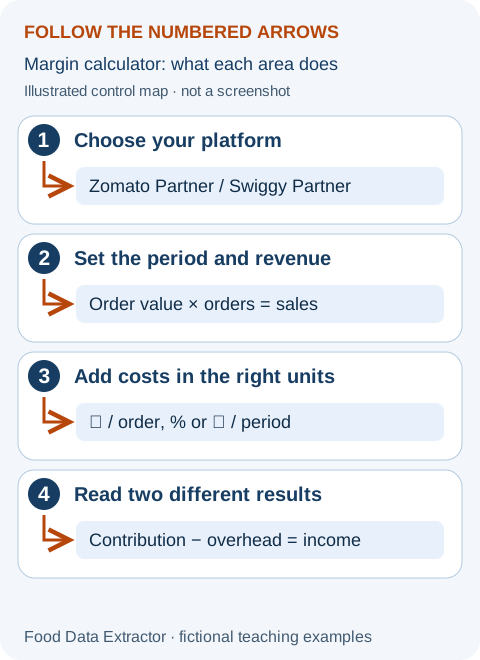
Translate the campaign bill into the right units
The margin calculator’s advertising field is rupees per order, not the entire campaign budget. If a fictional campaign costs ₹9,000 and the reviewed period contains 150 completed orders, the all-period allocation is ₹60 per order. Entering ₹9,000 into that field would apply the whole budget to every order and overstate the cost. If you instead allocate spend only to campaign-attributed orders, label that different scope and do not compare it silently with an all-outlet average.
The restaurant-discount field also expects a per-order rupee amount. Use only the restaurant-funded share supported by the offer records. A platform-funded customer discount is not automatically your cost. Keep the original promotion terms and the invoice beside the calculation so another person can reproduce the allocation.
A second worked case: more orders, fewer contribution rupees
Imagine a comparable baseline of 100 orders at ₹400 each. Ingredients cost ₹120, packaging ₹20, combined platform services ₹80 and restaurant-funded discount ₹20 per order. With no campaign spend, contribution is ₹160 per order and ₹16,000 in total. These are invented all-in cost assumptions, not a recommended platform fee.
The proposed promotion produces 150 orders at the same ₹400 value, but the funded discount rises to ₹50 and allocated advertising is ₹60 per order. Other costs remain unchanged. Contribution is now ₹70 per order: ₹400 − ₹120 − ₹20 − ₹80 − ₹50 − ₹60. Total contribution is ₹10,500, which is ₹5,500 below the baseline despite 50% more orders.
- Open the free margin calculator. Enter the baseline orders, value, food and packaging.
- For this all-in example, put ₹80 in fixed platform fee/order and zero the other fee percentages, taxes, refund allowance and deductions to avoid counting them again. Enter discount ₹20, ads zero and overhead zero.
- Record the ₹16,000 contribution result. Then change orders to 150, discount to ₹50 and ads to ₹60. Record the ₹10,500 result separately.
- Compare total contribution and fulfilment quality, not just the displayed percentage. The beginner manual explains every input and which defaults must be replaced.
Set a stop rule before launching
A useful decision log says who may change the budget, when the campaign will be reviewed, which completed orders are included and how much additional contribution is required. Include operational limits: a full dinner queue is not an appropriate place to add demand that delays both promoted and ordinary orders. Do not increase a budget merely because attributed sales look impressive.
Where the campaign aims to create repeat demand, keep the conclusion conditional until reliable aggregated repeat evidence exists. A promised future customer value is not cash already earned. Preserve incomplete tracking as an uncertainty, and compare equivalent weekdays, opening hours, menu availability and holiday conditions. Swiggy’s published self-serve ads guide describes campaign controls; only the current authenticated interface and your agreement establish the controls available to your outlet.
Walkthrough and arithmetic checked 3 October 2026. The complete beginner tool manual explains controls, units, privacy and access limits. Examples are invented and are not platform rates or restaurant results.
Illustrative analysis only. Campaign attribution and commercial terms vary by source.