
MENU GROWTH PLAYBOOK
Make a partner menu easier to choose—and worth selling
A strong delivery menu answers two questions at once: “Can the customer understand and trust this item?” and “Does the item leave enough rupees to help run the restaurant?” A visibility score or attractive photo can help the first question; recipe and contribution analysis answer the second.
Choose a section in this guide
A six-part menu-quality review
Swiggy describes Menu Score as a way for partners to review categories, images, combos and related catalogue opportunities. Zomato’s official integration documentation supports menu and outlet management through integrated systems. Treat these as operating aids, not promises of ranking or profit.
Interactive item-profit comparison
Enter per-item revenue and variable costs on the same basis. “Platform cost” should come from the relevant contract or an evidence-based allocation—not a generic internet rate. “Promotion” can include the item’s funded discount and attributable ad cost per order.
Example: percentage versus rupees
With the starting values above, Item A sells for ₹300 and contributes ₹100 per order, or 33.3%. Across 100 orders it produces ₹10,000 total contribution. Item B sells for ₹500 and contributes ₹160 per order, or 32%. Across 60 orders it produces ₹9,600.
If the owner looks only at contribution percentage, Item A wins. If the owner looks only at contribution per order, Item B wins. Total contribution shows they are close under current demand. The decision then needs non-financial evidence: which item attracts new customers, earns better ratings, is faster to prepare, has fewer complaints and uses spare kitchen capacity?
Connect popularity and contribution
| Demand | Contribution | Practical response |
|---|---|---|
| High | High | Protect availability and consistency; test modest discovery improvements. |
| High | Low or negative | Check price, portion, recipe yield, packaging, funded discount and allocation. |
| Low | High | Improve category, name, description, image or pairing with one controlled test. |
| Low | Low | Simplify, redesign or remove if it adds complexity without a strategic role. |
A safe menu experiment
- Choose one item and one problem. For example, high views but low orders, or high orders but weak contribution.
- Save the baseline. Record price, availability, views or orders, contribution inputs and the dates.
- Change one element. Improve the description, image, category, combo or price—not all at once.
- Protect operations. Confirm recipe, portion, packaging and preparation time before sending more demand to the item.
- Compare like periods. Account for closures, festivals, weekends, advertising and other changes.
- Keep or reverse deliberately. A decision needs both customer response and contribution, not a vanity metric.
Using ads and social traffic without losing the question
Swiggy’s Smart Links can route social-media visitors to a restaurant menu and provide channel insights. Self-serve ads let partners set targeting, timing and spend and review campaign states. Those tools can support discovery, but the restaurant still has to determine whether the extra orders were incremental and profitable.
Before a campaign, write down the expected contribution per additional order. If it is ₹120 and the campaign costs ₹6,000, the simplified break-even point is 50 additional orders: ₹6,000 ÷ ₹120. Attributed orders are not automatically additional orders; some customers might have purchased without the campaign.
Menu engineering for a US or Canadian restaurant
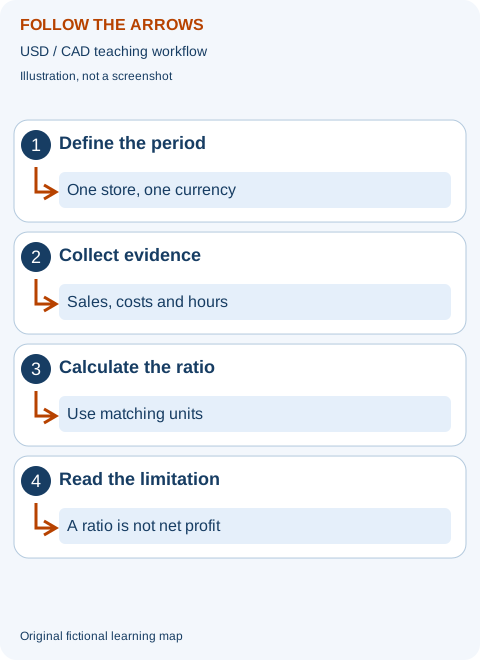
Menu engineering compares item contribution with popularity, but the definitions need to be explicit. For this international teaching exercise, contribution means menu revenue minus the item-variable costs included in the worksheet. It is not net profit after rent and the whole payroll. Record the currency, portion, channel, price basis and included costs before comparing dishes. The existing calculator above is labelled INR; do not mistake it for a USD/CAD conversion tool.
In a fictional USD menu, pasta sells for 18 and has 7 of included variable cost, producing 11 per sale; 180 sales generate 1,980 contribution. A burger sells for 16 with 8 cost, producing 8; 220 sales generate 1,760. A salad sells for 20 with 8 cost, producing 12; 60 sales generate 720. Soup sells for 10 with 5 cost, producing 5; 40 sales generate 200. The total is 500 items and USD 4,660 contribution on this deliberately limited scope.
For demonstration only, choose popularity of at least 100 sales and contribution of at least USD 10 as the high thresholds. These are invented teaching cutoffs, not an industry benchmark. Pasta is high on both dimensions; the burger is popular with lower contribution; the salad has higher contribution but fewer sales; soup is lower on both. In a CAD case, recalculate using actual CAD prices and recipe costs rather than simply relabelling a US menu.
These groups suggest questions, not automatic removals. For pasta, check recipe consistency and whether production can handle demand. For the burger, investigate whether an evidence-backed portion or purchasing improvement preserves the customer proposition. For salad, test a clearer description or suitable placement and verify that it fits what guests want. For soup, ask whether it provides an important dietary option, supports another sale or uses ingredients efficiently before judging it solely by two thresholds.
Delivery can change the classification. Packaging, channel fees and restaurant-funded incentives can reduce the contribution of a dish that looks attractive on a dine-in worksheet. Calculate the correct channel scope rather than applying one delivery percentage indiscriminately. Capacity matters too: an item with a high dollar contribution can consume scarce preparation time during the peak. A measured bottleneck review can be more useful than putting the most expensive dish at the top of the menu.
A controlled menu experiment should change one useful factor at a time and record item sales, contribution, order mix and service outcomes. If a photograph, description and price all change at once, it becomes harder to explain the result. Keep the observation window and unusual conditions visible. Do not copy another restaurant's descriptions or images, invent customer reviews or claim that a platform's proprietary ranking formula is known.
Swiggy Menu Score guidance in the earlier section is platform-specific. It should not be represented as a DoorDash, Uber Eats, Square or Toast scoring feature. The general contribution-and-popularity method here is independent of those platforms. For supporting research, see Toast's original menu-engineering research; the four-dish case and its thresholds are independently invented.
For the next review, keep a small table with item quantities, consistent prices, recipe versions, included variable costs and the reason for each proposed experiment. A strong candidate is one whose evidence can be checked and whose operational tradeoff is understood. If your business needs export data from a DoorDash or Uber Eats dashboard to perform this analysis, use the international extractor enquiry link below. Those integrations are not currently available in our extension.
Where to get help
Swiggy menu completeness
Review Menu Score in the current Swiggy Owner app. Swiggy’s published guide also provides a partner-insights email for feedback about the feature.
Open Swiggy’s Menu Score guideZomato menu integration
For POS-connected menu or outlet management, start with Zomato’s official integration documentation and your authorised POS provider.
Open Zomato integration documentationCampaign setup
Use the current authenticated partner interface and read the campaign budget, charging basis and placement terms before activation.
Read Swiggy’s self-serve ads guideItem economics
Use recipe evidence and the restaurant’s actual platform documents. Our margin calculator helps test a price or cost change before publishing it.
Open the margin calculatorSources and further checks
- Swiggy: Menu Score, categories, images and combos.
- Zomato: order, menu and outlet integration capabilities.
- Swiggy: Smart Links for direct social-menu traffic.
- Swiggy: self-serve restaurant advertising.
- Zomato: sponsored-listing commercial terms.
- Our restaurant contribution-margin guide.
The cited platform pages explain available or published tools, not a guaranteed ranking or financial outcome. Current in-app availability and contract terms control.
Frequently asked questions
Does a better Menu Score guarantee more orders?
No. It can identify useful catalogue improvements, but demand also depends on customer preferences, competition, availability, service area, price and platform systems.
Should every item have an image?
Use accurate, rights-cleared images where the current platform guidance recommends them and the image helps a customer decide. Never use a beautiful image that misrepresents the delivered portion.
Is the item with the lowest food-cost percentage best?
Not necessarily. Compare contribution rupees, total demand, preparation time, quality, complaints and capacity. A lower percentage can still produce more rupees per sale.
Can I use the same cost allocation for both platforms?
Recipe and packaging may be similar, but platform costs, promotions, refunds and order mix can differ. Calculate separately first, then compare on a documented common basis.
PRACTISE WITH EVIDENCE
Use the comparison without confusing a menu score with profit
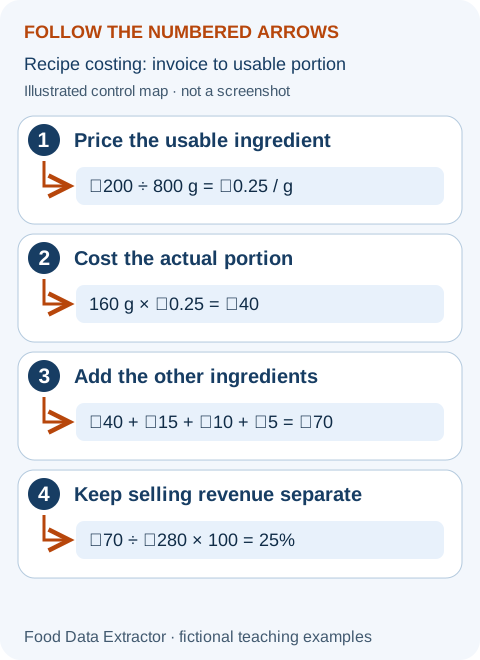
Start with one accurately costed basket
The comparison above is an independent calculator, not Swiggy’s actual Menu Score tool and not a Zomato ranking score. Type the two item scenarios into their separate columns and click “Compare items.” Its contribution result subtracts the food, packaging, platform and promotion amounts entered. It does not retrieve prices or costs from a partner account.
Start with the supplied fictional pair. Item A contributes ₹100 per order across 100 orders; Item B contributes ₹160 across 60. Their total contributions are ₹10,000 and ₹9,600. Now reduce Item B’s packaging cost by ₹5 after a real packaging test: contribution becomes ₹165 per order and ₹9,900 in total, if sales and other costs stay unchanged. Verify leak resistance and delivered quality before accepting the cheaper pack.
Make one menu test measurable
For an item with incomplete description, record baseline completed orders, availability, complaints and contribution before changing the description. State the actual quantity, ingredients and included accompaniments. Review the next equivalent service periods, while noting any ad campaign or price change. Improved orders during a festival are not evidence that the wording alone caused growth.
For an add-on, cost the complete extra portion and packaging, then include the service charges caused by the extra revenue. A ₹40 add-on with ₹12 ingredients, ₹3 extra packing and an assumed ₹8 service cost contributes ₹17 before other costs. Those numbers are a teaching exercise, not a universal fee schedule. If the add-on delays a constrained station or creates frequent packing errors, the rupee calculation alone is insufficient.
Choose the right companion tool
Use the on-page comparison for two already-costed items. Use the full margin calculator for percentage-based fees, refunds and period overhead. Use the settlement analyser to review cash adjustments—not to rank dishes. The beginner tool manual explains those boundaries with arrows and examples. Preserve the recipe source and test notes so the next manager can repeat the comparison.
The complete beginner tool manual explains controls, units, privacy and access limits. Examples are invented and are not platform rates or restaurant results.