
CANADA · RESTAURANT PAYMENT COSTS
Restaurant Payment Processing Fees in Canada: Read the Full Cost
Understand Canadian restaurant card-processing statements with CAD examples, a payment-category calculator and blended examples, payment-type distinctions and dated links to official pricing.
Independent educational guide. Examples are invented and independently calculated, not results from a real restaurant. Contract, accounting and jurisdiction-specific questions need the appropriate professional or official provider.
Choose a section in this guide
The advertised percentage is only one part of the comparison
A Canadian restaurant's processing cost depends on the payment methods it accepts, its transaction sizes and its actual provider agreement. The number on a headline pricing page is not automatically the effective cost of the whole restaurant. Some payments can carry a percentage fee, others a percentage plus a fixed amount, and software or additional services can be billed separately. Start with an actual statement rather than assuming every payment uses one rate.
This guide uses CAD throughout its Canadian cases. The calculator can label a separate US teaching scenario USD, but that does not make Canadian provider pricing applicable in the United States. Country, contract, payment channel and date matter. We do not recommend surcharging, promise lower fees or provide tax treatment here; those decisions require current contractual and local professional guidance.
For a clear comparison, separate processing charges from software subscriptions, hardware payments, transfer fees, disputed-payment costs and other services. You can then calculate both a processing-only ratio and a wider technology-cost ratio. Do not call the wider ratio a card-processing rate without disclosing what is included. A reader should be able to reproduce the number from the same statement lines.
Use dated official pricing, not a universal Canadian rate
As checked on 12 October 2026, Square Canada's official fee page lists standard in-person credit at 2.5%, Interac debit at 0.75% plus CAD 0.07, online payments at 2.8% plus CAD 0.30, and manually entered or card-on-file payments at 3.3% plus CAD 0.15. It also describes an additional charge for cards issued outside Canada. These are provider-specific published figures, not industry-wide rates or a quote for your account. Check the official page and your agreement before relying on them.
Do not treat a free software tier as proof that payment processing is free. Conversely, a monthly restaurant software subscription should not automatically be treated as a fee deducted from each individual card transaction. Keep the recurring invoice separate and show the allocation if you choose to compare a combined monthly cost. Custom agreements and added services can change the complete amount.
The useful question is not simply which provider displays the smallest percentage. Ask how much the complete service would cost for your actual mix of credit, debit, online and other transactions, using the same period and equivalent features. A cafe with many small debit purchases can have a different blended result from a full-service restaurant with larger credit-card checks. The mix explains the difference without requiring either restaurant to be mismanaged.
A fictional mixed-payment month in CAD
For an invented month, suppose the restaurant takes 400 in-person credit transactions averaging CAD 50, 200 debit transactions averaging CAD 20, and 50 online transactions averaging CAD 40. These volumes and averages are fictional. Using the published standard rates above only for this simplified exercise, credit volume is CAD 20,000 and its processing cost is CAD 500.
Debit volume is CAD 4,000. The percentage part is CAD 30, and 200 fixed charges of CAD 0.07 add CAD 14, for CAD 44 total. Online volume is CAD 2,000. Its percentage cost is CAD 56 and its fixed charges total CAD 15, for CAD 71. Combined modelled processing is CAD 615 on CAD 26,000 of card volume, approximately 2.3654%. This excludes foreign-card additions, disputes, transfers, software and other unentered costs.
The calculator below models one payment category at a time. For its default teaching case, enter CAD 10,000 volume, 200 transactions, a 2.5% rate, zero fixed fee and CAD 60 of monthly software. Processing is CAD 250; the wider total is CAD 310; the combined ratio is 3.10%. The CAD 60 is an assumed separate subscription, not a claim that every restaurant must buy it. Recalculate each category and sum the monetary amounts before deriving your blended result.
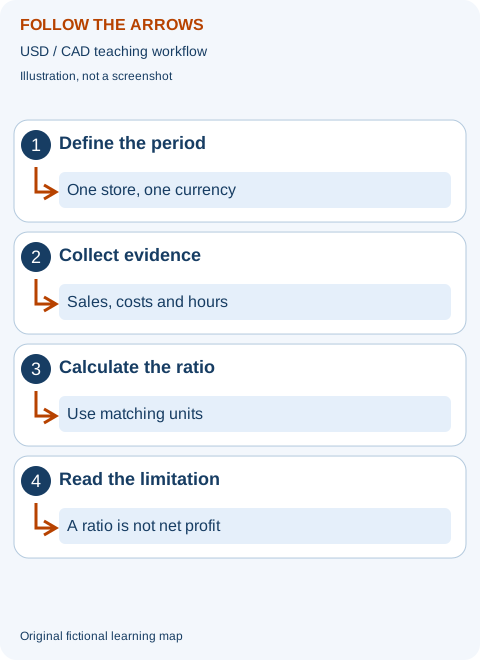
Trace the statement before challenging a charge
Identify settled payment volume, transaction count, refunds and the period covered by each source. The fee base may not match a restaurant revenue figure that excludes tax or tips. A processing percentage must use the transaction base described by the provider, while an operating margin may use a different accounting revenue basis. Label both denominators so the comparison remains understandable.
Check whether the fee was deducted from the transfer, billed separately or included in another statement total. Do not subtract it from a bank deposit a second time merely because you found a matching invoice. A refund may change net volume, while refund-fee treatment depends on the actual agreement. Keep any foreign-card or special-service category separate until its documented basis is clear.
Make one reconciliation row per statement period with payment volume, fee components, settlement references, bank transfers and any separately paid invoices. Retain source references without copying customer card information into your working sheet. Never record full card numbers, security codes or account passwords for a fee comparison. If a line is unexplained, ask the provider through authenticated support and preserve the question and response.
Compare alternatives using the same business assumptions
Request comparable quotes for the same locations, transaction mix, payment volume, hardware and required features. A lower headline rate can be offset by a fixed fee, additional devices or a higher subscription. Conversely, a more expensive service may solve an operational problem you can actually demonstrate. Keep a required-feature checklist alongside the money comparison rather than declaring a winner from price alone.
For a sensitivity test, hold monthly card volume constant and increase the transaction count. A fixed fee charged per transaction becomes larger even though revenue is unchanged. Then test a different mix of payment channels. These exercises can explain an actual change in blended cost; they are not forecasts of which payments your customers will choose next month.
Review cancellation terms, hardware ownership, data-export access, service support and the handling of exceptional transactions before switching providers. Ask a qualified adviser about tax and payment rules when those affect a decision. Our public calculator performs local arithmetic using your entries; it does not verify a merchant contract, certify payment compliance or access a Square, DoorDash or Uber Eats account.
Begin with one statement and one Canadian-dollar scope
A first fee review should be small enough to explain. Choose one location, one provider statement period and CAD amounts. Keep the relevant payment volume and transaction count with the charges. Do not compare a full group invoice with a single restaurant's volume. Do not use a tax-exclusive menu revenue total as the processing base without checking the provider's definition.
For a fictional café called Birch Cup, the owner writes the statement date, covered period, location identifier, currency and agreement reference on a cover sheet. They mark processing charges separately from software and other services. The unchanged original stays in private business storage while the working copy contains notes. Customer card information is not needed to calculate aggregate cost.
A useful first question is what the selected charges represent, not whether the headline percentage feels high. Some charges follow volume, some count, and others a separate service. A blended result can differ from a headline rate without the arithmetic being wrong. Identify the components before calling a difference unexplained.
The guide is not a recommendation to switch providers, surcharge customers or alter payment methods. Those decisions depend on current terms and applicable requirements. Its practical purpose is to explain the record and compare equivalent assumptions in plain language.
The payment base and food revenue may not be identical
A processing agreement can define its charge base using amounts processed, while a restaurant cost model uses a different net-revenue basis. Tax, tips, refunds and other components can affect the relationship. Read the actual definition rather than assuming the fee percentage always applies only to menu food revenue. A denominator means the amount you divide by, and it needs a clear label.
For an original fictional illustration, processed volume is twelve thousand dollars while a separately defined restaurant-revenue figure is ten thousand. Selected fees of three hundred equal two and a half percent of processed volume but three percent of that revenue. Both arithmetic results are correct; they describe different relationships. Do not call the second an advertised processing rate.
Use the processed-volume denominator for a statement-rate question according to its definition. Use the appropriate net revenue and expense classifications for an operating-margin question. Keep the two views side by side rather than forcing them into one percentage. Ask the accountant where tax and pass-through categories belong in the business accounts.
If the statement base is unclear, request an official explanation through authenticated support. Do not guess from the fee amount that a particular tax or tip category must have been included. A reverse calculation can be a question to investigate, not proof of the contract's meaning.
Small transactions make a fixed fee more noticeable
A fixed fee is an amount charged for each relevant transaction under the actual arrangement. When the average payment is smaller, that fixed amount represents a larger share of the payment. This is simple arithmetic, not evidence that a café is badly managed. A business with many small tickets can therefore have a different effective cost from one with fewer large tickets.
Use invented terms of two percent plus ten cents solely for this exercise. On a five dollar payment, the percentage part is ten cents and the fixed part another ten, totalling twenty cents or four percent. On a fifty dollar payment, the total is one dollar and ten cents, or two point two percent. These are not Square's published Canadian rates.
At the same ten thousand dollar volume, two thousand five-dollar transactions create two hundred dollars of fixed charges. Two hundred fifty-dollar transactions create twenty. The percentage part is two hundred in both hypothetical cases. The combined costs are four hundred and two hundred and twenty respectively. Count and volume must both be included.
Do not use the illustration to pressure customers into a particular payment choice or make a legal pricing recommendation. It explains why the same rate structure produces different blended results. A real decision should use the actual terms, customer experience and applicable requirements.
Calculate a mixed-payment result from money totals
A blended cost combines several payment categories. Calculate each category using its documented volume, count and terms, then add the monetary costs and divide by the compatible total volume. Do not average headline percentages equally unless the weights make that appropriate. A small category and a large category should not automatically count the same.
For an original fictional month, category A processes fifteen thousand dollars at an assumed two percent with no fixed fee. Category B processes five thousand at an assumed three percent plus ten cents across two hundred transactions. A costs three hundred; B costs one hundred and seventy. Combined fees are four hundred and seventy on twenty thousand volume, or two point three five percent.
The simple average of two and three percent is two and a half, and it also ignores the fixed charges. That is not the actual blended answer in this scenario. All terms and category names are invented teaching assumptions. They do not quote a Canadian provider or establish typical restaurant payment behaviour.
Keep a row per category and a clearly defined total. If a category has an additional charge under the actual agreement, show it separately or explain its inclusion. A complete blended calculation should be reproducible from the same statement components, not merely a rounded number copied from a dashboard.
Show software separately from processing
A monthly software subscription can be commercially relevant, but it is not automatically a per-card processing charge. Calculate a processing-only amount and a wider technology amount with clear labels. A provider may display a free software tier while payment processing still applies. Another plan may include required operational features for an additional monthly amount. Read the actual proposal.
In a fictional exercise, processing fees are two hundred and fifty dollars on ten thousand volume. A separate sixty dollar software assumption produces a wider total of three hundred and ten. Processing-only is two and a half percent; the wider ratio is three point one. Calling both the processing rate would obscure the distinction.
For a mixed-category calculation, add a single restaurant-level subscription once. Do not add the same sixty dollars to credit, debit and online categories and then sum them. The page calculator models one category at a time, so use zero subscription in category-only runs and add the actual separate amount once in the final combined worksheet where appropriate.
The exact service scope may depend on locations, devices and add-ons. A public guide should not assume one subscription covers every setup. Keep current proposal evidence and use the POS total-cost guide for the wider procurement question.
Refunds need their own definitions
A refund changes the financial record, but fee treatment depends on the agreement and actual statement. Do not invent a universal Canadian refund-fee rule. Identify whether the volume is gross, net or another defined base and whether any related charge or correction is shown separately. Ask the provider when the relationship is unclear.
For an original fictional reconciliation, gross processed receipts are five thousand dollars, a documented refund is one hundred and selected fees are one hundred and twenty. Under the exercise's explicitly simplified complete components, expected net transfer is forty-seven hundred and eighty. This arithmetic does not establish how a real provider calculates the fees or whether it returns any original charge.
If the five thousand figure is already net of refunds, subtracting the same hundred again would understate expected cash. Likewise, an invoice showing fee detail may explain charges already deducted from a transfer. Do not count those as a second cash payment unless the actual billing arrangement supports it.
Keep refund references and periods without copying sensitive payment credentials. A repeated sale reference may represent a legitimate refund record, not a duplicate to delete. The goal is to trace the relationship among transaction, statement and transfer.
Faster transfer and other optional services are different categories
A transfer-related charge can depend on a chosen service rather than the ordinary payment-processing rate. A hardware subscription or dispute-related item may also be separate. Read the current agreement and statement description. Do not assume every unexpected amount is part of a single percentage, and do not promise that a faster transfer is free or available to every account.
In a fictional statement exercise, selected processing totals three hundred dollars and an explicitly assumed separate service costs twenty. The wider cost is three hundred and twenty, but the twenty should have its own label and evidence. If it was already included in a grouped total, adding it again would double-count the cost.
For a decision, ask whether the service's benefit is actually needed and what other terms apply. A faster receipt can affect cash timing, but a cash model should include the relevant cost and evidence. This guide does not recommend a financing or transfer option or establish a guaranteed bank arrival date.
Keep optional-service use visible in the review. A month with more of one service may have a higher wider cost even when ordinary processing rates and volumes are unchanged. That is an explanatory driver, not automatically a provider error.
Cards issued elsewhere can change a statement
Provider terms may distinguish card origin or other payment characteristics. The current Square Canada fee page describes an additional charge for cards issued outside Canada. That is a provider-specific condition, not a universal Canadian processing rule. Use your own current agreement and statement rather than applying it to every processor.
A restaurant serving visitors can have a different mix from a neighbourhood café. If the effective cost changes, inspect the relevant categories before assuming the base rate changed. Do not infer a customer's nationality or identity from a fee category. Card-issuer location and a person's circumstances are not the same thing.
For teaching, create aggregate fictional totals rather than publishing customer transaction detail. A statement review can ask whether the documented category volume and charge agree without exposing full card information. Keep account-specific evidence in the authorised channel when requesting clarification.
The guide does not recommend refusing cards, changing customer prices or introducing surcharges. Those decisions require current contractual and applicable local guidance. The financial lesson is simply to explain the stated fee category and preserve its scope.
Separate a fee review from a settlement match
The fee review asks which charges apply and how they relate to processed volume. The settlement match asks whether the financial components explain the bank movement. They support one another, but they are not identical. A transfer can match while the owner still needs to understand a charge; an explained charge does not prove the transfer arrived.
For a fictional full-scope transfer, receipts are eight thousand dollars, refunds two hundred, selected deductions one hundred and eighty and a correction credit twenty. Expected bank cash is seventy-six hundred and forty. A matching amount still needs the correct reference and date scope. An unrelated deposit with the same amount is not enough evidence.
If charges are billed separately rather than deducted, the cash trail differs. Keep the invoice and payment date with that arrangement. Do not subtract the same fee from an already-net transfer and again from a separate working total as though two payments occurred. Write how the statement, transfer and invoice relate.
A payout is not restaurant profit. Ingredients, labour, premises and other costs need a separate operating review. Some transfer components also need appropriate accounting classification. Do not label the whole bank receipt food-sales revenue without checking its meaning.
Statement periods and bank periods can differ
A period statement can include activity whose cash posts later. A fee invoice can cover a period different from its payment date. Write transaction, statement and bank dates separately. An owner reviewing cash needs actual expected receipts and payments, while an accountant may need activity and expense recognition. Do not force the two views to have identical monthly totals.
For an original fictional bridge, opening transfers in transit are two hundred dollars, new transfers initiated in the month are nine thousand and closing transit is three hundred. With no other relevant movements, bank receipts are eighty-nine hundred. Each transit amount needs references. Do not insert a guessed timing balance to make the result match.
For an separately paid software invoice, the cash payment belongs on its actual date in a forecast. Its management cost allocation may use a different period under the policy. Keep that explanation visible. A simple bank debit should not automatically become the whole month's processing expense without identifying what it paid.
This is a reason to use a small cover sheet and exception log. A clear date basis can resolve an apparent difference before a dispute is raised. An unresolved difference still deserves a named next action rather than being labelled timing forever.
Make a plain-language statement dictionary
For unfamiliar lines, write exact label, meaning, amount basis, sign and inclusion in a total. Mark components, subtotals and transfer evidence. You do not need to memorise industry vocabulary. Explain a term in ordinary words and keep the official definition linked. An unexplained abbreviation should trigger a question, not a guessed classification.
A percentage component should identify the volume it applies to. A fixed component should identify count. A separate service should identify its period or use. A correction should identify what it changes where available. If a value is missing, write not provided rather than zero. Zero is evidence of no amount; missing means uncertainty.
Check one small known example before adding many rows. If the source shows signed charges, decide whether the sheet adds signed amounts or subtracts positive magnitudes. Mixing methods can turn a deduction into an addition. A subtotal should check its components, not become an extra cost alongside them.
Have another authorised person trace two lines and one subtotal. Their task is to understand the source relationship, not simply agree with the final number. This practical check is useful for a beginner bookkeeper or manager and does not require elaborate accounting software.
Compare quotes on the same payment mix
Give each provider the same business assumptions: locations, volume, count, average sizes, payment channels and essential features. Otherwise a low-cost proposal may merely use a different mix. Keep currency, date and conditions. A headline page is not necessarily a custom offer to the restaurant.
For a fictional quote comparison, option A assumes two percent plus ten cents per transaction, while B assumes two point two percent without a fixed fee. At ten thousand dollars and five hundred transactions, A costs two hundred and fifty and B two hundred and twenty. At the same volume with one hundred transactions, A costs two hundred and ten and B two hundred and twenty. The ranking changes with count.
Those terms are invented to teach the relationship, not current Canadian prices. Add actual separate software, hardware and service costs for a wider comparison. A lower fee does not establish suitable reporting or support. Required operational features remain part of the decision.
Ask about current eligibility, terms and exceptions directly. Do not infer that another restaurant's rate is available to your business or that a large sales target guarantees custom pricing. A guide can prepare the question without promising the negotiation outcome.
Changing transaction size without changing volume
Average transaction size is volume divided by relevant count. Under a structure with fixed charges, a lower average can raise cost at the same total volume. Keep this driver separate from a changed percentage rate. A new café owner should be able to explain why an effective cost moved without assuming the provider quietly changed the agreement.
For a fictional month, twelve thousand dollars across six hundred transactions gives an average of twenty. The same volume across twelve hundred gives an average of ten. With an assumed eight-cent fixed fee, the fixed cost rises from forty-eight to ninety-six dollars. A stable percentage part does not prevent a higher combined cost.
A menu change, customer mix or payment-channel shift may affect counts and sizes. Observing the change does not prove its cause. Compare compatible periods and record relevant context. Do not present a single month as an exact prediction of future customer behaviour.
Use the exercise to improve explanation, not to pressure people into spending more. The restaurant should evaluate its customer experience, costs and applicable requirements. A financial relationship is one decision input, not a complete business strategy.
Explain a month-to-month change with separate drivers
Split the review into volume, count, payment mix, agreed rates and separate services. Check source completeness first. A revised statement or late invoice can change the apparent result. Do not call a higher total cost a worse rate without comparing the denominator and included categories.
Suppose fictional processing cost rises from four hundred to five hundred while processed volume rises from twenty thousand to twenty-five thousand. Both effective costs are two percent under that simplified scope. The absolute charge increased, but the ratio did not. A message saying the provider raised fees would be unsupported by those totals alone.
Alternatively, cost stays four hundred while volume falls to sixteen thousand, making the ratio two and a half percent. A fixed subscription or changed category mix could be relevant, but the total alone does not establish the cause. Inspect the components and actual terms. Label any unconfirmed explanation a hypothesis.
Write a short conclusion with the observed driver and next check. This is more useful than a dramatic headline about hidden charges. A good guide helps the owner understand what evidence would support a claim before making it.
Ask the provider a question that can be answered
Use authenticated support for a statement-specific issue. Identify the account scope, period, line label, amount, related volume or count and agreement reference. Say what you already checked. Do not send a broad accusation combining subscriptions, card fees and several unrelated transfers.
A fictional structure is: this statement shows a fixed-charge amount of forty-eight dollars; our selected count is six hundred and the documented assumed per-transaction term is eight cents. Please confirm the included transaction population and any exception outside this copy. Replace the invented terms and values with verified real evidence before sending a case.
Keep the case reference, date, response and next action. If a correction is under review, do not count it as received cash. Verify a later adjustment on its actual statement and transfer. A support explanation about one account should not automatically be published as a universal provider rule.
Do not send full card numbers, security codes, passwords or session credentials. Share only necessary evidence through the legitimate channel. Unsolicited messages offering to recover fees in exchange for account access are not part of this guide's process.
Protect payment information while reviewing aggregate costs
A fee comparison does not require a second collection of cardholder credentials. Work with aggregate volumes, counts, statement references and authorised financial evidence. Use fictional examples for public teaching. A real export may include private information beyond the visible columns, so inspect the copy before any legitimate sharing.
Limit access according to the job. A person taking orders may not need bank settings or full financial downloads. A bookkeeper may need the report without a shared administrative password. Use the official controls supported by the service and review access when roles change.
A provider's payment-security statement has a particular scope. It should not be treated as a guarantee that every device, password and third-party integration in the restaurant is safe from all attacks. Follow the current official setup and security instructions and obtain appropriate help for an actual concern.
Our manual tool does not connect to a processor or inspect account security. It performs arithmetic locally. Future exporter conversations should describe report needs and workflow without raw customer exports, account passwords or authentication tokens.
Learn the calculator with one category first
Calculate the default fictional example and distinguish processing-only from the wider total including the assumed subscription. Then set the subscription to zero to inspect only processing. Explain the selected volume and count. The result is meaningful only when the inputs refer to one compatible category and period.
Change count while keeping volume fixed. A nonzero fixed fee responds; the percentage part does not. Change volume while keeping count fixed. The percentage part responds; the fixed part does not. These exercises teach the separate drivers without suggesting that customer behaviour will remain constant in a real decision.
For a mixed month, calculate category costs separately and sum money amounts before dividing by combined volume. Include a restaurant-level subscription once, not in every category. The model has no automatic category import, agreement verification or live price feed.
Select CAD for Canadian amounts. USD labels a separate US scenario only; it does not apply Canadian rates to a US merchant or convert currency. The inputs are not saved after reload. Keep real source records and calculations securely elsewhere.
Interactive questions for a new owner
Why is my combined ratio higher than the advertised percentage?
It may include fixed charges, a different payment mix or separate services. Check the actual components and denominator before diagnosing an error. A wider technology ratio should be labelled differently from processing-only cost.
Should I add the software subscription to every payment category?
Not if it is one separate restaurant-level amount. Calculate category processing, then include the relevant subscription once in the wider total. Confirm device and location scope under the actual proposal.
Does the calculator verify my provider charged correctly?
No. It calculates the entered assumptions. It cannot inspect your contract, determine the correct fee base, certify payment compliance or decide refund treatment. Source evidence and official clarification are still needed.
A monthly routine the next manager can understand
Keep the scoped statement, dictionary, category calculation, transfer evidence and exceptions together in authorised storage. Ask a reviewer to trace one percentage charge, one fixed charge and any separate service. The review should explain each amount once and identify missing evidence.
Carry unresolved questions forward instead of starting a fresh month that forgets them. Record which later statement or response closes an item. Preserve prior versions if a correction changes the result. A neatly balanced total is not useful if nobody can reproduce its source relationships.
Finish with three plain statements: selected processing cost, wider included cost and remaining account-specific questions. Keep cash matching and restaurant profitability separate. The result should help the owner ask better questions and compare equivalent proposals, not promise guaranteed savings or a universal Canadian fee.
Check what the transaction count actually counts
A successful sale count, an attempted payment count and a financial-record row count may be different. The applicable charge population should follow the agreement and statement definition. Do not multiply a fixed fee by every row in a file without understanding which rows are chargeable transactions. A refund or correction can add a row without representing a new customer payment.
For an original fictional file, there are one hundred successful payments and ten additional adjustment rows. An assumed ten-cent fee on successful payments gives ten dollars. Multiplying by all one hundred and ten rows gives eleven, but the exercise's fee definition does not support that. A real statement may use a different population, so verify it rather than applying this example as a provider rule.
Keep the count source and its definition beside the calculation. If two reports disagree, compare status, period and included categories before concluding one is wrong. A legitimate difference in report purpose can explain different counts. The useful support question names the population and exact line, not merely says the file has too many records.
Sources and further checks
Square Canada's processing and restaurant pricing pages rechecked 12 October 2026. Published standard figures are provider-specific and can differ from an actual agreement. All transaction mixes and invented comparison rates are learning scenarios, not a merchant statement or a savings promise. No Canadian account, tax treatment or surcharge policy was verified.
- Square Canada: official processing-fee page, checked 12 October 2026
- Square Canada: restaurant software and hardware pricing
Read our editorial and corrections policy. This guide is not audited financial advice, a legal determination or a recommendation to enter a contract.