
UNITED KINGDOM · RESTAURANT OWNERS · GBP EXAMPLES
Deliveroo UK invoices, payouts and refunds explained
Know what was sold, what was charged, what was transferred and what actually reached your bank. This guide takes you through one small review before you tackle a full month.
Start with these three records
The invoice explains the financial record. The order detail helps investigate individual transactions. The bank record confirms cash received. Use the same restaurant, period, currency and transfer reference before comparing totals. A matching payout is not proof of restaurant profit.
This is independent education. All restaurant names, references and numerical examples below are fictional. Deliveroo extraction is not available through our extension. The current extension and main settlement analyser support Zomato and Swiggy formats, not automatic Deliveroo imports.
Choose a section in this guide
The useful words, explained without accounting jargon
An invoice is a document showing what is charged or credited under the business arrangement. A payout is a transfer calculated from the relevant financial record. A bank receipt is the money your bank has posted. These three things are related, but they are not identical. A sales total tells you about activity; it does not include every business cost. A transfer can be smaller because recorded charges were deducted, not because the whole difference is missing money.
Commission is a charge under your actual agreement. A refund changes the financial treatment of an order or part of it. A rebate or correction may reverse a previous charge or make another adjustment. Contribution means the money left from sales after the costs that change with those sales, using clearly stated definitions. It is not final profit because fixed expenses still need to be covered. When a word has a special meaning in a report, read that report's definition rather than relying on everyday usage.
Reconciliation simply means checking that two records can be explained together. You are not trying to make them match by changing numbers until the difference disappears. You are finding the reason for any difference and saving the evidence. The process can be done in a small sheet with a handful of columns. A beginner who understands the source, scope and signs can produce a more useful review than a complicated workbook whose formulas nobody can explain.
Start with pounds throughout a single exercise. Do not combine a euro transfer and a pound invoice without a separately documented conversion. Do not compare one week's order record with one calendar month's bank total. Write the restaurant, currency, covered dates and question at the top. That small note is the foundation of the whole review. It also helps another manager understand exactly what you checked when they open the sheet later.
What Deliveroo's invoice guidance establishes
Deliveroo's official invoice guide distinguishes a PDF summary from CSV detail. It describes weekly payment calculation based on completed orders from the previous Monday-to-Sunday period, with invoices available in Partner Hub. Use your own account and current agreement to confirm the precise documents and payment arrangements. A general help page does not guarantee the date a particular bank will post your money.
The practical value of those two formats is different. The summary helps you locate the stated payout and its overall categories. The detail helps explain the underlying records. Start with the summary, then trace only the items that need explanation. Do not add the summary total to all the detail rows as if they were different income. They are two views of related evidence. This mistake can make the restaurant appear to have twice the actual activity.
Save the original files before changing anything. A working copy can contain your notes, filters and formulas; the source should stay unchanged. Name the files with the platform, location, currency and period. Also save the retrieval date. If a later document changes a correction, you can explain which version supported the first review. You do not need to publish these documents to receive general educational help. Keep them in authorised business storage.
Remember that the PDF can show enough information to identify a transfer while leaving an individual refund question unanswered. The CSV can have detailed rows but still need a summary or bank reference for a cash match. Choose the document by the task, not by which format feels easiest. If the correct document is unavailable, log that missing evidence and use official merchant support. Do not replace missing information with an invented zero.
Your first payout check, step by step
Choose one location and one settled payout. Avoid starting with a combined multi-store month while learning. Write a cover note with the business reference, currency, covered order dates, stated payout and bank posting date. Open the invoice and the related detail. Then locate the bank movement that belongs to that transfer. Match by reference and scope where available, not by amount alone. Two unrelated receipts can have the same value.
- Keep an unchanged source copy.
- Write the location, currency and period.
- Identify which amounts are financial components and which are subtotals.
- Explain the stated payout using those components once each.
- Match the transfer to the appropriate bank receipt.
- Record any remaining difference with its next action.
Use ordinary headings: source amount, what it means, included in the calculation and evidence checked. That is easier for a new owner than a sheet full of unexplained abbreviations. If a subtotal includes several charges, do not also subtract those charges separately. If a correction has a sign, preserve its direction. Write increases payout or reduces payout beside unfamiliar categories. The goal is to make the arithmetic visible and understandable.
When the transfer matches, mark the cash question as matched and keep the source reference. Do not mark the whole restaurant profitable. When it does not match, stop before changing the formula. Check scope, timing, duplicates and adjustments. Give the unresolved difference a precise amount. A support question about a remaining twenty pounds is more useful than a claim that all delivery sales have disappeared. This deliberate order makes the process calmer and more reliable.
An original fictional week: £3,000 sales becomes £2,160 cash
Imagine a fictional UK takeaway called Willow Kitchen. Its weekly financial exercise starts with report sales of £3,000, commission-related charges of £600, restaurant-funded promotion charges of £120, refunds of £150 and a correction credit of £30. These are invented numbers, not Deliveroo pricing, a real invoice or a statement of typical restaurant performance. The exercise uses one consistent payout basis and deliberately omits other possible components. Real records must include everything relevant to their documented scope.
The simplified expected transfer is £3,000 minus £600 minus £120 minus £150 plus £30, which equals £2,160. If the bank shows £2,160 for the same transfer, the match is complete. If it shows £2,100, the remaining unexplained difference is £60. The full £900 gap between the sales figure and the smaller bank receipt is not all missing money. Most is explained by the selected components. Investigate the remaining £60 separately.
Try changing one fictional input. If the correction credit were £50 instead of £30, the expected transfer would be £2,180. This demonstrates sensitivity: a £20 increase in a credit raises the transfer by £20 when everything else stays the same. It does not establish that Willow Kitchen is entitled to an extra credit. Only source evidence supports changing the actual review. A worksheet is a way to understand a record, not a way to manufacture a claim.
Now write a one-sentence conclusion: the selected transfer is matched, or the selected transfer has an unresolved difference of £60 after scope and component checks. Keep that sentence with the worksheet. It tells the next person what was actually concluded. Avoid writing payout lost unless the evidence establishes that specific finding. Careful conclusions protect the owner from confusing a temporary difference, a legitimate charge and a genuine unresolved issue.
Why £2,160 received is not £2,160 profit
Willow Kitchen still paid for ingredients, packaging, staff, rent and other business costs. The bank transfer exercise did not include those expenses. For a separate invented operating example, assume £3,000 is tax-exclusive food-sales revenue on a comparable basis, ingredients cost £900, packaging £150, selected channel charges £600, funded promotions £120 and refund expense £150. Contribution before fixed expenses is £1,080. The correction credit is deliberately left aside until its actual purpose is classified.
If same-period fixed expenses are £800, the simplified operating surplus is £280 before other omitted costs, financing and tax. This scenario is not a tax return or an audited account. It merely demonstrates why money received from the platform is not the amount available to withdraw. The payout review and the operating review use different definitions and evidence. Do not lift a tax-inclusive report sales number into a net-revenue cost model without checking its meaning.
Owner withdrawals and loan repayments also affect bank cash without necessarily being operating expenses in the same way as food or wages. Buying stock can use cash before all of it is consumed. A profitable week can therefore still feel tight on cash. Separate the profit question from the timing question. Your accountant should apply the appropriate accounting and tax treatment; a public guide cannot decide it from one transfer.
A useful habit is to put three headings on the weekly review: activity, operating contribution and cash movement. Activity shows orders and sales. Contribution includes the relevant variable costs. Cash shows receipts and payments when they occur. These views help one another but should not be forced into one number. A beginner who can explain the differences can ask much clearer questions about a price increase, a campaign or a late payment.
Credit notes: do not add the same benefit twice
Deliveroo's invoice guidance specifically says the Partner Hub Credit Note column relates to refund commission adjustments and does not affect the payout. Read that warning alongside your actual documents. Do not assume every field with credit in its name is an additional cash amount. A credit note may support an accounting correction while a different payout category describes cash. The important step is to identify the document's role before inserting its number into the transfer formula.
For a fictional reading exercise, the payout summary says £2,160 and a separate document shows a £10 refund-related commission credit note. Adding £10 to £2,160 without checking how the documents relate would produce an unsupported expected transfer of £2,170. The exercise does not tell you how that note should be entered in your accounts. It tells you not to turn an explanatory document into a second bank entitlement simply because its title sounds positive.
Give each number a role: component of the payout, subtotal checking the payout, separate accounting document or bank evidence. A separate accounting document should be reviewed under the business's accounting policy. A subtotal should check the component sum, not be added to it. If the relationship remains unclear, ask the official support channel to identify how the note relates to the relevant invoice and transfer. Keep the response with the records.
This approach also helps with other confusing labels. A redeemed restaurant-funded voucher is not necessarily extra revenue just because it appears near customer feedback. A correction to a previous charge is not automatically a new order. Look for the underlying transaction and the report definition. Avoid building a universal spreadsheet based only on column position. A small field dictionary with plain-language meanings is safer than a large formula that guesses what every credit represents.
Refund questions: review the order before deciding what to challenge
First establish which order, item and reason the financial record describes. A full-order refund and a partial missing-item refund need different explanations. Read the customer claim in the authorised account, inspect the related kitchen record and review legitimate fulfilment evidence where available. Do not start from the assumption that every refund is wrong. An incorrect or missing item can be a genuine service problem that the restaurant should address.
The current Deliveroo refund guide describes reviewing refunds through the Sales and Refunds area and submitting eligible disputes. As checked on 12 October 2026, it states seven days from the refund issue date for a dispute and describes later statement adjustments if approved. Confirm the current local rule in your account. Submission is not approval, and a public guide cannot guarantee an outcome.
For a fictional case, order EXAMPLE-W is charged £8 for a claimed missing side. The manager locates the ticket and a legitimate packing record. They write what the evidence shows and what remains uncertain. If the record clearly shows the side being packed, the manager may use the official dispute process within the current rules. If the record is incomplete, they should not create or alter evidence to make it look conclusive.
Also consider an operational improvement even when the financial decision remains pending. A clearer bagging checklist or modifier label may reduce future confusion. Do not confuse this improvement with proof that the original customer claim was false. The review has two outputs: a properly supported financial question and a service-learning question. Keeping them separate makes the process fairer to customers and more useful to the restaurant team.
Follow a disputed refund all the way to its financial outcome
Use a simple case log with order reference, refund issue date, amount, reason, action taken, status and next check. Keep submitted, under review, approved and financially reflected as different stages. A submission confirmation does not mean the restaurant will receive a credit. An approval message still needs to be checked against the relevant later financial document. Do not count the expected credit twice when it eventually appears.
Suppose a fictional £8 refund is disputed on Tuesday. The manager records the case reference and does not add £8 to this week's cash forecast as if paid. If approval is later confirmed, they note which future statement should contain the adjustment. When the statement arrives, they verify the exact reference and amount. Only then is the financial trail complete for that purpose. This habit prevents a list of optimistic expected credits from being mistaken for actual money.
If a case is rejected, read the official decision and any current review options. Do not assume that repeating the same claim without new information will change the result. Deliveroo's current help describes a limited response window for further review after a rejection; use the rule presented in your account and the linked documentation. Avoid publishing customer details or accusing anyone publicly. Financial disagreement is not permission to misuse private information.
Keep the case log with the payout exception sheet, but do not merge every case into a single missing-money total. Different disputes can be at different stages and belong to different periods. Mark the expected next evidence: decision, revised invoice, payout adjustment or bank receipt. A clear next evidence field is more useful than repeatedly writing pending. Assign responsibility so a case is not forgotten when the original manager is away.
Collect evidence responsibly, without turning the kitchen into a surveillance problem
The purpose of fulfilment evidence is to establish what was prepared or packed, not to collect unnecessary personal information. Follow the platform's current requirements and applicable privacy obligations. Any photography or camera setup should be assessed appropriately for the business, workers and customers. This guide does not advise you to install surveillance or publish footage. If evidence is used, share it only through a legitimate authorised process and only to the extent needed.
For training, use a fictional order receipt rather than a real customer's address. Photograph a staged packed meal with the example reference and label it as an illustration. An original diagram can show where to check the item, modifier and business reference without exposing anybody. A training image should not be presented as proof of a real disputed order. Creating clear examples is useful; manufacturing evidence is not.
Before sending actual evidence, check whether it contains unrelated receipts, phone numbers, people or bank details. Remove unnecessary information from the copy where the legitimate process allows it, while keeping the original secure. Do not place transparent shapes over private information and assume it is gone. Check the exported result. Also avoid sharing a whole workbook when a narrow screenshot or a specific authorised document would answer the question.
A packing process can improve even without cameras. A team member can compare the ticket with the assembled items and confirm modifiers before sealing. Record the practical procedure and train new staff. Review genuine recurring error categories rather than blaming an individual from a single refund. The best evidence routine is proportionate, lawful and operationally useful. It should support correct orders, not create a second risky collection of customer data.
Month-end: explain orders in one month and cash in another
A week can cross month-end. The order may belong to one activity period while the transfer and bank posting fall later. Write all relevant dates separately. Do not change an order date to make the bank total agree with monthly sales. An accountant may need transaction-based information, while an owner planning bills needs expected receipt dates. The two views answer different questions and can legitimately show different monthly totals.
Here is an original fictional bridge. At the beginning of May, £300 of transfers is still in transit from the prior period. During May, £8,000 of new transfers is initiated. At the end, £500 remains in transit. With no other relevant cash movements, May bank receipts would be £7,800: £300 plus £8,000 minus £500. Each transit amount must be supported by individual references. Do not invent a timing adjustment merely to make the formula work.
If the bank shows £7,760, the remaining £40 requires a separate investigation. Check whether a transfer is split, reversed, incorrectly scoped or accompanied by a documented adjustment. Matching the same amount without a supporting reference is not enough. A restaurant can receive several unrelated credits of similar value. Preserve the opening and closing transit list, including which later bank movement eventually closes each item.
Use three useful statuses: matched, explained timing difference and unresolved. An explained timing difference should name the future evidence and next review date. It should not remain untouched indefinitely. An unresolved item should have an exact amount and responsible person. This system makes month-end calmer because the owner can see what is genuinely unknown instead of worrying about every difference between sales and the bank.
Repeated order numbers and overlapping files
One order can have several legitimate records: an original sale, a partial refund and a later adjustment. A repeated order number therefore does not automatically mean duplication. Inspect the record type, amount, sign, date and available unique references. Keep original files unchanged and work on a copy. If you remove a confirmed repeated import, save it in a review tab with the reason rather than deleting the trail completely.
In a fictional example, order EXAMPLE-X has a £24 sale and a later £4 refund. The financial effect before other components is £20. If an overlapping file repeats the £24 sale and you count both, you get £44. If you delete every row with a repeated order number, you can erase the legitimate refund. Both actions are wrong for different reasons. The safe method reads the whole financial record rather than just the first identifier.
When combining several weeks, write the boundaries and report basis. Adjacent weeks should not accidentally overlap or leave a gap. A late correction may legitimately belong to a later financial period. Do not move it backwards simply because it refers to an older order. Follow the document definitions and accounting policy. Keep the source filename beside each imported batch so a questionable row can be traced back quickly.
After combining the working files, compare each interval's total with its own summary and the combined result. Any removed row should explain a specific difference. Ask a second authorised person to check a few kept repeated references and removed duplicates. This is a useful beginner training exercise because it reveals whether the method understands financial events or merely makes the file smaller.
Restaurant-funded offers: evaluate the decision separately from the invoice
First confirm how the offer appears in your actual financial record. If the revenue amount already reflects the funded discount, do not subtract it again. If it is a separate charge, include it once. Then ask whether the offer helped after the costs of producing the additional orders. An increase in gross sales does not by itself establish that the campaign was commercially successful.
Suppose a fictional dish has net revenue of £20, ingredients £6, packaging £1 and selected per-order channel charges £4. It contributes £9 before fixed expenses. A restaurant-funded £3 discount reduces contribution to £6 under these invented unchanged-cost assumptions. Twenty genuinely additional orders bring £120 contribution before extra staffing and other effects. They do not bring £400 of profit. None of these values represents Deliveroo's prices or a typical merchant result.
If ten discounted customers would have bought without the offer, the simplified contribution loss on those existing orders is £30. The new-order benefit of £120 becomes a £90 change before other effects. Identifying additional demand is difficult. Compare similar days, record trading hours and note holidays, weather and menu changes. Do not label every observed increase as caused by the offer. Explain uncertainty openly.
Check capacity too. A campaign that requires an extra paid shift or causes more mistakes may be less attractive than its sales chart suggests. Write a budget, a hypothesis and a review date before changing promotions. Measure service quality alongside contribution. A small result can still be useful learning. The purpose is a better decision, not a guaranteed growth claim or a promise that higher app visibility always creates profit.
Write a useful message to official merchant support
Keep the request specific. Include the restaurant identifier, document period, relevant payout or order reference, currency, expected amount and actual bank amount. Describe the checks already completed. Do not combine several unrelated menu, order and payment issues into one large accusation. A narrow question is easier to investigate. Our website is not Deliveroo support and cannot change an invoice, approve a dispute or verify your bank details.
A fictional message could say: for payout EXAMPLE-Y in GBP, the selected invoice components total £2,160 and the matched bank receipt is £2,100. We checked the restaurant, reference and dates. Please identify the remaining £60 and any adjustment outside this copy. The example shows structure only. Replace every reference and value with verified evidence before sending an actual case, and use the authorised support channel.
Save the support reference, date, response and next action. If support explains a charge, link that explanation to the corresponding report component. If a correction is under review, do not mark it financially received. If a later adjustment is promised, verify it on the relevant document and transfer. The case log should show why the conclusion changed rather than silently replacing an earlier figure.
Share only necessary private evidence through the legitimate channel. Do not post bank account numbers, customer exports, authentication codes or session cookies in public discussions. Beware of unsolicited messages asking for credentials to accelerate a payout. Navigate to the official service yourself. A feasibility conversation about future data tools does not require account access, and we do not offer payment recovery services.
A practical weekly routine for an owner with little spare time
Reserve a small regular review slot after the relevant documents are available. First check last week's unresolved items. Then gather the new scoped invoice, detail and bank evidence. Match transfers, log exceptions and assign next actions. Finish with one operational question. Repeating the same simple structure is usually more effective than building a new elaborate workbook every month.
For the fictional Willow Kitchen, Monday's management note might say that two refund cases need a status check, one transfer is awaiting bank evidence and packaging errors are being reviewed. The owner does not need to solve all questions instantly. They need to know which evidence is missing, who owns the next action and when it will be checked. This turns general worry into a small set of manageable tasks.
At the end of the month, review recurring categories rather than only the cash total. Repeated missing-side charges may suggest a packing process issue. Correct transfers with poor contribution may suggest recipe costing. Adequate contribution with a cash shortage may suggest bills and receipt timing. Keep the remedy connected to the actual question. A price change does not resolve a wrongly scoped bank match.
Use the manual cash-flow exercise to explore receipt timing, and the food-and-labour planner for a separate operating-cost view. Check each model's available currency labels and assumptions. These are learning tools, not automatic Deliveroo imports or tax determinations. The main rupee-denominated calculator and Zomato/Swiggy settlement parser should not be presented as a Deliveroo-specific solution.
Teach a new manager to understand the review
Begin with a fictional invoice, not a live customer export. Ask the trainee to find the location, currency and period. Next ask them to explain each component in plain language and identify which figures are subtotals. Have them calculate the expected transfer before seeing the bank result. This prevents the habit of altering a formula to reach a number they already know.
Give them three small mistakes to find. The first sheet subtracts a funded promotion twice. The second compares two locations with one bank receipt. The third deletes a legitimate refund because its order number repeats. Ask them to explain why each method fails and what evidence would correct it. These exercises build judgement, which is more useful than memorising a button location that may later change.
Then introduce uncertainty. A blank component should be marked not provided rather than silently set to zero. A submitted dispute should remain pending rather than automatically becoming a credit. A transfer marked initiated needs bank evidence before being treated as posted cash. Ask the trainee to describe the next action for each case. This checks whether they understand the boundary between a fact, a reasonable explanation and a still-open question.
Write a short handover procedure with file naming, authorised access, report basis, reviewer and exception process. Include the official source links and the last check date. Do not include passwords. Another authorised person should be able to reproduce one sample from saved evidence. If they cannot, improve the procedure before expanding it to more stores. A dependable small process is better than a complicated system understood by only one person.
Interactive checklist: check the boxes as you practise
These checkboxes are a local reading aid. They do not submit information, approve an account, save your documents or confirm that your records are correct. Reloading may clear the choices. Keep the real business record securely in your own system. A box should mean that you actually checked evidence, not merely that you read the heading.
Practice question: why is a matching transfer not profit?
The transfer reflects selected platform financial components. Food, packaging, labour, premises and other business expenses need their own consistent operating review. Tax and other pass-through movements also need correct classification. Matching is valuable but answers only a particular cash question.
Practice question: the bank is £60 short. Should I change the commission input?
No, not simply to make the difference disappear. Check the scoped source, dates, references and adjustments. Change an input only when evidence supports the change, and keep a note explaining the revision.
Practice question: should I add the Credit Note column to the payout?
Not automatically. Deliveroo's current invoice guidance says that column does not affect payout. Identify the document's purpose and ask the appropriate official or accounting channel if its treatment is unclear.
A simple map of the evidence
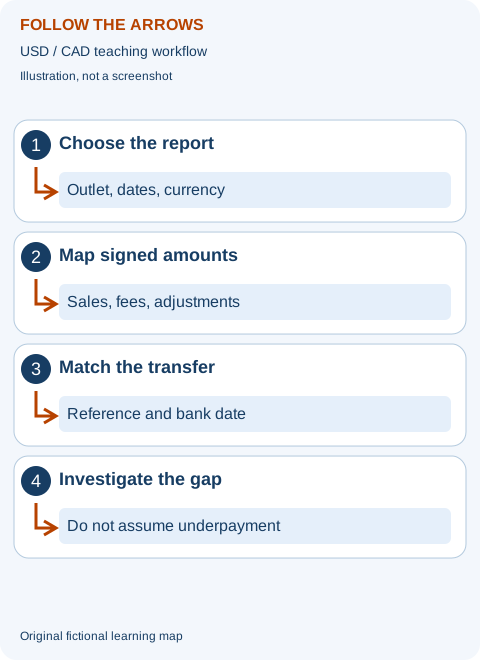
Arrow one represents the scope decision: restaurant, currency and period. Arrow two represents the financial explanation: charges, credits and correctly identified totals. Arrow three represents the bank match: reference, amount and posting date. Arrow four represents the exception process: unresolved amount, evidence needed and next action. The diagram does not imply that all reports have the same fields or that our extension reads them automatically.
If you are reading on a phone, work through one task at a time using the links near the top. Use the worked numbers to practise before opening sensitive business records. The illustration has a text explanation so its meaning is not dependent on colour or tiny labels. When demonstrating a real issue to colleagues, create a similarly narrow diagram instead of sharing a whole private export.
Final review: what the guide helps you do and what it cannot decide
You should now be able to choose relevant evidence, explain a scoped payout, distinguish a separate credit-note document, follow a refund case and describe month-end timing. You should also be able to say when you do not yet know the answer. That is useful progress for a new owner. A careful unresolved item is better than a falsely matched total.
The guide cannot establish your contract fees, guarantee payment arrival, approve a refund dispute, determine VAT classification or sign off your business accounts. For UK VAT, restaurant and takeaway supplies can require different treatment; use current HMRC catering and takeaway guidance and appropriate advice rather than applying one tax assumption to every order. Food licensing and safety obligations are separate from delivery-platform onboarding.
Before closing your weekly review, ask another authorised person to read the conclusion. They should be able to find the source documents, reproduce the selected arithmetic and understand any open items. If an important explanation exists only in memory, add a privacy-safe note. That final step makes the work usable when you are busy, absent or handing over to a new manager.
A three-week exercise: do not let old questions disappear
In week one of an original fictional exercise, Willow Kitchen has one unexplained thirty pound difference. The owner logs the transfer reference, expected amount and bank receipt, then assigns the next document check to the manager. In week two, a new transfer matches perfectly. That good result does not close the week-one item. Carry the older question forward until evidence explains it. Starting a fresh sheet each week without an opening exception list makes unresolved problems disappear from attention, not from reality.
Later in week two, the manager finds a thirty pound receipt. Before closing the item, they verify its reference and scope. If it belongs to the questioned transfer, they link it and record the closing explanation. If it belongs to a different transfer, they leave the old item open. Matching by amount is tempting because it feels quick, but it can falsely clear one item while creating a hidden shortage somewhere else. The business reference is part of the evidence, not an optional decoration.
In week three, the owner discovers a revised financial document affecting an earlier refund. They keep the previous copy and write a revision note. They do not quietly alter the first review to pretend the new information was always known. The note names the new document, the changed component and whether the adjustment belongs to a later transfer. An authorised reviewer can then understand why last week's conclusion differs from this week's updated conclusion.
Now practise a service comparison. Week one has four relevant packing complaints among two hundred completed orders. Week two has three among one hundred orders. The raw complaint count fell, but the rates are two percent and three percent respectively. That does not prove the packing change made service worse; the sample is small and other conditions can differ. It does show why an owner should review volumes and context rather than celebrate every fall in the absolute count. Use the actual complaint categories and current definitions for real analysis.
For a money comparison, suppose the simplified contribution per order is six pounds in both weeks. Two hundred orders contribute twelve hundred pounds before fixed expenses; one hundred contribute six hundred. If the same-period fixed costs are eight hundred pounds, the simplified outcomes are a four hundred pound surplus and a two hundred pound shortfall. These invented numbers explain the model, not a real merchant's results. Cost patterns can change when volume changes, so the assumption must be stated.
Finish by writing three different conclusions: the cash question was resolved by a documented receipt, the service rate needs further observation, and the lower-volume week contributed less toward fixed costs. Do not compress those into one judgement that the platform performed well or badly. Each conclusion uses different evidence and points to a different next action. This is the skill the long guide aims to teach: clear, proportionate decisions that remain understandable to a new owner and reproducible by the next manager.
Official sources and limits
Checked 12 October 2026. Procedural summaries are brief; the worked cases, worksheets, teaching questions and arithmetic are our original fictional material. No authenticated UK merchant account was tested. Interface labels, eligibility and agreements can change. Independent education is not official support, legal advice, an audited accounting opinion or a platform partnership.
- Deliveroo: invoices, payment components and credit-note distinction
- Deliveroo: reviewing and disputing refunds
- HMRC: catering and takeaway VAT guidance
Read the editorial and corrections policy if you spot information that needs updating.