
UNITED KINGDOM · JUST EAT RESTAURANT PARTNERS · GBP EXAMPLES
Just Eat UK invoices and restaurant analytics explained
Use sales information to understand activity, an invoice to understand recorded charges and your bank to confirm cash. Then turn one observation into a sensible restaurant decision.
A practical guide, not a promised button-by-button tutorial
This page teaches a manual reading method using original fictional examples. Just Eat's official UK invoice and analytics references were accessible through indexed material, while their current dynamic pages did not expose the full article during our check. We therefore do not promise exact current menu paths, report limits or payout weekdays. Confirm those account details in the official Partner Hub or with merchant support.
The existing Food Data Extractor extension and main file analyser support Zomato and Swiggy formats. They do not automatically connect to or parse Just Eat. No platform endorsement, earnings guarantee or approval is implied.
Choose a section in this guide
Start with four questions, not every number on the screen
What did customers order? What financial amounts were recorded? What transfer was due under the selected record? What cash reached the bank? Each question needs appropriate evidence. Sales insights can describe demand, but they do not automatically include ingredients, wages and rent. An invoice can explain a charge, but it does not prove when the bank posted a transfer. A bank receipt confirms cash, but it does not explain every order behind it.
A new owner can use a sheet with four headings: activity, financial record, bank evidence and next action. Keep the relevant business reference with each item. Do not record customer names merely to make the sheet look detailed. You need to find the right evidence again, not build a second customer database. A private original export should stay in authorised business storage, while any teaching example should be fictional and clearly labelled.
Before comparing totals, write one location, one currency and a defined period. Also write which date the period uses. A combined-store sales total compared with a single-store deposit is not a valid match. A monthly bank total compared with orders by transaction date can also differ legitimately. This scope note is simple but important. It prevents the owner from assuming the first large difference is missing money.
Use the guide one task at a time. Begin with one small invoice and one related transfer. Once you can explain the arithmetic, add the wider monthly review and sales analysis. A plain worksheet that another manager can reproduce is more useful than a complicated dashboard built before anyone understands its categories. The goal is a clear decision, not a larger collection of numbers.
The few financial words you need
Revenue means sales on the chosen basis, not the money left after all expenses. Gross and net can have different meanings in different reports, so read the stated definition. A deduction reduces the selected amount. A credit may increase it or correct an earlier charge, depending on the document. A subtotal groups components that may already appear elsewhere. A transfer is a cash movement, not another sale to add to the invoice.
Contribution is money left from sales after the costs that change with those sales, using clearly stated assumptions. Fixed expenses still have to be covered. Profit requires the wider cost and accounting treatment. Cash flow describes when money enters and leaves the bank. A profitable period can still have a cash shortage if bills are due before receipts arrive. Explain these distinctions to the team rather than expecting them to interpret abbreviations.
Reconciliation means explaining how related records fit together. It does not mean changing values until a difference reaches zero. If a value is missing, mark it not provided and investigate. Zero is a known amount, while missing evidence is uncertainty. If a report category is unfamiliar, write a question rather than assigning it the meaning you would prefer. This is a practical way for a beginner to avoid false precision.
Average order value means a selected sales total divided by the relevant order count, according to its definition. It is not contribution per order. A cancellation rate is a proportion using a particular denominator; different definitions can produce different rates. Always write the definition with the figure. A percentage without context can sound authoritative while telling the owner very little about what to change.
What the official references can and cannot establish here
The official Just Eat UK invoice reference and business analytics reference are useful starting points. Their indexed descriptions separate invoices and business insights. Because current full rendering was unavailable during this review, this guide uses screen-independent methods. We do not reproduce old screenshots as current screens or infer a guaranteed payment schedule from cached instructions.
When using your account, locate the official document relevant to your question and read its current definitions. If its name differs from the reference here, do not assume the account is faulty. Ask which current document supplies the required information for your location and permissions. An owner, shift manager and bookkeeper may have different access. Use authorised roles rather than trying to bypass a missing control.
Write the retrieval date and any account-specific explanation with your source files. A support answer about a particular charge can be valuable, but it should not automatically become a universal rule for every restaurant. A published general page can also omit contract-specific details. Your actual agreement and current official guidance remain necessary for fee, bank and account questions.
This distinction keeps the long guide useful without making unsupported promises. The original arithmetic, worksheets and decision exercises do not depend on an exact button position. The precise menu path and report availability need direct verification in the authorised account. If those details are confirmed later, they can be updated transparently rather than guessed now.
Read an invoice in a sensible order
First identify the business, location, currency and covered dates. Next locate the stated balance or transfer-related total. Then read the component amounts and their meaning. A summary can group charges that are shown separately in detail. Do not add the summary and its detail as different income. Mark each number as component, subtotal, accounting document or bank evidence before choosing a formula.
Create a field dictionary with exact label, ordinary-language meaning, sign and inclusion in a total. For example, a deduction might be recorded as a negative signed component or as a positive amount under a deduction heading. Those layouts require different arithmetic. A correction can refer to a prior period. Its positive sign does not automatically make it a new sale. Ask what it corrects before choosing an accounting category.
Keep an unchanged original and work on a copy. Name the source with platform, location, currency, document type and period. A file called latest is difficult to trace later. Keep the download date and a version note if the document changes. The owner should be able to understand why a revised review differs from the first one without relying on memory or a private chat message.
If a document shows an amount owed to the platform, read how that balance relates to current or later records under the actual agreement. Do not assume a negative balance means the restaurant had no sales or that a future transfer must equal a particular number. The guide teaches the reading process, not a universal Just Eat invoice formula. Account-specific questions belong with the official merchant channel and appropriate accounting advice.
A fictional GBP invoice exercise
Imagine a UK takeaway called Hazel Plate. Its original teaching record has report sales of £2,400, selected charges of £480, restaurant-funded promotions of £80, refund deductions of £45 and a correction credit of £15. These numbers and the restaurant name are invented. They are not a Just Eat invoice, advertised rate, typical commission or real business result. The exercise assumes these are complete separate components on a consistent payout basis.
The simplified expected transfer is £2,400 minus £480 minus £80 minus £45 plus £15, which equals £1,810. If the appropriate bank receipt is £1,810, the selected transfer matches. If it is £1,760, the remaining unexplained difference is £50. The full distance between report sales and bank cash is not all missing money. Most is explained by the selected deductions and correction. Investigate the remaining £50 with references and evidence.
Try changing the refund deduction from £45 to £25 while leaving everything else unchanged. Expected cash rises by £20 to £1,830. That is arithmetic sensitivity, not evidence that Hazel Plate should receive a reduced refund charge. A real change requires a documented correction or other source record. Never adjust a spreadsheet merely to reach the desired bank amount.
Write a plain conclusion: the selected components explain a transfer of £1,810, and the scoped bank evidence leaves £50 unresolved. Add the next action and responsible person. This conclusion is much clearer than the app took £640. The latter mixes legitimate charges with an open question and gives support no precise issue to investigate.
Positive and negative amounts: practise with a tiny example
Suppose a fictional record has sales of one hundred pounds, a signed fee of minus twenty pounds and a signed credit of plus three pounds. Adding the signed components gives eighty-three pounds. Subtracting minus twenty instead would give one hundred and twenty-three pounds, reversing the fee. If the fee is instead shown as a positive twenty under a deduction heading, subtracting that magnitude gives the appropriate eighty pounds before the credit.
The safe habit is to write how the amount affects the chosen total. This reduces the transfer or this increases the transfer is easier for a beginner than a vague label. Decide whether the sheet adds signed components or subtracts positive deduction magnitudes. Do not mix the two representations. A calculator with deduction fields may expect positive numbers even when the source export uses negative charges.
A refund already included in net sales should not be subtracted again in the same model. A grouped charge should not be counted alongside all its component charges unless the formula is deliberately checking the grouping rather than adding them as separate costs. Write included in this total beside relevant columns. If the grouping is unclear, pause and seek an official explanation instead of assuming a blank or a familiar-looking label resolves it.
Rounding needs a clear policy too. Add values at their provided precision before displaying a rounded answer where possible. Small rounding differences can exist, but do not dismiss a recurring or large difference without testing it. Record any tolerance and why it is used. A tolerance is a review practice, not permission to ignore a genuine unresolved payment.
Match the bank without confusing dates
The order date, invoice period, transfer date and bank posting date can be different. A week crossing month-end may place activity in one month and cash in another. Write the dates separately. Do not change a transaction date to make the monthly bank total equal sales. The accountant's activity review and the owner's cash forecast can use different bases if each is appropriate and clearly stated.
In a fictional monthly bridge, opening transfers in transit total £200. New transfers initiated during the month total £6,000. Closing transfers still in transit total £350. Assuming no other relevant cash movements, expected bank receipts are £5,850: opening transit plus initiated transfers minus closing transit. Every transit item needs its own evidence. Do not invent a timing adjustment to make the total appear correct.
For a split receipt, identify which references connect the parts. A £1,000 receipt and a £810 receipt could explain an expected £1,810 transfer only if they actually belong to it. Unrelated deposits with convenient amounts do not solve the problem. Also inspect whether a transfer was reversed or rejected rather than merely delayed. Use the current account status and official support process for unresolved questions.
Carry timing items forward with a next check date. When later evidence closes one, record the exact receipt and explanation. A label such as timing should not remain indefinitely without investigation. Normal bank posting, incorrect scope and a genuine unexplained difference are distinct possibilities. This method helps an owner avoid both unnecessary alarm and unjustified reassurance.
Use sales insights to ask a better business question
Business insights can show activity patterns such as revenue, order volumes or average order value when available in the account. Their role is to help identify a question worth investigating. They do not automatically include all restaurant costs. A label containing profit in an interface should not be assumed to mean full net business profit without a definition. Ingredients, wages and rent must be considered in an appropriate operating review.
Start with one question: why was Tuesday quieter than a comparable Tuesday? Record trading hours, availability, menu changes, promotions and any unusual events. A smaller total may reflect fewer open hours rather than weaker demand during the hours actually open. A larger average order may reflect a different item mix, not improved contribution. Write observations first and possible explanations second. This prevents a guess from being reported as fact.
Use a comparison table with period, days open, selected sales, orders, average order value and context. Keep the definitions consistent. If a report is incomplete or still updating, mark it provisional and recheck before drawing a conclusion. Do not assume a foreign or old help article establishes the current delay or history limit in your account. This guide deliberately avoids those unverified claims.
The result should be a practical next action, such as investigating sold-out periods or reviewing a confusing modifier. Do not change everything at once. A small documented test is easier to evaluate. The dashboard helps you notice patterns; it does not prove why they happened. Good beginner advice teaches this boundary clearly rather than promising traffic or earnings from one chart.
Average order value: useful, but easy to misread
Suppose a fictional week has selected net sales of £1,800 across ninety completed orders. The average is £20 per order on that basis. The next week has £1,980 across ninety orders, an average of £22. The activity measure improved. To judge contribution, the owner must also examine what was sold and what it cost. A higher-value dish can have higher ingredients, packaging or channel costs.
For an original example, item A sells for twenty pounds net and has fourteen pounds of selected variable costs, leaving six pounds contribution. Item B sells for twenty-four pounds net and has nineteen pounds of those costs, leaving five pounds. A shift toward item B can raise average order value while reducing contribution per order. The numbers are invented, not Just Eat fees or a menu recommendation. The lesson is to inspect the item mix.
Bundles can also change the average. A customer who previously bought only a bowl may add a drink, increasing revenue and contribution. Another customer may switch from separately priced items to a discounted bundle, reducing contribution. The outcome depends on the baseline and actual costs. Do not assume every larger basket is an additional profit improvement. Write what you think would have happened without the change and label that assumption.
When explaining the result to staff, avoid fancy terms. Say the customer spent more on average, but we still need to check the cost of the items chosen. That sentence is both accessible and accurate. Then show a small original example rather than an unexplained percentage. The team can make better menu and packing decisions when they understand what the number does and does not mean.
Hourly patterns: plan service without pretending sales equal capacity
A time-of-day pattern can help plan staffing and preparation, but it should be read alongside opening hours and operational context. A restaurant that was offline or sold out for part of an hour cannot be compared fairly with a fully available hour without noting the difference. The day boundary matters for a business trading past midnight. Shift reports and calendar reports can use different definitions, but each must be written clearly.
For a fictional takeaway, one hour has twelve orders and another has eighteen. The second looks busier, but the first may contain complex dishes and the second simple ones. Count alone does not measure kitchen workload. Identify the constrained station, packing effort and in-store commitments. A roster based solely on delivery order count can miss work happening outside that channel.
Try a worksheet with time block, delivery orders, dine-in commitments, planned staff, actual staff and observed issues. Do not use it to pressure workers to skip quality or safety checks. Review representative periods rather than a single unusually quiet night. Staffing costs should follow current lawful requirements and the business's actual employment arrangements, not an invented universal hourly rate from a blog.
The practical conclusion might be that the handoff area needs better organisation at peak time, not that everybody must prepare food faster. A clear operational remedy should correspond to the actual bottleneck. Once a change is made, record the date and compare a reasonable period. Be honest about uncertainty and other changes. This keeps the guide useful without presenting a dashboard as a perfect explanation of demand or service quality.
Cancellation numbers: write the denominator and investigate reasons
A cancellation count is a starting point. A rate requires a defined order population. Ten cancellations among two hundred relevant orders is five percent under that invented definition. Five among fifty is ten percent. The smaller count is not necessarily a better rate. Use the current official report definition for real analysis rather than assuming every platform uses the same denominator or status categories.
For a fictional training exercise, separate confirmed issues within the restaurant's control from matters needing an official explanation. A stockout and a confusing modifier may suggest a menu or operational fix. A courier or customer circumstance may require a different review. Do not assign fault from a status word alone. Preserve the business reference and legitimate evidence. A financial effect should be checked in the financial record, not inferred solely from the operational count.
Review patterns over comparable periods and include volume. A quieter week may have fewer cancellations without a process improvement. An opening-week sample may be too small for a strong conclusion. Describe what was observed and what remains uncertain. Avoid claiming that one staff member caused a trend because they happened to work during a busy shift.
Choose one practical improvement, such as a clearer stockout responsibility or modifier label. Record the hypothesis and review the relevant category. A useful guide should help the team learn, not encourage accusations or fabricated evidence. Any account-specific refund or cancellation dispute belongs in the official merchant process with its current rules.
A funded-offer exercise: measure the change, not just the sales
Check who funds the offer and how the financial record shows it. If the selected revenue is already reduced, do not subtract the discount again. If a separate charge records the funding, include it once. A customer-facing promotion badge does not establish the contract or accounting treatment. Read the actual campaign terms and current report definitions for your business.
Suppose a fictional dish contributes eight pounds before fixed expenses. A restaurant-funded two pound discount reduces contribution to six pounds under unchanged cost assumptions. Thirty genuinely additional orders bring one hundred and eighty pounds contribution before extra staffing and other effects. If fifteen customers would have bought anyway, the discount loses thirty pounds on those existing orders. The simplified net improvement is one hundred and fifty pounds before other costs.
If the campaign needs an extra fully assumed one hundred pound shift, the simplified improvement falls to fifty pounds. The actual additional-order count is difficult to establish. Compare similar periods and note uncertainty. Do not call all discounted orders additional merely because they appeared while the offer ran. The exercise is original teaching arithmetic, not an earnings forecast or a platform guarantee.
Set a budget and a review date. Include kitchen capacity, service errors and contribution, not only order count. A campaign can bring useful learning without a dramatic result. A busy campaign can also be unattractive after costs. This is a better decision framework for a beginner than a claim that more impressions always create more profit.
Separate profitability from the money available today
A correct invoice and a matched transfer can coexist with a cash shortage. Ingredients may be bought before orders are sold. Staff and rent can be due before a receipt posts. Loan repayments and equipment purchases can reduce the bank balance without being the same kind of operating expense as ingredients consumed. Your bookkeeper should apply the appropriate accounting treatment. One payment report cannot settle every question.
For a separate fictional operating case, net food revenue is £2,400, food consumed £720, packaging £120, selected variable channel costs £480, funded offers £80 and refund expense £45. Contribution is £955 before fixed expenses. If same-period fixed expenses are £700, the simplified operating surplus is £255 before other omitted costs and tax. The correction credit remains separately classified according to its actual purpose.
Now suppose the business pays for £900 of stock during that period but consumes only the assumed £720. Cash and food expense differ because some stock remains. This simple illustration does not establish your inventory valuation policy; it explains why a bank total and operating result need not match. A cash forecast asks when receipts and bills occur. A cost review asks what resources were consumed to earn sales.
Use the manual cash-flow model to explore timing and the food-and-labour exercise for operating costs, checking their currency labels and assumptions. They are manual learning aids, not Just Eat parsers or tax tools. Do not upload unsupported platform files expecting automatic extraction.
Create a small exception sheet that survives a busy week
An exception is an item whose explanation is not yet complete. Use headings for reference, location, currency, amount, question, evidence checked, owner and next action. Keep confirmed facts separate from conclusions. Bank shows £1,760 is a fact supported by the record. Platform owes £50 is still a question until the scoped financial and transfer evidence supports that conclusion.
Use practical categories such as wrong scope, waiting for bank evidence, missing document and unexplained adjustment. A category should lead to an action. Wrong scope means get the correct record. Missing document means request the relevant evidence. Unexplained adjustment means identify its reference and ask the official channel when necessary. A label with no next action is not a useful control.
In a fictional sequence, a £50 difference is logged on Tuesday. A later related £50 receipt may close it after the reference is verified. If the receipt is unrelated, the item remains open. Keep the investigation history and closing evidence. Do not delete old items simply because the current week balances. A fresh sheet can hide an old problem unless the opening exception list is carried forward.
Assign responsibility clearly. A manager away on leave should hand over open cases rather than leave them in a private message. A reviewer should be able to trace the current conclusion back to saved evidence. This process can be maintained by a small restaurant without complex software. Its value is clarity, not the number of tabs or charts.
Ask official support a narrow, evidence-based question
Use the authorised merchant channel for account-specific invoice, payment or refund questions. Prepare the location, currency, document period, reference, expected amount and actual evidence. Say what you already checked. Do not send a broad accusation containing unrelated orders, menu changes and several payments. Separate cases are easier for both the restaurant and official support to understand.
A fictional structure is: for transfer EXAMPLE-H in GBP, our scoped components total £1,810 and the matched bank receipt is £1,760. We checked the location, reference and date basis. Please explain the remaining £50 and any adjustment not included in this copy. Replace these invented details with actual verified evidence before submitting anything. The example teaches clear writing, not a claim template for money the restaurant has not established.
Save the support reference, response and next step. If a correction is being reviewed, do not recognise it as received cash. If an adjustment appears later, match its reference to the case. A support answer about one business is not automatically a general fee rule. Keep it with the relevant private record rather than publishing it as a universal fact.
Do not send passwords, one-time codes or session details to unsolicited contacts offering rapid recovery. Navigate to the official service yourself. Share only necessary evidence through the authorised process. Food Data Extractor is independent and cannot change Just Eat invoices, recover accounts or approve disputes. A future-tool discussion does not require account access.
Use safe examples and proportionate access
Teaching examples should be fictional and contain no real customer information. A private export may include names, phone numbers, addresses or hidden workbook content. Do not publish it simply to ask why a subtraction is wrong. Create a new example with the same numerical structure. The guide's invented restaurants are not anonymised claims about actual merchants; they are original exercises.
For legitimate support evidence, share only what the authorised process requires. Keep the original secure and inspect any redacted copy. A transparent shape does not necessarily remove information. Hidden sheets, comments and formulas can also reveal details. A narrow permitted screenshot may be more appropriate than a whole workbook, depending on the official request.
Review account permissions when people leave or move roles. The person packing food needs the necessary ticket information, not unrestricted bank controls. A bookkeeper needs financial records, not a shared password circulating through a group chat. Use the official access controls supported by the account. Keep passwords and recovery information out of the written handover procedure.
Do not reuse delivery customer details for unrelated marketing simply because the restaurant received them for fulfilment. Follow applicable law, platform terms and the business's authorised process. This guide does not provide a legal determination about your data use. When uncertain, seek appropriate advice and use a privacy-preserving teaching example rather than exposing more information.
A weekly routine and a first-month learning plan
In week one, choose one small invoice and transfer. Write the scope, explain its components and match the bank. Leave unresolved items clearly labelled rather than forcing agreement. In week two, repeat the method and carry the earlier exceptions forward. Consistency is more useful than a new elaborate spreadsheet each week. Keep the unchanged originals and a simple version note for any revision.
In week three, add one sales question. Compare reasonably similar periods and record opening hours, availability and other changes. Do not infer profit from revenue alone. In week four, connect one useful observation to recipe cost or an operational improvement. Write the hypothesis, owner and review date. Avoid changing several unrelated things simultaneously if you want to understand the observed result.
Teach a second authorised manager using fictional records. Ask them to explain scope, signs, subtotal grouping and why a matched transfer is not profit. Introduce one duplicate sale and one legitimate refund sharing an order reference. They should inspect rather than delete by identifier alone. Introduce a blank category and ask them to flag missing evidence rather than type zero.
Write a handover with source storage, file naming, report basis, authorised owner, reviewer and exception process. Include official links and the check date. Another person should be able to reproduce a sample and understand the conclusion. If they cannot, improve the notes before adding more locations or longer periods. A useful process remains understandable when the restaurant is busy.
Interactive review checklist and knowledge checks
The checkboxes are a reading aid, not an account connection. They do not submit information, approve a restaurant or persist source documents. Reloading can clear them. Keep actual business records securely in your own system. Mark a task only after checking evidence, and write the next question if something remains unclear.
My average order value rose. Did profit definitely rise?
No. The item mix, ingredients, packaging and other costs can also change. Check contribution on a consistent basis and include the relevant wider expenses before making a profit claim.
Why does this guide not give an exact current invoice button path?
The official reference was accessible through indexed material, but current full rendering and an authenticated account were not verified. The manual method remains useful without pretending an old screen is today's interface. Confirm the current path in the official account.
Can the current extension automatically extract Just Eat data?
No. The current extension and main analyser support Zomato and Swiggy formats. This article provides independent manual guidance, not a working Just Eat connection or parser.
A picture of the financial evidence, with a text explanation
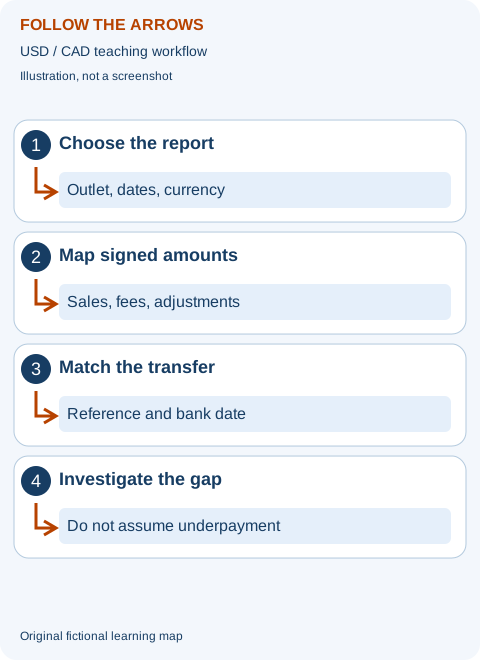
The first arrow asks whether location, currency and period agree. The second asks what each component means and whether a total already includes it. The third asks which bank movement belongs to the transfer. The fourth asks what remains unexplained and what action will obtain the missing evidence. These text steps provide the same meaning without relying on colour or small labels.
A diagram should make a decision easier, not make the page busier. On a phone, use the jump links and work through one task at a time. Try the fictional arithmetic before opening sensitive records. For a real support question, a narrow privacy-safe explanation is often more useful than a large screenshot containing unrelated information.
Finish with a conclusion a new owner can explain aloud
Use five plain sentences rather than a vague verdict. First name the location, currency and period checked. Second describe which financial components explain the selected transfer. Third identify the matching bank evidence or precise unresolved difference. Fourth state what remains uncertain. Fifth give the next action and responsible person. This is a useful final test of understanding: if you cannot explain the result simply, the worksheet may still be hiding assumptions.
For the fictional Hazel Plate exercise, an appropriate explanation might be that one scoped GBP transfer was reviewed, its separate components total £1,810, the bank evidence shows £1,760, a remaining £50 is not yet explained, and the manager will obtain the relevant adjustment detail through the official channel. That conclusion does not accuse the platform of losing all sales, claim that £1,810 is profit or promise that support will approve a credit.
For the sales review, the conclusion should be different. Say that average order revenue increased, the item mix also changed and contribution needs checking before a profit conclusion. For a service review, say which error category and order population were examined. Each question deserves its own evidence and language. Keeping these conclusions separate is what makes a compiled beginner guide genuinely helpful rather than a collection of impressive-looking totals.
Save the final explanation with the sources and exception log. Another authorised manager should be able to reproduce it when you are busy or away. A process that survives handover is a practical asset for a small restaurant. It is more valuable than an elaborate dashboard whose meaning is known only to the person who built it.
Sources, scope and honest limits
Evidence checked 12 October 2026. Just Eat references below were accessible through indexed article material; their current dynamic full articles and an authenticated UK merchant account were not verified. This page deliberately avoids exact current menu paths, export formats, report limits, fee percentages and payout weekdays. The calculations, scenarios and learning exercises are original fictional material.
This is independent education, not official support, a platform partnership or audited accounting, legal or tax advice. See our editorial and corrections policy.