
RESTAURANT LEARNING WORKSHOP
Dine-in, takeaway and margin: a visual restaurant workshop
Start with what the customer receives. Then follow the same order through its sales, costs and cash. The illustrations, editable example and downloadable records show exactly which number answers which question.
Teaching scope: all businesses, amounts and records here are fictional. INR is one consistent money unit, not an assumed platform contract, tax rule or industry benchmark. There is no connection to a restaurant account. Inputs stay in this tab; refreshing restores the sample. These manual CSVs are not uploads for the settlement analyser.
1. Read a customer order before analysing it
The invented order TEACH-001 contains two rice bowls at ₹300 each. That is one order and two portions, with a starting restaurant price of ₹600. A ₹40 merchant-funded discount makes the revenue used in this exercise ₹560. Taxes passed through to an authority and delivery fees retained by someone else are outside this example’s restaurant revenue.
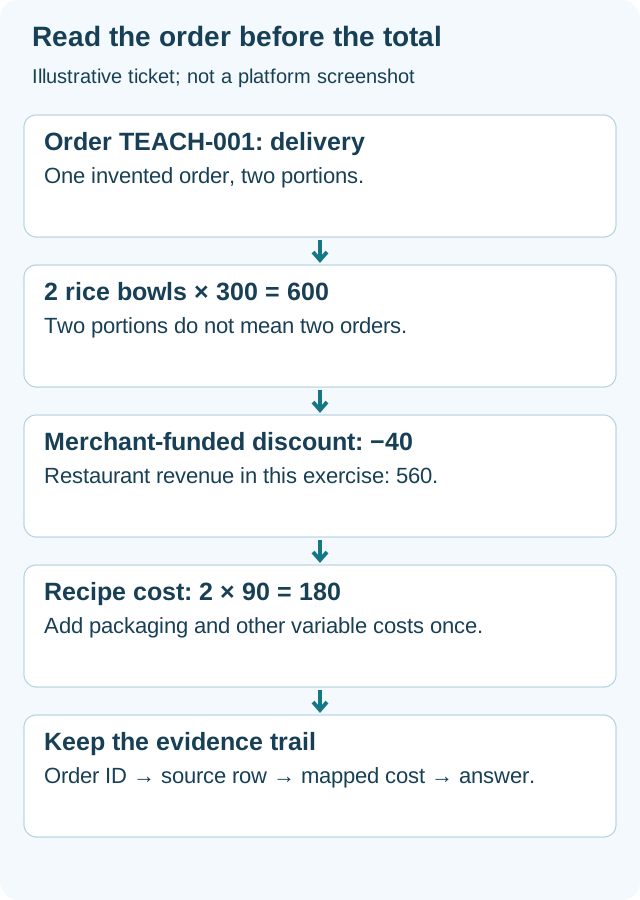
If the recipe costs ₹90 per bowl, the ingredient cost is 2 × ₹90 = ₹180. The ₹380 left after ingredients is not the full contribution: packaging, actual incremental handling, platform services and campaign costs still belong in the declared variable-cost scope. In the delivery example below, they bring total variable cost to ₹440 and leave ₹120 contribution.
Keep the discount in one place. Here it reduces starting price to net restaurant revenue before any cost subtraction. If your source already shows revenue after that discount, use its net amount and do not subtract the discount again. Keep customer-funded, platform-funded and restaurant-funded amounts separate when evidence distinguishes them.
Try this reading check
Question: another file has one row for each of the two bowls. How many orders were sold?
Answer: one, if both rows are reliably tied to TEACH-001 and no other orders are present. Summing row count would give two item records, not two orders. Validate the grouping key and check whether repeated rows are genuine items, exact duplicates or conflicting exports. See the export cleaning guide.
2. Compare dine-in, takeaway and delivery on the same basis
For a fair starting comparison, the fictional basket starts at ₹600 in all three channels. The recipe costs ₹180 in each. The other costs differ because of the assumptions entered for this exercise. No channel is always more profitable: prices, refunds, discounts, capacity, recipes and contracts can change the result.
| Channel | Price | Discount | Net revenue | Variable cost | Contribution | Margin |
|---|---|---|---|---|---|---|
| Dine-in | 600 | 0 | 600 | 230 | 370 | 61.67% |
| Takeaway | 600 | 0 | 600 | 220 | 380 | 63.33% |
| Delivery | 600 | 40 | 560 | 440 | 120 | 21.43% |
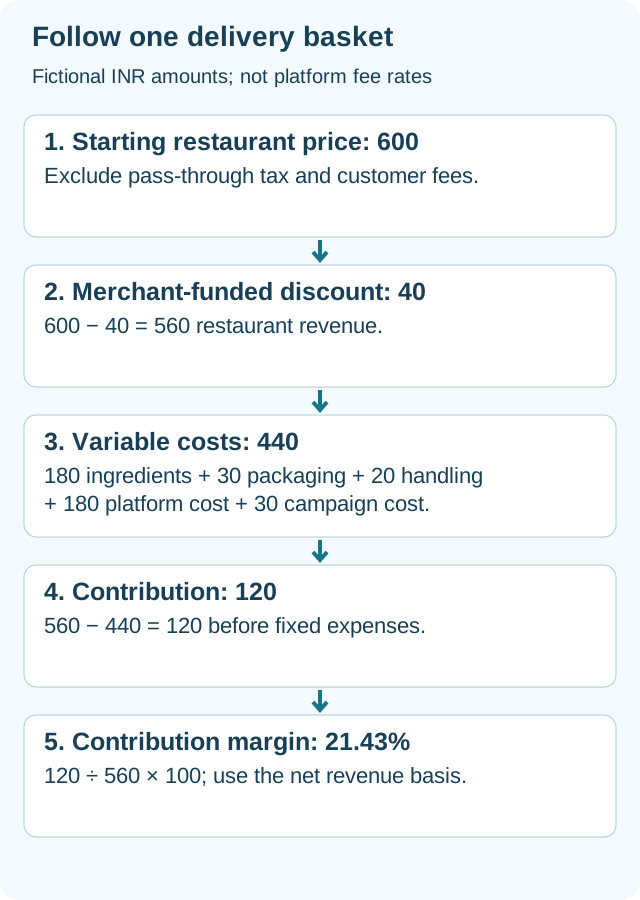
Reproduce the delivery answer
- Revenue after merchant discount: ₹600 − ₹40 = ₹560.
- Variable costs: ₹180 ingredients + ₹30 packaging + ₹20 incremental handling + ₹180 platform cost + ₹30 campaign cost = ₹440.
- Contribution: ₹560 − ₹440 = ₹120.
- Contribution margin: ₹120 ÷ ₹560 × 100 = 21.43%, rounded for display.
“Handling” means only the incremental costs you chose to include, such as an evidenced payment charge or truly additional handling expense. It is not a second allocation of the same staff wages. Keep fixed wages, rent and other period expenses in the fixed-cost field if that is your chosen classification. Tax recoverability, owner pay, depreciation, interest and every other omitted category must be assessed separately; the example does not supply a complete profit statement.
Change the assumptions
The baseline table and formulas work without JavaScript. Enable JavaScript to change inputs and export calculated channel rows.
| Channel | Orders | Net revenue / order | Variable cost / order | Contribution / order | Margin | Period contribution |
|---|
The calculated CSV contains channel rows; fixed expenses remain a separate period input shown in the result. It saves values, not spreadsheet formulas. If you change an input, the previous result is hidden until you calculate again. A zero-revenue margin is undefined; a negative contribution remains visible rather than being forced to zero.
Read the total without averaging percentages
At 20 dine-in, 25 takeaway and 55 delivery orders, the baseline totals are 100 orders, ₹57,800 net revenue and ₹23,500 contribution. Add the money first: 20 × ₹370 + 25 × ₹380 + 55 × ₹120 = ₹23,500. Divide by ₹57,800 to get 40.66%. The simple average of the three channel percentages would ignore both order mix and revenue differences.
After only the ₹20,000 fixed expenses entered in this example, ₹3,500 remains. That is not a claim of full net profit. The “ingredients 10% higher” scenario changes each ₹180 recipe cost to ₹198 while holding other assumptions constant. At the same 100 orders, contribution falls by ₹1,800 to ₹21,700; ₹1,700 remains after the stated fixed expenses. Nothing in that scenario proves future demand or a supplier price.
Download baseline channel inputs · Download baseline answers · Read the calculation rules
For a deeper explanation, read restaurant contribution margin and service-type differences and channel comparisons. Use the margin calculator when you need a single-order worksheet with its own documented cost scope.
3. A contribution result is not a bank balance
Even a business with positive period contribution can run short of cash before its next receipt. This separate constructed week starts with ₹20,000 available cash. Receipts add ₹37,000 and payments remove ₹46,000, leaving ₹11,000 at the end. The order of those events matters.
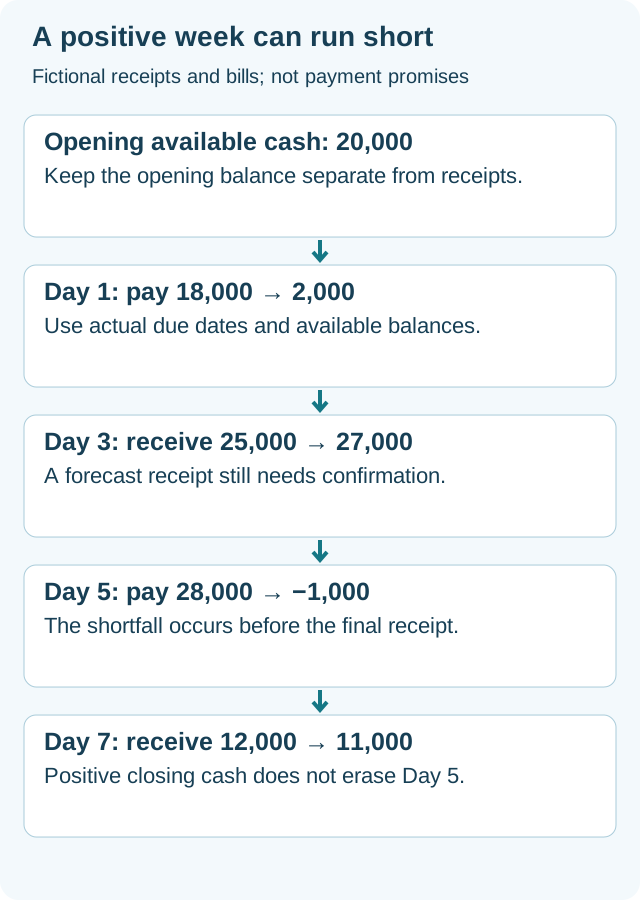
Reproduce it: 20,000 − 18,000 = 2,000; +25,000 = 27,000; −28,000 = −1,000; +12,000 = 11,000. The lowest balance is −₹1,000. The closing balance alone would hide the funding gap.
This timeline does not advise paying late or borrowing. Confirm due dates, actual available cash and receipt uncertainty, then discuss any proposed change with the relevant party. Multiple events on one day require an intraday sequence or a stated conservative assumption. Do not add opening cash to sales, count an invoice and its settlement twice, or treat forecast receipts as already received.
Download the cash events · Build a 13-week restaurant cash forecast · Try the interactive dated-cash investigation
Choose a useful next step
Starting a restaurant is a different question from interpreting its numbers. Use the UK registration guide, Singapore food-business guide or Australian starting route for their specific authorities and scope. This workshop does not determine whether an activity is licensed.
Methods, sources and reuse
The teaching records, illustrations and arithmetic are created for this workshop. The contribution method follows the distinction between sales, variable costs and fixed costs described by OpenStax: contribution margin per unit, ratio and total. BCcampus: food-cost percentage explains ingredient-cost relationships; an ingredient percentage alone does not include all channel costs.
No source validates the invented amounts as typical restaurant performance. The diagrams are original teaching illustrations, not screenshots, real customer receipts or case-study outcomes. Writing and code use software and AI assistance; no outside expert endorsement is claimed. See the editorial process.
You may copy and adapt our fictional CSVs and illustrations with attribution to Food Data Extractor. This does not grant rights to third-party platforms or trademarks. Read the file dictionary and formulas. To report a calculation issue, send the field name and sample step through Support, without customer records or credentials.